



OPINION:
“The natural progress of things is for liberty to yield, and government to gain ground.” — Thomas Jefferson (1743-1826)
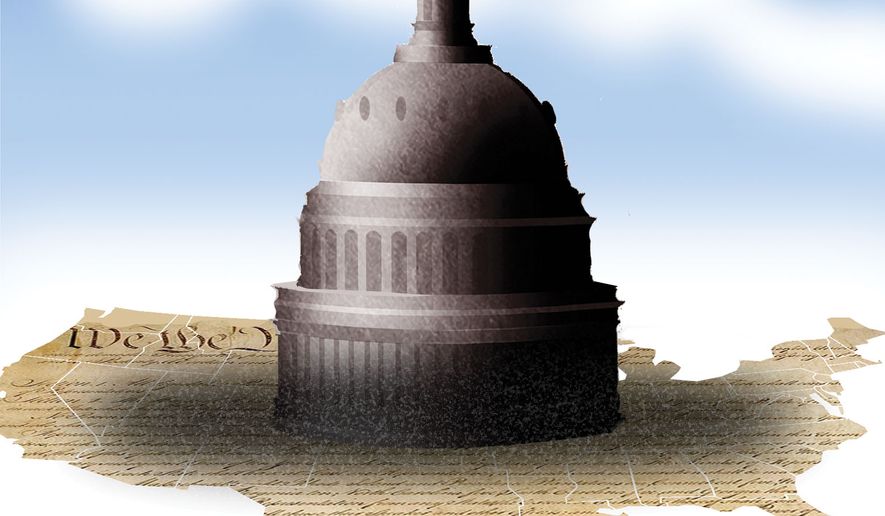
The U.S. Constitution was ratified to create and to restrain the government. It established boundaries beyond which the government may not venture, even when it invokes national security, public order, economic necessity, emergency or the will of a popular majority. Its purpose is not to make government more powerful but to keep the government off the people’s backs.
By that measure, the American Constitution is a failure.
People were interested in these podcasts
Formally, the document physically survives, its ceremonies continue, and politicians swear their oaths to abide by it. Yet in practice, the government designed to restrain has accumulated vast, totalitarian powers that its authors would never recognize.
Power grows, concentrates and perpetuates itself, while liberty contracts. Every emergency supplies a justification for new authority. Every temporary restriction threatens to become permanent. Every president discovers powers that his predecessors claimed but that the Constitution never authorized, and every generation is told that the latest surrender of freedom is necessary to preserve freedom itself.
The Alien and Sedition Acts of 1798 criminalized criticisms of government officials. Newspaper editors and political opponents faced prosecution. The government that had declared independence from a distant king was punishing Americans for criticizing their own elected officials.
The contradiction was extraordinary. The First Amendment had been adopted precisely to prevent the federal government from suppressing political expression, and it was ratified by some of the same human beings who later voted to undermine it.
Thomas Jefferson and James Madison resisted these measures, recognizing that a government that could legally determine which political opinions could be expressed would eventually conflate criticism with sedition. And so it did.
During the Civil War, the Lincoln administration suspended habeas corpus, imposed military dictatorships that arrested civilians and directed armies to kill civilians. In Ex parte Milligan (1866), the Supreme Court invalidated Lincoln’s arrests without trial and affirmed a principle that ought to be self-evident: Neither Congress nor the president can simply replace constitutional government with personal or unaccountable authority.
That did not stop President Wilson from arresting those who verbally opposed the draft or Congress from establishing the administrative state as a fourth and unaccountable branch of government or President Franklin D. Roosevelt from arresting Japanese Americans for being Japanese Americans.
The Federal Reserve Act of 1913 created the Federal Reserve System, a central bank with authority over monetary policy. It triggered unlimited money creation, the eventual abandonment of gold convertibility in 1933 and the end of the dollar’s international gold convertibility in 1971.
The Federal Reserve today creates money whenever it wants, and its monetary expansion weakens the purchasing power of money and transfers costs onto future generations.
The National Security Act of 1947 created the CIA and established the national security state as the fifth branch of government, truly unaccountable. The U.S. had emerged from World War II with unprecedented military power and global ambitions. Rather than return to a posture of restraint, Washington established more than 850 worldwide permanent military and intelligence institutions designed for a world of perpetual confrontation and American domination.
The CIA was created to collect intelligence, not to serve as the president’s personal army. Nevertheless, its history of secret interventions, covert actions, murders, tortures and even domestic operations conducted beyond ordinary public scrutiny raises a fundamental constitutional question: Who controls the government when the government acts in secret?
The national security state also perpetuates itself. Agencies justify their budgets through threats; military establishments seek new missions; presidents discover that secret operations are politically easier than openly debated wars.
What began as a response to a particular international crisis becomes a permanent structure of government. The republic that once warned against standing armies and foreign entanglements is now a failing empire that thrives on both.
The Patriot Act of 2001 extended this pattern into domestic surveillance. Enacted after the Sept. 11, 2001, terrorist attacks, it radically expanded surveillance authorities available to federal agencies, unleashing the federal government’s mass suspicionless and warrantless surveillance that today captures every keystroke and conversation transmitted on fiber optic cables anywhere in the U.S.
Across these episodes, the pattern repeats itself. Government restricts speech in the name of stability, expands executive power in the name of war, weakens monetary discipline in the name of economic management, conducts secret operations in the name of security and broadens surveillance in the name of preventing terrorism.
Each measure arrives with an explanation. Each emergency is declared exceptional. Yet the cumulative result is a more powerful government and a citizen less secure in his liberty. Neither is countenanced by the Constitution.
Was Jefferson right that the tree of liberty must be refreshed from time to time with the blood of patriots and tyrants? His famous language arose from the revolutionary generation’s experience and its fear of concentrated power. It expressed a belief that liberty cannot survive without eternal vigilance and a continuous willingness to resist oppression.
The deeper question is whether the Constitution can preserve liberty when the people entrusted with enforcing it benefit from its erosion. The answer depends on whether Americans treat the government as their servant or their master.
In the long march of history, power tends to grow because those who possess it have incentives to retain it, while those who surrender their freedoms rarely recover them. All these attacks on liberty were enacted or carried out with popular support, even though the Constitution was crafted to prevent Congress and the president from impairing personal freedom, whether popular or unpopular.
If Americans fail to regard freedom as a birthright, the Constitution may survive as a historical document while the constitutional republic it created becomes a bankrupt failure.
The Constitution cannot save a people who have abandoned the principles from which it sprang. Ultimately, liberty survives only when the governed insist that the government remain within its constitutional limits. If it will not, we must alter or abolish it.
• To learn more about Judge Andrew Napolitano, visit https://JudgeNap.com.
Follow the author


Please read our comment policy before commenting.