


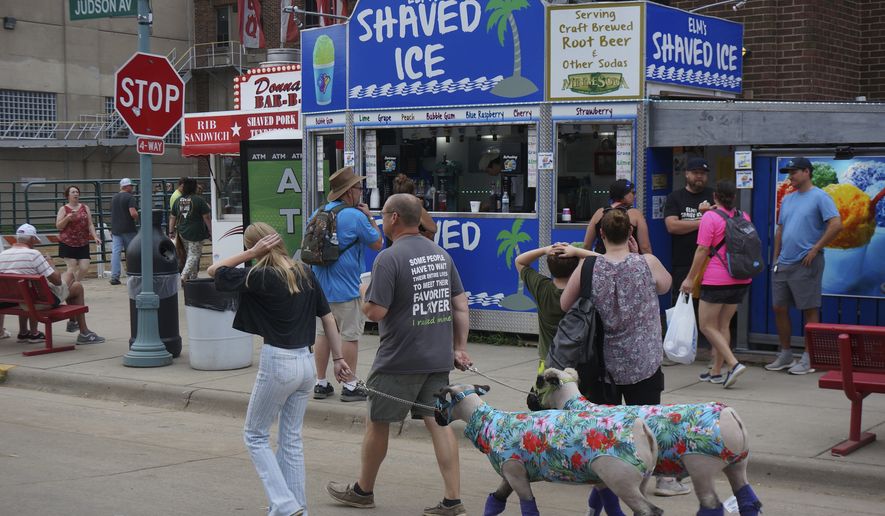

For nearly 70 years, a trip to the North Carolina State Fair could include a stop at Al’s French Fries. When the gates opened in Raleigh on Oct. 15, the stand wasn’t there.
The business stepped away after the fair replaced its flat fee for food sellers with a 15 percent cut of their sales. A family member told ABC11 off camera that the change would be hard on a stand that is open just 10 days a year. Oak City Fish and Chips sat out too. Owner Isaac Horton said his stand typically brought in $150,000 to $200,000 at the fair, and he estimated the new fee would have cost him roughly $25,000 to $30,000, ABC11 reported.
“When the cost of doing business goes up, somebody has to pay,” Mr. Horton said.
People were interested in these podcasts
Until this year, a 10-foot food stand paid $1,800 to sell for the fair’s 11-day run, based on a flat charge of $180 per front foot, WRAL reported. Now food and beverage vendors owe 15 percent of gross sales after sales tax, and fair officials told ABC11 that booth rent is credited toward that amount. Once a 10-foot stand’s sales pass $12,000, the fair’s cut is larger than the old rent. At $100,000 in sales, it is $15,000.
A fair spokesperson told ABC11 that about two dozen vendors did not come back this year. The station said it was not clear how many of them stayed away because of the fee. Fee schedules, vendor rules, cost figures and fair reports from North Carolina, Minnesota, Iowa, Colorado, Texas and Oregon help explain why single-stand family businesses feel that math most, even though the evidence does not show independent vendors vanishing nationwide. North Carolina is late to this model, not an outlier: The spokesperson said it is one of the last large fairs in the country to adopt a percentage fee.
How do state fairs charge food vendors?
A WRAL review found that North Carolina’s 15 percent is the same rate charged in South Carolina, Ohio and Tennessee, and below Iowa’s 19.5 percent and Colorado’s 25 percent. Virginia and West Virginia take 18 percent to 20 percent of sales or a flat fee of more than $1,500, whichever is greater.
The Minnesota State Fair’s published terms also set 15 percent of gross revenue after tax. Colorado State Fair concessionaires pay 25 percent of food sales and 30 percent of alcohol sales, according to the fair’s 2024 annual report.
Those charges apply to revenue, not profit. For every $100 in sales, a fair may take $15 or $25 before the operator pays for ingredients, workers, transportation and equipment.
A percentage fee also means the fair needs to see the sales. North Carolina vendors had never shared their earnings with the fair before this year, WRAL reported. Mr. Yelverton told the station that the fair now requires vendors to use the Clover point-of-sale system, which an independent auditor will use to monitor sales, and that secret shoppers will check that vendors are using it properly. In an email to WRAL, vendors who asked the station not to name them said they “deserve to know how the auditor was chosen, whether there was a bidding process, how the auditor is paid, what rules will be used, who can see private sales numbers, and what happens if a vendor disagrees with an audit.”
The commission may be only part of the bill. Minnesota’s terms say license fees do not cover electric connection and use, utility assessments, insurance or outside gate admission for workers and vehicles. The fair says it “does not issue outside gate passes of any kind” and requires commercial general liability insurance.
There is a reasonable case for percentage rent. When bad weather cuts attendance or customers spend less, the fair collects less too. Raleigh may be getting a test of that. Fair officials reported nearly 354,000 visitors through the first five days of this year’s fair, compared with about 392,000 at the same point last year, ABC11 reported. The station noted that the stretch included a rainy, colder Saturday that may have held down turnout. Under a flat fee, the fair’s take from vendors would not have dropped with attendance.
North Carolina State Fair manager Kent Yelverton told WRAL, “We’re going to industry standard, which is percentage, and we’re going in at the low end of the range.” He said the fair plans to spend the added revenue on air conditioning, new restroom buildings and more programming.
“That makes us partners with the vendor … and as the vendors have good days, we have a little bit better day,” Mr. Yelverton told ABC11.
Mr. Horton, in a separate ABC11 interview, also described the fee as a partnership, from the vendor’s side of the deal. “Fifteen percent is in the realm of partnership. It’s in the realm of equity, right? Somebody’s getting 15 percent of your business. It’s like them being a partner,” he said.
What does it cost to run a fair food booth?
A fair concession may operate for only days or weeks, but it carries many of the same expenses as a permanent restaurant. Inventory has to be bought before the gates open. Workers have to cover long hours. Trailers have to be hauled in, hooked up to utilities and maintained.
Labor drives much of that. The Agriculture Department’s Economic Research Service estimated that in 2023, about 64 cents of every dollar spent on meals eaten away from home, at restaurants and similar places, went to workers’ salaries and benefits. That figure covers everyone who makes, processes and distributes the food, not just the people at the counter, so it is not the labor cost of any one stand. It does show how much prepared food depends on paid workers.
At the Iowa State Fair, Grant Campbell of Campbell’s Concessions estimated that his corn dogs cost 40 percent more to produce than before the pandemic, Axios Des Moines reported. He said operations and labor costs are rising fastest. Card-processing fees take another 2 percent to 3 percent of each transaction.
Scale helps absorb those costs. Campbell’s is the Iowa fair’s longest-running food vendor and also runs Coney Corner and The Depot. Mr. Campbell told Axios that selling in large volume helps offset slimmer margins. A traveling concessionaire with several booths can spread trucking, management, storage and equipment costs across multiple locations. A family running one stand has fewer ways to make up for a weak week.
Why is it hard for small vendors to get into big state fairs?
Cost is not the only obstacle. The Minnesota State Fair calls its application process “very competitive” and says it reviews many applications each year for a limited number of openings. Its review criteria include experience at other fairs or events, booth presentation and appearance, a balance of similar products around the fairgrounds, and physical requirements. The fair keeps no waiting list. Applications stay on file for three years and are drawn from only when an opening comes up.
Those standards have a practical purpose. Fair managers need operators who can handle long lines, keep equipment running and follow health and safety rules. The same standards also favor businesses that already have big-event experience and polished, high-volume operations.
Sellers who don’t offer food face similar pressures. For nearly 20 years, the Oregon State Fair’s Artisan Village gave craftspeople a grassy, tucked-away corner of the fairgrounds, away from the rides, to sell handmade glass, jewelry and metalwork, the Salem Reporter reported. In 2025, all 15 of the previous year’s artisans boycotted the fair, according to blacksmith Trystan Nguyen. He said the fair had raised the price of his 100-square-foot booth from $450 to about $1,500 and planned to move the group to pavement among commercial vendors.
After Mr. Nguyen’s complaints drew public attention, the fair offered $1,058 and a return to the grassy area. He said even that price, more than double the old one, was too much for many of the artisans, particularly those who drive in from other parts of Oregon and make little on each sale. About 10 of them applied to the Salem Art Fair instead, according to its organizer, Anna Davis.
Fair events coordinator Maddie Kansky told the Salem Reporter that the fair’s own costs for hosting vendors, including utilities and tents, had gone up, and that commercial vendors were charged more as well. “Everyone across the board received an increase,” she said. She also said the changes were meant to expand the area and give artisans more exposure and foot traffic.
The Artisan Village was back for 2026, according to the fair’s vendor application, which listed a 10-by-10-foot booth at $685, with electrical hookups extra. It is not clear how many of the 2025 artisans returned or where the village was placed.
For those sellers, location is part of the economics. A craft demonstration in a garden may draw a different crowd than a sales table among ordinary commercial booths, even when the square footage is the same.
Are independent vendors really disappearing from state fairs?
No national count shows a broad collapse. The National Independent Concessionaires Association describes a “growing membership” of more than 1,200 mobile food and retail concessionaires, fairs, festivals and associate members in the United States and Canada. That total includes fairs and suppliers, so it is not a count of independent vendors.
Large fairs also keep adding new vendors. The State Fair of Texas, which drew 2,020,064 visitors over 24 days in 2025, said four new concessionaires and three new food and beverage concepts joined that year, along with 25 new shopping booths, according to the fair’s season summary. The fair describes its vendors as ranging “from family-owned food stands to mom-and-pop shops, to national brand exhibitors.”
Colorado’s annual report shows concession revenue up 5 percent in 2024, even with the fair’s 25 percent commission. The report says revenue from commercial exhibitor fees was slightly down and that the department “tried to be more selective in the vendor application process to ensure quality vendors that created a positive customer experience.”
Would-be vendors can test the numbers before applying. Figure the commission at several sales levels, then add electricity, insurance, worker admission, parking, card fees, travel and lodging. At $50,000 in sales, a 15 percent commission comes to $7,500.
State fairgrounds may not be getting emptier, but they are becoming more selective and more dependent on scale. A fair can replace a booth’s sales. It is harder to replace what a fry stand that lasted nearly 70 years, or a garden of handmade glass and ironwork, meant to the people who kept coming back.
This article was constructed with the assistance of artificial intelligence and published by a member of The Washington Times' AI News Desk team. The contents of this report are based solely on The Washington Times' original reporting, wire services, and/or other sources cited within the report. For more information, please read our AI policy or contact Steve Fink, Director of Artificial Intelligence, at sfink@washingtontimes.com
The Washington Times AI Ethics Newsroom Committee can be reached at aispotlight@washingtontimes.com.

Please read our comment policy before commenting.