



Voters will decide Sunday whether Brazil will be the latest South American nation to embrace closer ties with the U.S. and President Trump, who is backing conservative, pro-Washington Sen. Flavio Bolsonaro, the eldest son of former President Jair Bolsonaro, in the presidential runoff race against the leftist incumbent, Luiz Inacio Lula da Silva.
Mr. Trump has championed a more forceful role for the U.S. in the Western Hemisphere, including ramping up strikes on drug traffickers, enforcing a suffocating blockade of Cuba, executing direct military intervention and effecting regime change. Ousted Venezuelan leader Nicolas Maduro is now awaiting trial in the United States.
Yet Mr. Trump also seems to be winning hearts and minds, as pro-Trump conservatives have racked up a string of election victories across Latin America, including Jose Antonio Kast in Chile, Nasry Asfura in Honduras and the Trump-endorsed Abelardo de la Espriella in Colombia.
People were interested in these podcasts
A Bolsonaro victory Sunday would give Washington another influential partner on trade and security in a nation where the U.S. has already invested billions of dollars in critical minerals.
“The winner of the Brazil election determines who develops some of the world’s most strategically important mineral reserves — and where the industries built around them take root,” Victor Rios Ojeda, a justice of the Supreme Court of Paraguay, said in a written statement to The Washington Times. “It’s an election that politicians, legal experts and miners across the Americas are watching closely.”
Mr. Bolsonaro received 47% of the vote in the first round on Oct. 4, while Mr. da Silva received 45%. Mr. Bolsonaro exceeded expectations in earning his narrow first-round lead. He also has received the endorsement of the candidate who finished third.
Rare earth minerals are increasingly important commodities in the global economy, used in items such as cellphones and fighter jets. Brazil holds the world’s second-largest estimated reserves. The U.S. Geological Survey estimates China’s reserves at roughly 48.5 million short tons of rare-earth oxide equivalent and Brazil’s at 23 million metric tons.
Other countries are developing and searching for rare-earth deposits, but Brazil has additional advantages.
With about 214 million people, the nation is a significant market in its own right and has an experienced mining workforce.
Access to renewable electricity and established mining infrastructure are other attractions for investors.
Billions of dollars more in minerals may still lie beneath the Amazon Basin. Experts say only about a quarter of the country has been surveyed for rare earths.
“We’re not going to repeat what happened with silver and gold in Latin America,” Mr. da Silva told journalists in Washington on May 7 after a meeting with Mr. Trump. “With rare earths, we’re going to change our behavior. We want Brazil to be the big winner of these riches.”
Mr. da Silva has dominated Brazilian politics this century. During his earlier presidency, Brazil co-founded BRICS, a loose but expanding international bloc seeking to reduce U.S. control over global trade and finance.
Its first leaders’ summit was held in 2009, during Mr. da Silva’s second term.
In addition to Brazil, the group includes a rogues’ gallery of traditional U.S. antagonists: Russia, China and Iran. Yet BRICS also has important emerging economies and U.S. partners such as India, Egypt, Ethiopia, Indonesia, South Africa and the United Arab Emirates.
In his current term, Mr. da Silva’s government has signed tax credits and incentives for mining projects into law. Amid the campaign, he enacted Brazil’s National Policy on Critical and Strategic Minerals on Sept. 16. His policies seek to prevent Brazil from remaining primarily an exporter of raw materials. The strategy calls for domestic processing to ensure more value stays in Brazil.
He also has overseen the expansion of Chinese interests in Brazil’s mining sector. Chinese investment across Brazil’s economy surged by 45% to $6.1 billion in 2025, making Brazil the largest destination for Chinese capital, according to the Brazil-China Business Council.
If elected, Mr. Bolsonaro is expected to move Brazil closer to Washington.
On May 26, he met with Mr. Trump and pledged that, should he win, Brazil would join the Shield of the Americas, a regional coalition against drug trafficking and other security challenges launched in March.
“We are the only real alternative to China for the free world,” Mr. Bolsonaro told reporters after the meeting. “As for my government, there will be a long-term strategic partnership in this sector, with protected investment and shared reindustrialization between the two countries.”
Mr. Bolsonaro’s father, once one of Mr. Trump’s top Latin American allies, lost to Mr. da Silva in the 2022 Brazilian presidential election.
Jair Bolsonaro was convicted of plotting a coup in September 2025 and sentenced to 27 years and three months. After a period in federal prison, he was granted humanitarian house arrest in March because of health issues and remains under house arrest.
The Bolsonaro family and their supporters dispute the conviction, which they see as a political witch hunt. In July 2025, Mr. Trump announced additional tariffs that brought duties on covered Brazilian goods to 50%, with many exemptions for key commodities, amid the dispute over the prosecution of the former Brazilian president.
Despite the disagreement, American investment in Brazil has continued. USA Rare Earth completed its acquisition of Serra Verde Group on Sept. 3 after a cash-and-stock agreement valued at about $2.8 billion.
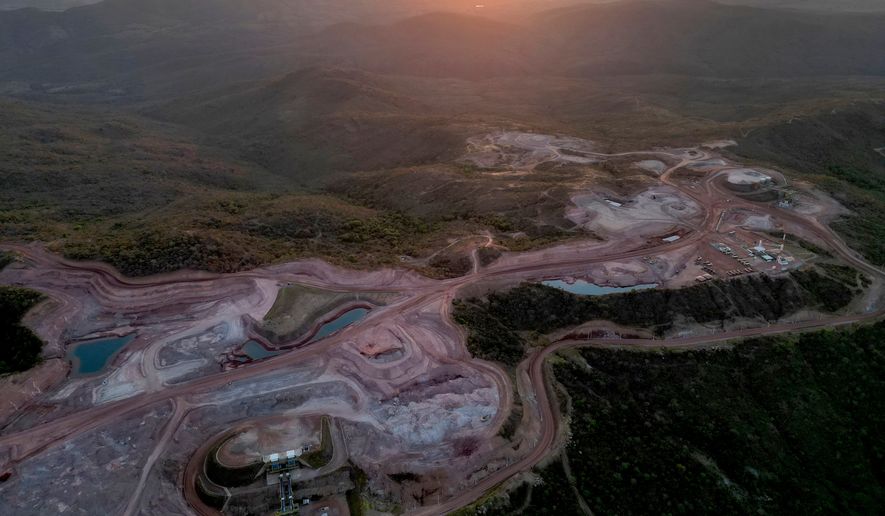
Serra Verde operates the Pela Ema heavy rare-earth mine in central Brazil. The U.S. government holds a stake in USA Rare Earth.
Separately, an Aug. 24 announcement detailed a $750 million U.S. government commitment to a special-purpose vehicle to purchase Serra Verde’s production, distinct from the acquisition price.
The mine has attracted U.S. funds because of its strategic importance to the United States. According to the company, Serra Verde is the only scaled producer outside Asia of all four principal magnetic rare earths: dysprosium, terbium, neodymium and praseodymium.
Chinese interests are also increasingly looking at Brazil’s rare earths. Mineracao Taboca, a major Brazilian tin producer, was acquired last year by China’s state-owned CNMC. Separately, the Chinese firm Gulf Resources announced an agreement with Brazilian company Montes Verdes on Aug. 26 to establish a mineral joint venture involving rare-earth interests.
“President Lula may see his policies as in line with domestic value addition,” said Miguel Nunes Silva, director of Instituto Trezeno, a Portuguese conservative think tank, “but refining Brazilian rare earths with Chinese technology risks replicating old supply-chain choke points, and his longstanding preference for China as a partner is alarming for those in America and Europe who are troubled by China’s recent export bans for rare earths.”

Please read our comment policy before commenting.