


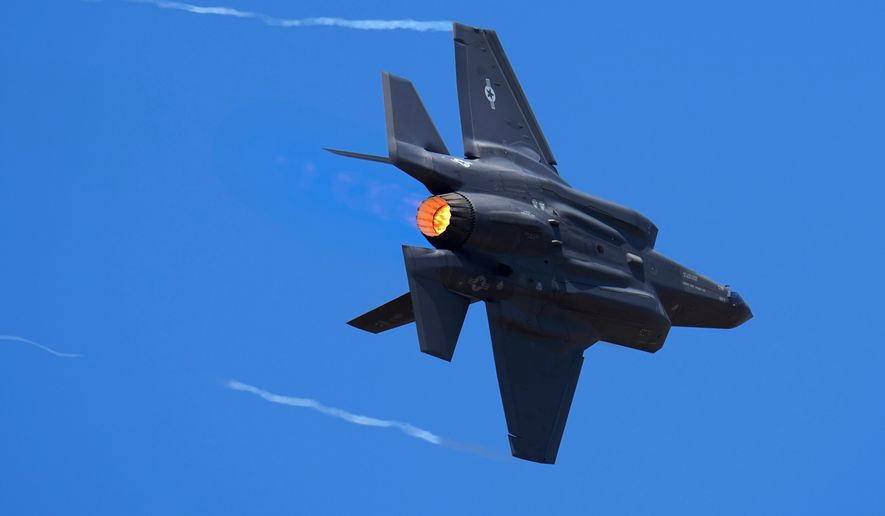

The Pentagon announced Thursday that it finalized a 10-year agreement with defense company Lockheed Martin for F-35 fighter jets, including production and future maintenance of the stealth fighter, according to a release.
The longer-term contract is a major change for the U.S. military as the Pentagon attempts to shift to “stable, long-term” deals for the American defense industry. Under Secretary of Defense for Acquisition and Sustainment Mike Duffey said the agreement with Lockheed Martin for the plane proves that the department is “aligning financial incentive with actual performance.”
“We are ensuring our war fighters are equipped with the lethal capabilities they need to fight and win,” Mr. Duffey said.
People were interested in these podcasts
The drive for long-term contracts, specifically for the F-35, has gone on for years. The Trump administration’s Pentagon team has driven that priority into nearly every aspect of the defense industry. The F-35 deal is the latest example of a series of agreements spanning past the administration’s tenure.
The announcement of the agreement says that Maryland-based Lockheed Martin will “self-fund at least $7 billion in initiatives that support the F-35 Program” and that it guarantees that the company can produce a minimum of 850 jets during the 10 years.
The Pentagon said the deal “maximizes purchasing power and delivers true economies of scale.”
The stealth fighter has not been without controversy this year, as parts of the jet were shipped to Hong Kong instead of the U.S. in September. The department opened an investigation into how a shipment of parts for what analysts argue is the most advanced fighter jet in the world ended up in Chinese custody.
The F-35 is a multirole stealth fighter, and its radar and sensors enhance pilots’ capability and allow the plane to serve as a node in battle networks with other fighters.
“My understanding is that there is a sense of comfort that we’re not talking about sensitive equipment here or sensitive parts,” Australian Defense Minister Richard Marles, whose country the parts originated from, told reporters at the time. “Ultimately, though, this is an issue which is going to be managed by the United States and Lockheed.”
Earlier in the year, President Trump said he was willing to see more allies with the advanced plane, specifically approving of Turkey’s bid to have access to the jet program.
Mr. Trump, sitting with Turkish President Recep Tayyip Erdogan on the sidelines of the NATO summit in Ankara, said inviting Turkey back into the F-35 sphere is “something certainly we would consider.”
“Why wouldn’t we do that?” Mr. Trump said. “Turkey, in many ways, has been much more loyal than other countries that we think would be loyal.”
Congress has not always agreed with continuing the program, one of the Pentagon’s most costly. A U.S. Government Accountability Office report about the F-35 program raised questions over the $13.7 billion strategy that the Defense Department launched last year to improve the readiness of the jet fighters.
“The strategy aims to address challenges we’ve identified, such as a lack of spare parts,” the report said, which was published this past June. “However, we found that multiple issues could threaten its success — such as constrained industry capacity to meet increasing demand for parts.”
It’s unclear if the production issues found in the GAO report have been resolved.
More than 1,300 operational F-35 jets have rolled off the assembly line, with about 830 being flown by the Navy, the Marine Corps and the Air Force. The remaining fighters are with more than 20 partner nations that are part of the F-35 program, according to Marine Corps Lt. Gen. Gregory L. Masiello, the program executive officer of the F-35 Lightning II.
Lt. Gen. Masiello testified before Congress during a late June hearing that the stealth fighter has unique capabilities, saying that some pilots have only been able to hit certain targets while flying the F-35.
He said the fighter could “actually act as a quarterback of the joint force.”
Contact the author


Please read our comment policy before commenting.