


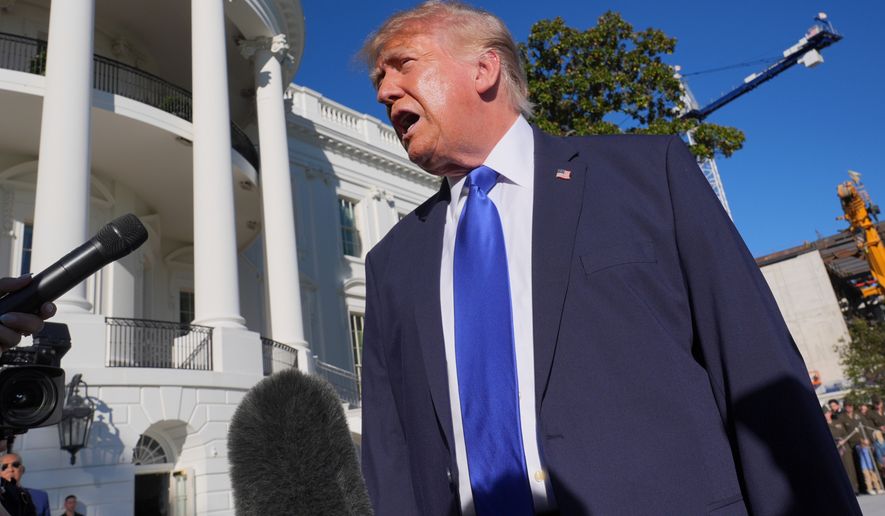

President Trump said Thursday that The New York Times should apologize for running polls showing Democrats with sizable leads in competitive gubernatorial and Senate races that later turned out to be fraudulent.
“The polling company just said that the numbers were fake and I haven’t had an apology from The New York Times,” Mr. Trump told reporters at the White House before departing for a campaign rally in Iowa. “The New York Times uses that polling company. To the best of my knowledge, they haven’t apologized.”
Wedgewood Polling announced Tuesday that the vast majority of its surveys had been fabricated to “demonstrate the vulnerabilities of the modern political polling industry. Its polls had been cited by The New York Times, MS Now, Newsweek, Decision Desk HQ and Mediaite.
People were interested in these podcasts
“We wanted to test a simple hypothesis: How easy is it for an entirely fabricated polling firm to gain traction, be taken seriously, and expose how little scrutinization exists in media and public commentary?” Wedgewood Polling said in a statement. “The short answer: Far too easy.”
Wedgewood Polling released the statement after FiftyPlusOne, a polling and election analysis company, questioned the veracity of its results.
“The ease with which unverified figures were absorbed into mainstream political narratives highlights a systemic breakdown in media vetting and data aggregation,” Wedgewood said in its statement.
The New York Times had been using Wedgewood’s polls on its website where they show an aggregate of data compiled by several polling agencies. In a statement, the outlet said, “All of Wedgewood’s polls have been removed from our tracking project.”
“This page previously included surveys from Wedgewood Polls. On Oct. 20, after being questioned by the polling site FiftyPlusOne, Wedgewood released a statement admitting it had fabricated data for its polls. All of Wedgewood’s polls have been removed from our poll tracking project.”
Wedgewood’s polls largely showed Democrats with big leads in races other polling agencies found were much closer.
For example, Wedgewood reported Abdul El-Sayed, a Democrat, had a six-percentage-point lead over Republican Mike Rogers in the Michigan Senate race. Other polls give Mr. El-Sayed an average of a two-percentage-point lead over Mr. Rogers, with some surveys calling the race even.
In the Michigan gubernatorial race, Wedgewood gave Democratic candidate Jocelyn Benson a 10-point lead over Republican John James, while other pollsters give Ms. Benson a six-point lead.

Please read our comment policy before commenting.