


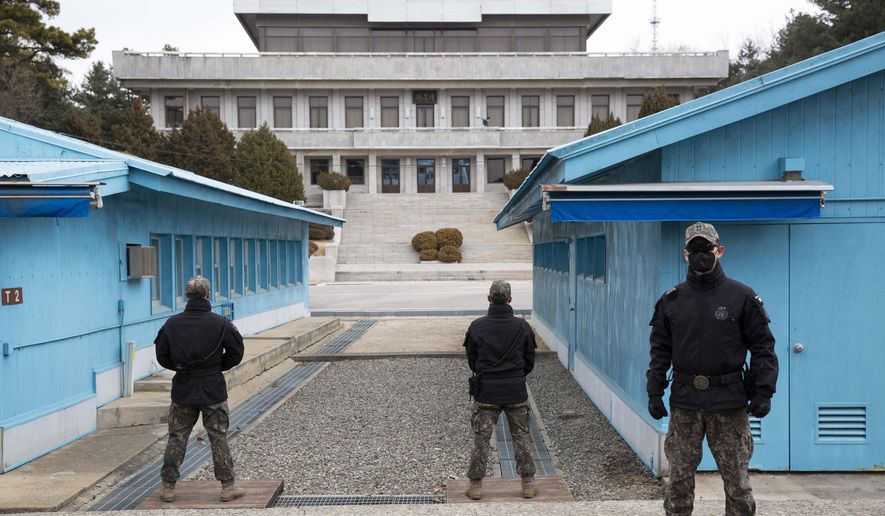

SEOUL, South Korea — North Korea has laid some 960,000 landmines along the Demilitarized Zone since 2024, according to sources in South Korea’s National Assembly on Friday.
The Joint Chiefs of Staff gave the National Assembly Intelligence Committee and Defense Committee the estimated figure of almost a million newly laid mines, which multiple domestic media outlets later reported.
On the same day, Seoul requested joint talks with Pyongyang to reduce simmering frontier tensions.
People were interested in these podcasts
“South Korea’s Defense Ministry hereby officially proposes holding inter-Korean military talks with North Korean authorities to jointly verify the locations of the land-based MDL, restore military communication lines and discuss measures to prevent accidental clashes along the border,” Deputy Defense Minister Kim Hong-cheo told a press briefing.
The MDL, or Military Demarcation Line, is the poorly demarcated border inside the 2.5-mile-wide DMZ. A series of white posts that demarcated the line, laid after the Korean War armistice in 1953, have largely rotted away, been covered in vegetation and/or not been renewed, making navigation by patrols extremely hazardous.
There has, as yet, been no response; North Korea has either ignored or responded angrily to recent outreach by the South.
Friday’s developments come at a tense time on the DMZ, which crosses the waist of the peninsula, keeping the two Korean nations physically apart.
On Wednesday, Kim Yo-jong, sister of national leader Kim Jung-un, toured the northern side.
There, she issued warnings against South Korea and said that the North would resume propaganda broadcasts, which had been suspended by both sides in 2025, by the end of October.
Earlier, on Sept. 21, three South Korean troops were injured, two seriously, while patrolling inside the DMZ. Seoul blamed North Korea for laying landmines south of the MDL; Pyongyang angrily denied the accusations.
The massive increase in minelaying reported Friday has been underway since April 2024, when Pyongyang ditched its long-held ambitions for the reunification of the two Koreas, instead declaring South Korea a “hostile state.”
In addition to mines, it has been otherwise fortifying its side of the DMZ with dug-in positions, an anti-tank trench and wall and fields of barbed wire.
Military sources believe that, with the recent increase in North Korean minelaying, some 3 million mines, laid by both sides, are hidden in the soil of the DMZ.
Many North Korean antipersonnel mines are cased in plastic resin or wood, making them harder to detect than metal variants.
Contact the author


Please read our comment policy before commenting.