



OPINION:
The floor of the Combined Air Operations Center never really went dark.
Screens cast a pale light across controllers tracking sorties from the Suez Canal to the Gulf of Oman. It was August 2022, three months into my tour as deputy commander, and Lt. Gen. Alexus Grynkewich walked onto that floor and asked a question: Could the U.S. Air Force fight without an air tasking order, the document that tells each pilot the mission, where to fly and when?
I did not expect to run that test in a combat theater, on a question the Pentagon has been working on since 2019. Joint All-Domain Command and Control, or JADC2, renamed CJADC2 in 2023, promises to link every sensor to every shooter at the speed of relevance.
People were interested in these podcasts
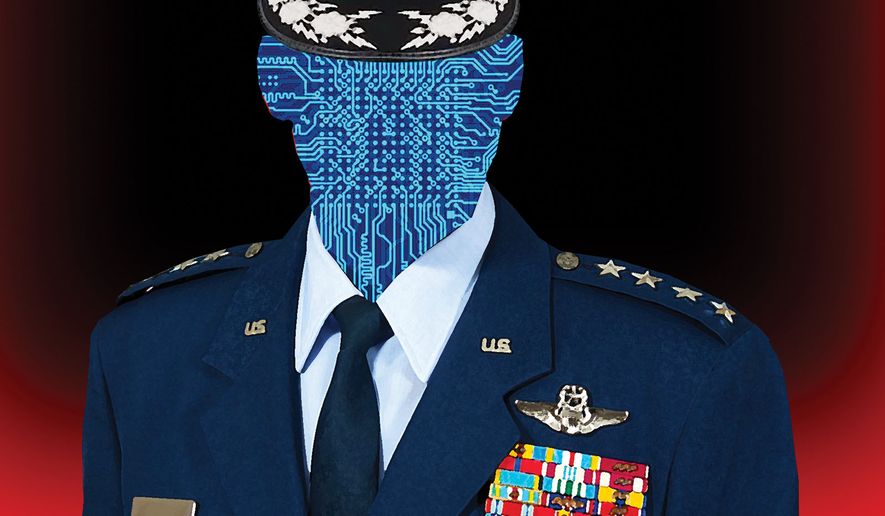
Seven years later, artificial intelligence is proving itself part of the fix, but the department must decide who holds the authority to act: the commander or the machine?
In August 2020, Gen. John Hyten, vice chairman of the Joint Chiefs, called JADC2 the key to integrating operations across every domain. The Pentagon released its unclassified strategy two years later, in March 2022. Last year, the Government Accountability Office found that after more than five years, the department still lacks a framework to guide investment and that services continue to build their own systems in isolation.
In February 2024, the department fielded a minimum viable capability, far short of the promise.
For 20 years, the tasking order — refined overnight by planners and published each morning like Scripture — had driven every air campaign I had flown. We needed something else: a stated purpose, a few key tasks, a clear end state and then to get out of the way.
AFCENT then had five subordinate wings across the Middle East, each with trained commanders and staff, but the old doctrine still ran the show.
I wrote a one-page mission-type order underpinned by commander’s intent. The air commander approved it, and for two days, the wings executed on their own.
What we learned humbled me. Every wing tracked its aircraft on a different common operating picture. Worse, the wing commanders lacked authority. They could not draw equipment from reserve stock two echelons up or approve a higher-risk mission when intelligence changed overnight.
Every one of those calls still belonged to the air commander or me. That gap is the real lesson.
CJADC2 needs three things working together: a backbone that moves the data; AI that turns it into something useful; and a commander with the authority to act on it. The department has spent seven years building the first, four years chasing the second and no years solving the third.
Mission command, pushing the decision to a human at the tactical edge, is part of the answer, but it assumes a human stands at that edge to receive it.
The department established a Chief Digital and Artificial Intelligence Office in 2022 and has run more than a dozen AI experiments since 2023. One recent assessment described the problem I saw on that floor: The constraint is not data access. It is the ability to align, interpret and act on it at speed.
Better sensors and algorithms do not solve the decision problem, and trust is the harder one.
The department must stress-test the control processes, confirm that the data feeding the model is accurate, and give operators enough insight into the AI’s reasoning to trust it under fire. That trust matters most when the edge is unmanned, flying beside a crewed aircraft and taking direction from the same AI-enabled node, with no human aboard to question an order that looks wrong.
Still, AI works only if the entire stack works. The Air Force’s Program Executive Office for Command, Control, Communications, and Battle Management, or PEO-C3BM, is building CJADC2’s connectivity backbone, but Nvidia’s Jensen Huang reminds us that AI runs five layers deep: energy, chips, infrastructure, models and applications.
Connectivity is only one layer, and an adversary need not beat the model, only sever a link beneath it, as Russia proved in February 2022 by blinding Ukrainian command terminals through a cyberattack on Viasat’s satellite modems. AWS and Anduril answered this June with a data center built to keep those layers together at one forward node.
The Center for Strategic and International Studies assesses that Ukraine’s Delta system closely resembles CJADC2 in practice. Delta works because of decisions made around the network, not because of a smarter network.
Money and authority sit at the brigade level, where commanders manage monthly budgets and require every new system to feed into the shared picture as a condition of purchase. Each of those is a decision about who says yes.
The wing commanders in Qatar had neither a shared picture nor the authority to act on one. Together, a connected backbone and useful AI push the right picture forward, to the commander who must decide at the speed of war. That commander still needs the authority to act on a picture that arrives complete, every layer intact, from power to application.
Congress and the Defense Department should fund the backbone, accelerate AI, delegate authority and prove the AI itself is trustworthy in the loop. A broken picture — whether at a screen far from the fight, a severed data center or a model that nobody on the floor understands — does not buy speed.
• David Harris is a retired lieutenant general in the U.S. Air Force. The views expressed are his own and do not reflect the official guidance or position of the United States government, the Department of Defense, the U.S. Air Force or the U.S. Space Force.

Please read our comment policy before commenting.