


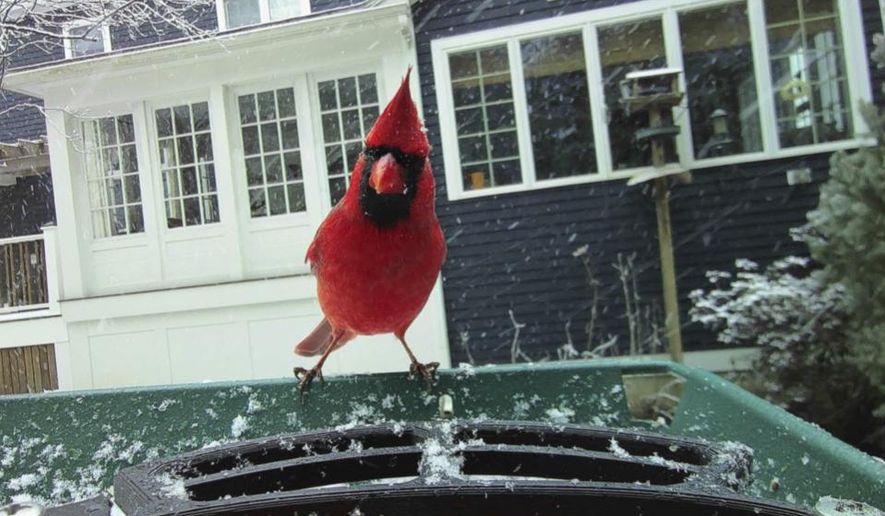

A male Northern Cardinal lands on an October windowsill, its red feathers bright against fading leaves. It may stay a few minutes, come back later in the day or hop between a nearby shrub and the ground.
The bird is probably not stopping during migration. The Cornell Lab of Ornithology’s All About Birds guide says cardinals do not migrate. Pairs that stay close through breeding season may join groups of a dozen to several dozen birds in fall and winter.
The sign has limits
People were interested in these podcasts
A calm, returning cardinal can be good news in a practical sense. It may mean the area around your home offers food, cover or both.
The visit is not proof that the wider ecosystem is healthy, though. Cardinals do well around people: Cornell notes that suburban growth has helped them spread north. Ornithology also describes cardinal behavior, not luck, fortune or messages from a deceased relative. Those readings belong to folklore and personal belief.
The yard may explain the visit
Cornell says to look for cardinals in thick, shrubby spots, from woodland edges and hedgerows to backyards. Seeds and fruit make up most of their diet, and the lab lists dogwood, wild grape, blackberry, hackberry and sumac among their foods. They feed low, in branches near the ground and on it.
A cardinal that keeps visiting the same shrubs or ground beneath a window has probably found usable habitat, and may be responding to the landscape rather than the house. A 1999 U.S. Fish and Wildlife Service backyard-habitat guide for the Southeast says plants supply both food and shelter. It says an ideal habitat mixes plants of varied size and density, and it advises planning for different fruiting and flowering times so food is available through the year.
A slightly messier yard can help. Audubon recommends leaving the seed heads of native wildflowers standing for winter food, skipping the leaf raking and building a brush pile for shelter. It also points to native shrubs such as dogwood, hawthorn and sumac, whose fruit feeds birds in winter. Audubon’s native plants database, searchable by ZIP code, can show which species suit your area.
Tapping signals a conflict
A cardinal sitting quietly on a sill is one kind of visit. A bird that repeatedly pecks, flutters or lunges at the glass is doing something else.
Penn State Extension says the cause is territorial: a male mistakes his reflection for an intruder and attacks the glass to drive it away. The behavior is reported most often in mockingbirds, robins and cardinals. Cornell adds that both males and females do it.
It is most common in spring, when birds defend breeding territories. Cardinals are an exception, though. Penn State says male cardinals often keep it up all year because they hold territories year-round. The Tufts Wildlife Clinic says territorial attacks on windows can also happen in fall.
These fights are usually less dangerous than full-speed collisions, but they are not harmless. Tufts says the reaction can be strong enough that the bird may exhaust itself, though it does not usually cause fatal injury. Cornell adds that the bird may even hurt itself.
The remedy is to change the outside of the glass so the reflection disappears. Cornell says that means covering the outside with netting, fabric or newspaper, or smearing soap streaks on it, then removing the covering once the bird has gone. Because the fix has to be on the outside, an indoor curtain alone may not help.
A thud requires action
Territorial tapping is different from a sudden collision. Tufts says birds hit windows because they see reflected trees and sky, or a clear passage, rather than glass. It adds that birds fleeing a predator are even more likely to fly into glass.
Strikes happen outside migration season too, Audubon notes. Still, the Fish and Wildlife Service says birds are drawn to lights from porches, landscaping and windows during spring and fall migration, and it suggests turning off unneeded lights in those seasons.
The agency says vertical stripes or patterns no more than 4 inches apart, or horizontal stripes no more than 2 inches apart, work for most birds, and patterns on the outside of the glass prevent more collisions than patterns on the inside. Hawk silhouettes are mostly ineffective unless applied in high densities. External insect screens cut reflections, and netting placed inches in front of the glass and pulled tight can prevent injuries, as long as its openings are no larger than half an inch.
A bird that flies away after being stunned has not necessarily escaped injury. The Fish and Wildlife Service notes that many birds that seem fine after a collision can die later from related head injuries. Audubon reports that glass strikes often cause concussions and that the best step is to get the bird to a wildlife rehabilitator. If that is not possible, it advises leaving the bird in a bag or box in a dark, quiet room, away from pets, for about an hour, without food or water, though that does not guarantee recovery. Tufts says to see a veterinarian or rehabilitator if the bird has not recovered within a couple of hours.
A yard with food and cover may help keep a cardinal nearby as temperatures fall. In the coming weeks, a bird that has been there all along may simply become easier to spot as the leaves thin.
This article was constructed with the assistance of artificial intelligence and published by a member of The Washington Times' AI News Desk team. The contents of this report are based solely on The Washington Times' original reporting, wire services, and/or other sources cited within the report. For more information, please read our AI policy or contact Steve Fink, Director of Artificial Intelligence, at sfink@washingtontimes.com
The Washington Times AI Ethics Newsroom Committee can be reached at aispotlight@washingtontimes.com.

Please read our comment policy before commenting.