



According to an 1893 Arizona newspaper, settlers had spent the previous decade telling stories about a giant red creature that knocked down a prospectors’ tent, trampled a woman to death at a sheep ranch and seemed to carry a rider on its back. They called it the Red Ghost. By the time the paper reported it dead, it had been identified as a camel.
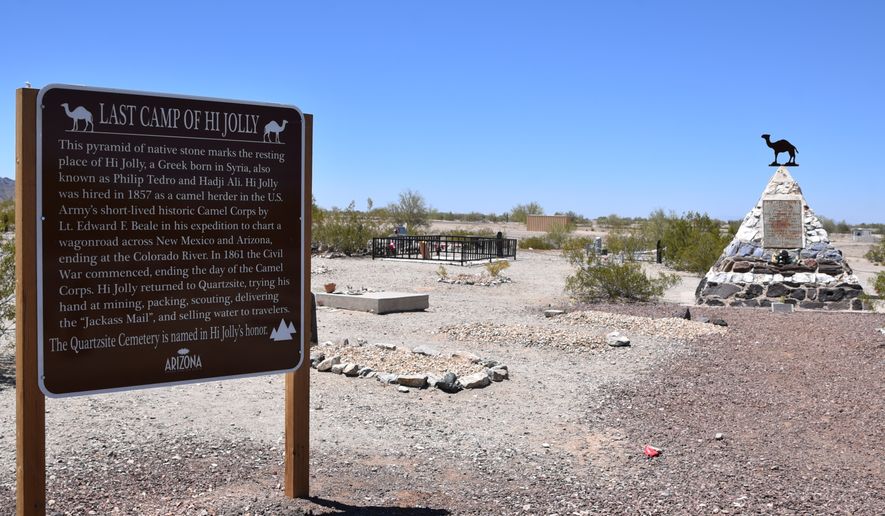
How did a camel end up loose in the Arizona desert? Much of the answer goes back to the U.S. Army Camel Corps, an experiment that began in 1856, when the government shipped camels to Texas to haul supplies across the dry Southwest. Army histories, National Park Service records and later research suggest the animals did that job well. The Civil War ended the program, the herds were sold off, and some camels escaped or were turned loose.
Why did the U.S. Army bring camels to Texas?
People were interested in these podcasts
The Army wanted a pack animal that could carry heavy loads across dry country with little water or forage.
After the Mexican-American War, the Treaty of Guadalupe Hidalgo added more than half a million square miles to the United States, including the deserts of the Southwest. Troops there had to stay close to known water or haul their own grain and water, which slowed them down and limited how far they could go, according to a 1975 Military Review history by John Shapard, republished by Army University Press.
Maj. Henry C. Wayne, an Army quartermaster officer, began pushing the idea of using camels in 1848. Jefferson Davis backed it as a senator from Mississippi but could not get it funded. As secretary of war, he won a $30,000 appropriation from Congress in 1855 and assigned Wayne to buy the animals, according to an Army history of the program published in Army Sustainment magazine, and records held by the Library of Congress.
The Navy handled the shipping. Lt. David Dixon Porter refitted the USS Supply with stalls and ventilation for the animals, and Wayne bought 33 camels in Turkey, Egypt and Tunisia, according to the Army’s historical account. When the ship reached Indianola, Texas, in mid-May 1856, it carried 34 camels, including a newborn calf, Shapard wrote. Once on land, Wayne reported, the camels “became excited to an almost uncontrollable degree, rearing, kicking, crying out, breaking halters, tearing up pickets.”
The herd was based at Camp Verde, near present-day Kerrville, according to the National Park Service. A second shipment arrived in early 1857 and brought the herd to about 70 animals by the Army’s count. Shapard put the total at 75.
Did the Army camel experiment work?
As pack animals, largely yes. As cavalry mounts, and with the soldiers who handled them, no.
In September 1856, Wayne sent six camels to San Antonio for oats alongside mule-drawn wagons. The camels carried as much as two six-mule wagons and beat them by about 42½ hours, he reported. The following February, a camel stood up and walked off carrying four bales of hay that weighed 1,236 pounds in all, while a crowd of doubters watched.
“The usefulness of the camel in the interior of the country is no longer a question here in Texas among those who have seen them at work, or examined them with attention,” Wayne wrote, according to the same history as published by the Army Transportation Corps.
Combat was another matter. Wayne concluded that using camels in battle was not feasible. Soldiers and officers resisted the animals, Shapard wrote. Camels needed constant care to avoid a contagious mange, they smelled, and they could bite or throw up their cud on handlers. Many troops also complained of motion sickness after riding them. The camels’ smell also appeared to bother horses, the Army history says.
The biggest field test came in 1857. Edward Fitzgerald Beale, a former Navy lieutenant turned explorer, led an expedition with 25 camels to survey a wagon road from Fort Defiance, then in New Mexico Territory, to the Colorado River. The route crossed the high desert and petrified forest country of what is now northern Arizona.
In September 1857, near present-day Winslow, the party ran nearly out of water. Beale wrote that the mules crowded around a small barrel, “frantic with distress,” while “the camels appeared to view this proceeding with great contempt, and kept quietly browsing on the grass and bushes,” according to Army University Press. Earlier on the trip he had written, “Certainly there never was anything so patient and enduring and so little troublesome.”
Beale reported to Secretary of War John B. Floyd: “It gives me great pleasure to report the entire success of the expedition with the camels so far as I have tried it,” according to a 2022 National Park Service bulletin. Floyd declared, “The entire adaptation of the camels to military operations on the plains may now be taken as demonstrated.” He asked Congress for 1,000 more camels in 1858 and tried again in 1859. Congress never acted.
Two more expeditions, in 1859 and 1860, took camels through the rugged country between the Pecos River and the Rio Grande. The National Park Service says that on marches that left men, horses and mules “completely distressed,” the camels “easily marched on over rough, rocky ground with little or no water or vegetation.”
What happened to the Army camels after the Civil War?
They were auctioned off. Many went to circuses, zoos, ranchers and freight businesses, and some escaped or were turned loose in the desert.
Confederate forces captured Camp Verde and its camels on Feb. 28, 1861, Shapard wrote. The Union’s second herd, in California, was moved from post to post “because no one could think of a mission for them,” according to the Army’s history. Secretary of War Edwin M. Stanton saw the animals as useless and ordered them sold.
The California camels went to auction in February 1864. Accounts differ on the buyers. Shapard wrote that circus owners took most of them, with others going to prospectors and ranchers. Smithsonian magazine reported that Samuel McLaughlin bought the whole herd and sent some to Nevada to haul salt and mining supplies.
After the war, the federal government recovered the Texas herd. A January 1866 Army and Navy Journal item reported 66 camels at Camp Verde up for sale. All 66 went that year to Bethel Coopwood, a Texas lawyer, according to the Handbook of Texas. Smithsonian reported that he used them for three years to haul freight between Laredo and Mexico City.
After that, the animals are hard to trace. The new owners resold them a few at a time to traveling menageries, businessmen and others, and some ended up with butchers, Smithsonian reported. Private imports make tracking harder: while the Army brought in its camels, private businesses imported hundreds more through Mobile, Galveston and San Francisco. “Those commercially imported camels start to mix with the formerly Army camels in the 1870s,” Doug Baum, a former zookeeper and owner of Texas Camel Corps, told the magazine in 2015.
Owners who no longer wanted the animals often let them go. “Many camels were abandoned by new owners or escaped into the wild,” the Army history says. Mr. Baum estimated “six to ten” actual sightings after the war, up to about 1890. Smithsonian says sightings were reported into the early 20th century, and the Army history says alleged sightings were still being recorded in the 1940s. One story involves a young Douglas MacArthur at Fort Selden, New Mexico, in 1885. The Army says he recalled seeing a camel. Smithsonian says he heard about one.
Was the Red Ghost of Arizona a real camel?
Probably. The evidence supports a feral camel in territorial Arizona. The story of a dead man tied to its back rests on a single newspaper account.
That account ran on Feb. 25, 1893, in the Mohave County Miner, a weekly in Kingman, under the headline “The Phantom that Terrified all Arizona for a Time.” The page is preserved by the Arizona Memory Project and the Library of Congress, and Arizona Highways reprinted it in July 1935. The unsigned story is credited to the “Examiner,” which indicates the Miner reprinted it from another paper.
According to the account, the creature first appeared about 10 years earlier. Two Mexican men washing for gold on a creek feeding the San Francisco River had their tent knocked down on top of them and saw “something taller than two horses” crash into the brush. Later, at a sheep ranch on Eagle Creek, a woman was found “trampled and crushed.” Her sister, the only witness, said the thing “was red, she said, very tall and ridden by a devil.”
About a month later, Si Hamlin, a hunter in the Salt River country, saw the animal from half a mile away and recognized it as a camel. The burden on its back “looked to him like a man, but he wasn’t sure,” the paper reported. Prospectors on the Verde River then fired at it. As it ran, something fell off, and they found “a man’s head dry and withered but with flesh and hair still on it.” A cowboy who later roped the camel at an abandoned branding corral said the pack was nearly gone, “but there was no question it had once been a man.”
According to the story, the camel was killed “a couple of months” before it was written. Mizoo Hastings of Ore, who had a ranch a little above the gold camp on the San Francisco River, saw “a big red camel banqueting in his turnip patch” and shot it from his cabin window. He found it “covered with a perfect network of knotted rawhide strips,” some of which “had cut their way into the flesh.” He tanned the hide and planned to make cowboy boots from it.
The account has weak spots. It was reprinted from another paper and describes events going back a decade. Robert Froman, who retold the story for American Heritage in 1961, acknowledged that “the only contemporary account of this career seems to be the one in the Miner.” The coroner’s jury returned a verdict of “death in some manner unknown to the jury,” and jurors went home with “half an idea” that the surviving woman had killed her sister and invented the apparition. One witness claimed the camel galloped half a mile through the air across the Black River valley. The paper noted that the same man had reported a flying bear and a mountain of solid gold. The paper could only guess whether the rider had been tied on “for deviltry or revenge,” as “some lunatic’s hideous scheme of suicide” or as an “ugly piece of humor.” None of the sources reviewed for this article identifies him.
The camel itself stands on firmer ground. “Do I think it happened? Yes,” Mr. Baum told Smithsonian. “And it very likely could’ve been one of the Army camels since it was an Arabian camel.”
That makes the Red Ghost less of a monster story and more of a loose end from a government experiment. Decades after the Army gave up on its camels, at least one was apparently still roaming Arizona, familiar enough to show up in the newspaper and strange enough to be taken for a ghost.
This article was constructed with the assistance of artificial intelligence and published by a member of The Washington Times' AI News Desk team. The contents of this report are based solely on The Washington Times' original reporting, wire services, and/or other sources cited within the report. For more information, please read our AI policy or contact Steve Fink, Director of Artificial Intelligence, at sfink@washingtontimes.com
The Washington Times AI Ethics Newsroom Committee can be reached at aispotlight@washingtontimes.com.

Please read our comment policy before commenting.