


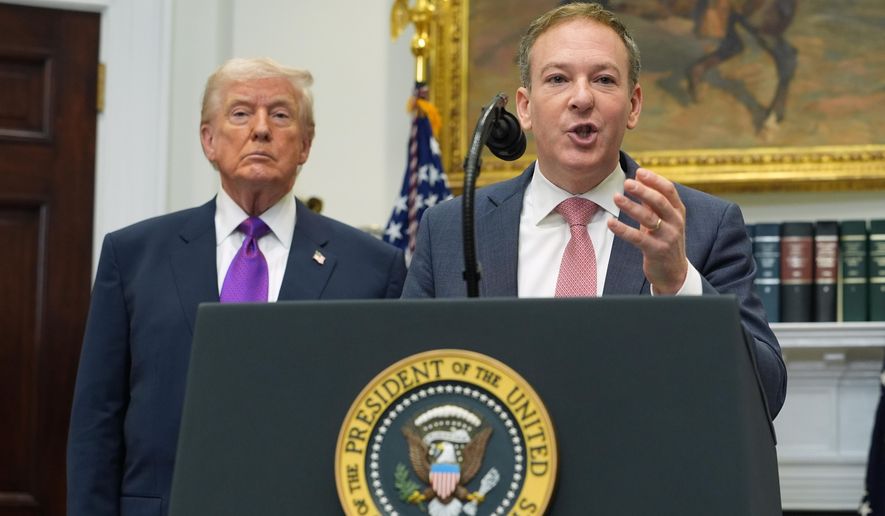

The Environmental Protection Agency is still doing serious science, its research chief said, rejecting complaints from climate activists and other Trump critics that the agency’s basic research was gutted by a reorganization last year.
Teresa Booeshaghi, the assistant administrator for the EPA’s Office of Applied Science and Environmental Solutions, said it’s working on everything from so-called forever chemicals to algal blooms.
It’s been a year since Administrator Lee Zeldin started shrinking his agency’s footprint. One of those decisions was to close the Office of Research and Development and create the new OASES, with Ms. Booeshaghi named its head.
People were interested in these podcasts
“There’s been a sort of narrative out there basically saying EPA is no longer doing science after our reorganization. That really couldn’t be further from the truth,” she told The Washington Times.
She spoke after a recent trip to the Great Lakes, where she watched the agency’s Lake Explorer II research vessel. It samples the nutrient content in the water, seeking ways to keep the lakes in balance.
Ms. Booeshaghi was particularly enthused by the vessel’s underwater glider, which she said looks like a missile and slips through the water collecting real-time data used to predict harmful algal blooms.
The EPA this month released a list of 100 “science wins” under Mr. Trump.
Leading the list was research into PFAS emissions. Those are chemicals that persist in the air and water long after their emergence from power plants, factories and waste treatment facilities.
PFAS emissions are gaining attention, but Ms. Booeshaghi said there was a dearth of remediation or treatment technology.
The EPA tested a PFAS incinerator at a facility in Florida this year, and the agency said it showed emissions from solid waste could be mitigated in real-world scenarios.
“The more we can develop these sorts of technologies, it will not only help us reduce contamination in the environment, but it will also help us bring costs down,” she said.
The list of wins also included updated health information on children’s asthma and exposure to environmental hazards such as lead.
“We’re really working to reduce lead in the environment and provide tools for the public and schools to limit exposure,” Ms. Booeshaghi said.
The victory list celebrated grants to research institutions and firms for monitoring and remediation of all manner of potential health and environmental threats.
Critics of the EPA, particularly those in the climate change debate, have been infuriated by moves such as the revocation of the Obama-era “endangerment” finding that had underpinned the agency’s ability to take action on the climate.
“EPA throws out science in favor of anti-regulatory ideology,” blared a headline in March in The BMJ, formerly known as the British Medical Journal.
Ms. Booeshaghi said such criticism is overheated.
“Science is still happening at the agency,” she said.
Mr. Zeldin has also recommitted the EPA to a goal of phasing out the use of mammals in toxicity tests of chemicals by 2035.
The agency has already begun to retire some of its research animals from its North Carolina lab.
The first Trump administration had set the 2035 goal, but it was erased by the Biden team, which dismissed the goal as unreasonable and dangerous.
Ms. Booeshaghi, though, said EPA’s scientists find the goal worthwhile.
“If anybody can complete this, it’s definitely our team of scientists,” she told The Times. “The general sense I have from our staff is overwhelmingly supportive.”
Contact the author


Please read our comment policy before commenting.