


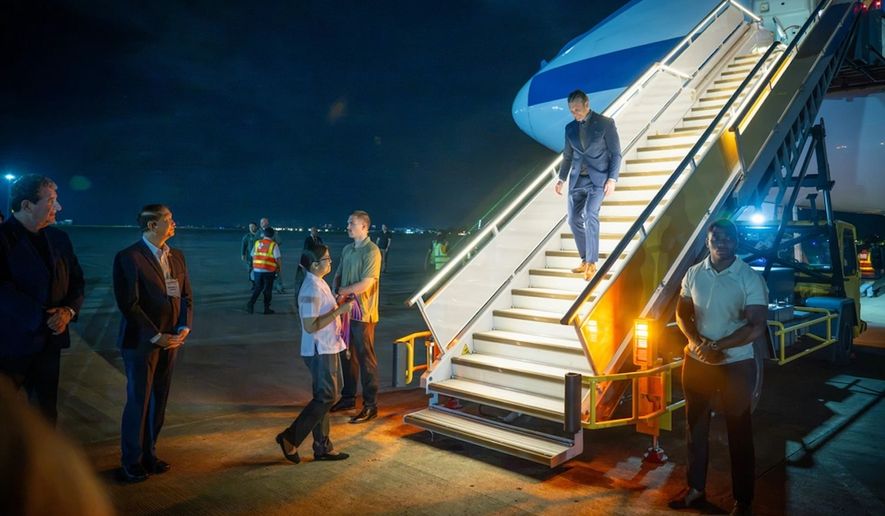

CEBU, Philippines — Defense Secretary Pete Hegseth arrived here Tuesday for a quick turnaround visit to the Pacific theater, where he is slated to hold talks with counterparts from across the region at a major Association of Southeast Asian Nations (ASEAN) defense ministers gathering.
The visit to the Philippines, which is hosting the gathering, comes at a sensitive moment for the Trump administration, as the U.S. military balances multiple hot zones around the world, even as it looks to bolster regional deterrence against China’s increasing military ambitions in the Pacific.
The Pentagon said in a statement that Mr. Hegseth’s focus at ASEAN meetings Wednesday and Thursday will be “to reaffirm America’s commitment to peace through strength in the Pacific,” while also pushing to “strengthen deterrence, advance key alliances and partnerships, and expand burden-sharing across the region.”
People were interested in these podcasts
Defense ministers from across ASEAN’s 11 member nations are slated to attend, including from Cambodia, Indonesia, Thailand, Vietnam, Singapore, Myanmar and other nations. Regional news reports indicated that Japan and South Korea, both of which are official “dialogue partners” of ASEAN, are also sending delegations.
Both Russia and China are also dialogue partners of ASEAN. Reuters reported Tuesday that the defense attache from the Chinese embassy to the Philippines will attend this week’s meeting. It was not clear whether Moscow is sending a delegation.
Mr. Hegseth flew 20 hours to get to Cebu, where he’s slated to spend less than 24 hours before returning back to Washington. The hours are expected to be packed with crucial bilateral and multilateral meetings with partners, as well as a possible engagement with officials from China.
“Just a short trip,” Mr. Hegseth said Monday, as he boarded an E4 Doomsday jet — nicknamed “Christine” — that ferried him across the Pacific. Conducting in-air refueling somewhere over the Aleutian Islands, the jet went nonstop between Washington and Cebu, Philippines, in a single push.
The trip presents the defense secretary with an opportunity to focus on the Pacific theater at a moment of global headlines tied to the ongoing U.S. war with Iran.
The Trump administration has said the Pacific is a priority, and this week’s ASEAN meeting comes as Pentagon officials describe China as the U.S. military’s “pacing threat.”
In a recently published “How The Army Fights” document, acting Chief of Staff of the U.S. Army Christopher LaNeve wrote that the national strategic guidance of “peace through strength” requires Army forces to have “regularly rehearsed with Allies and partners” while postured throughout the world.
He also wrote that the doctrine of peace through strength “requires us to organize, train, and equip against the [Chinese] People’s Liberation Army (PLA) — the ’pacing threat’ — with the same institutional focus that the Cold War generations brought to the Soviet Army.”
U.S. Air Force Secretary Troy Meink, whom President Trump tapped last year as the service’s top civilian leader, has also pointed to China as the competitor.
Mr. Meink told reporters at the annual Air and Space Forces Association conference near Washington, D.C., in September that the need to be capable of quickly scaling military resources was a requirement to stay abreast of the Pacific region’s adversaries.
“In a high-end, near-peer adversary kind of engagement, we need to scale our weapons,” said Mr. Meink, who added that the U.S. needs to be prepared to “produce them quicker at scale and for a lower cost.”
Those goals will have to be weighed against the costs associated with the ongoing conflict in the Middle East, and may also hinge on the Trump administration’s effort to convince regional partners in the Pacific theater to share more of the defense cost burdens in the region.
Mr. Hegseth’s attendance at the Philippines summit will be one of the opportunities for the Trump administration to strengthen ties with regional partners.
ASEAN bilateral and multilateral meetings present a chance to talk honestly about military interoperability in the region and send a message to adversaries that are also attending.
The Chinese Communist Party’s stated goal of taking control of the U.S.-aligned island democracy of Taiwan, by force if necessary, hangs in the backdrop of this week’s gathering.
Many in the region see a rising threat of so-called “gray zone” tactics by Beijing, ranging from maritime harassment and aerial intimidation to cyberattacks and damage to undersea infrastructure.
The Philippines, the oldest U.S. military treaty ally in Asia, recently coordinated with Taiwan on protecting undersea cables from China in a strategic channel, according to Taipei media outlets.
Manila and Taipei appear, specifically, to be cooperating on the under surface defense of the Bashi Channel, a strategic waterway between the northern Philippines and southern Taiwan.
Philippine Deputy Chief of Mission Felipe Carino III said during an appearance at a seminar in Washington last week that undersea cable security is critical, given the cables’ centrality to transnational data flows.
“These are very important features that should be protected, so much so that we are exploring deeper cooperation with our friends in Taiwan,” Mr. Carino said, adding that the Philippines would conduct such cooperation “notwithstanding our ’One China’ policy.”
A report published this month by the Center for Strategic and International Studies think tank in Washington found that Chinese research vessels spent a disproportionate amount of time near undersea communications cables across the Pacific, compared to vessels from other neighboring countries.
The report said the vessels show a “persistent pattern of activity in locations where undersea data could have significant military value.”
It remains to be seen how such developments will factor into Mr. Hegseth’s meetings over the coming two days.
Contact the author


Please read our comment policy before commenting.