


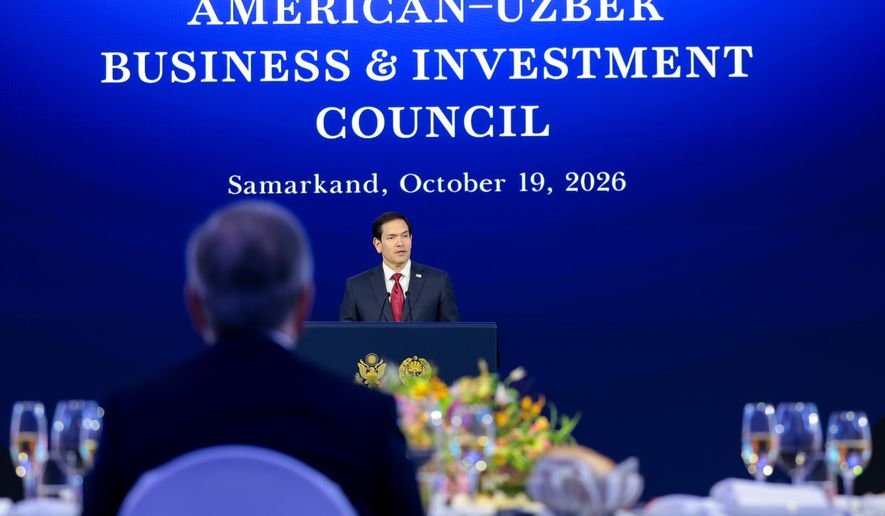

Economic partnerships between the U.S. and Uzbekistan have continued to deepen, the American Uzbek Business Investment Council said following this month’s investment summit in Samarkand, even though marquee tariff commitments between the two countries still need to be made legally binding.
Nozima Davletova, head of the secretariat of the council, said in written answers to questions from The Washington Times that after the U.S. Supreme Court struck down several of President Trump’s tariff measures this year, the next step in the trade relationship with Uzbekistan is to make the commitments legally binding.
“In this context, the commitments undertaken by Uzbekistan and the United States should be rendered through legally binding agreements,” she said. She described a “consensus” under which the U.S. has agreed to treat the Uzbek market favorably “according to the U.S. law,” and said both sides are “binding the tariffs to the level of reciprocity.” She did not say which commitments are binding today.
People were interested in these podcasts
Under the U.S.-Uzbekistan bilateral framework, negotiated earlier this year by the Office of the U.S. Trade Representative, Washington agreed to consider Uzbek agricultural and industrial goods favorably.
In return, Uzbekistan agreed to reduce or eliminate tariffs on U.S. products.
After a 2025 White House meeting between Mr. Trump and Uzbek President Shavkat Mirziyoyev, the leaders announced $35 billion worth of bilateral commercial deals covering aviation, critical minerals and energy.
The growing partnership between Tashkent and Washington was on full display earlier this month at the AUBIC meeting in Samarkand. Secretary of State Marco Rubio met with Mr. Mirziyoyev and Central Asian ministers, as well as 200 U.S. and Uzbek business leaders.
Uzbekistan announced 54 agreements and proposed investment projects worth nearly $12 billion, according to reports. The recent deals, like those announced last year, also cover critical minerals, aviation and infrastructure.
Tashkent also joined the Artemis Accords, a set of nonbinding principles outlined by NASA and the State Department to guide space exploration.
The focus on critical minerals in the developing trade discussions with Uzbekistan comes as the Trump administration continues to sound the alarm over China’s dominance in the space.
China has a near monopoly over the mining and processing of critical minerals, which are used in the production of consumer products such as phones and electric vehicles, as well as military assets like advanced ballistic missiles.
Washington and Beijing have clashed repeatedly over rare earth access since the start of Mr. Trump’s second term. China tightened export controls on critical minerals in 2025 in following Mr. Trump’s expansive tariffs on Chinese goods.
China eventually agreed to pause its export controls through Nov. 10, 2026, after an October meeting between Chinese President Xi Jinping and Mr. Trump.
Contact the author


Please read our comment policy before commenting.