



OPINION:
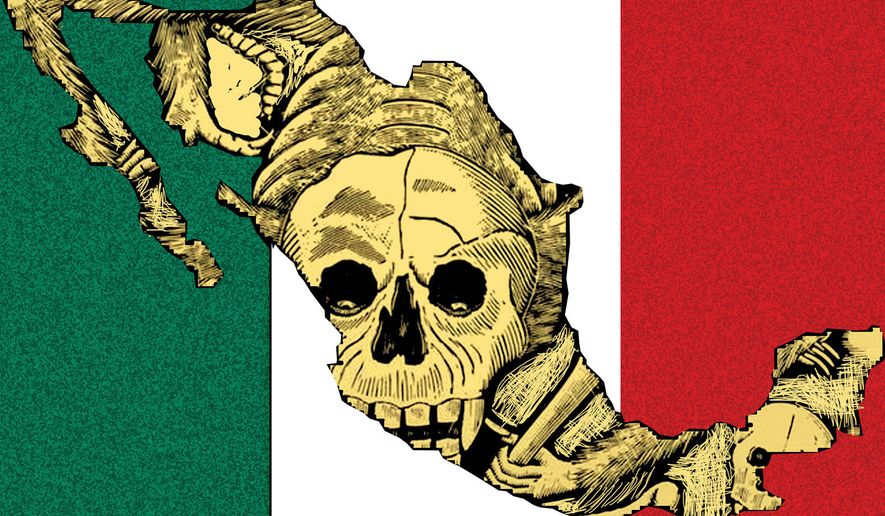
In his Sept. 22 speech to the United Nations General Assembly, President Trump delivered his most direct threat against Mexican drug cartels and the government that shields them.
The cartels and the Mexican government of President Claudia Sheinbaum were put on notice.
Saying that Mexico is “the epicenter of cartel violence” and that “the cartels are the ISIS of the Western Hemisphere,” Mr. Trump pressed Mexico to reclaim control of its soil.
People were interested in these podcasts
For years and across multiple administrations, Mexico has been neither a good neighbor nor a strategic partner. Successive Mexican governments actively undermined the U.S., and Washington’s past reluctance to say so plainly has allowed the problem to fester.
Until now.
In the key areas of immigration, narcotics trafficking and diplomacy, our national security interests radically diverge.
It is impossible to ignore Mexico’s complicity in the disastrous border crisis under President Biden. The United States, unfortunately, delegated a critical component of its border enforcement to Mexico, expecting cooperation in managing the flow of millions of illegal migrants heading north.
What Washington received instead was official inconsistency bordering on manipulation.
In 2024, Mexican President Andres Manuel Lopez Obrador offered to help with migrant flows in exchange for a $20 billion investment in Latin American and Caribbean countries, work visas for 10 million long-term Hispanic residents and an end to the embargo on Cuba.
Those demands were not the actions of a friend.
Thankfully, upon taking office, the Trump administration put a quick end to the madness at our southern border.
Today, Mexican border enforcement tightens when it fears pressure from Washington and then loosens when it does not.
Migrant surges do not occur in a vacuum. They are shaped by Mexican political signals, diplomatic imperatives, complacent policies and police enforcement choices. These surges are well-organized and well-financed.
Millions of these migrants, many in organized caravans, were allowed to enter Mexican territory en route to the U.S. southern border. Mexicans aid and abet these migrant surges, extracting anything of value from the hapless people as they traverse the country.
Mexico has the capacity to regulate movement through its territory, disrupt smuggling networks and prevent illegal crossings into the U.S., but it will not.
A far greater failure lies in Mexico’s handling of cartel violence and drug trafficking, particularly the flow of fentanyl.
Tens of thousands of Americans die each year from synthetic opioids, many of which are produced, trafficked or routed through Mexican territory.
Mexico’s response has been defined by hesitation and half-measures, often deflecting blame to U.S. demand. The strategy of avoiding direct confrontation with cartels does not reduce cartels’ power; it deepens and entrenches it.
These killer organizations have expanded their reach, diversified their operations and now operate with unthinkable impunity. The political will to dismantle them does not exist. Diplomatic statements, periodic drug seizures and low-level extraditions cannot be substitutes for directly challenging the cartels.
Cartels are not ordinary criminal gangs. They are highly trained, heavily armed enterprises that traffic narcotics, smuggle people, extort local populations, corrupt officials and challenge the authority of the Mexican state.
Vast swaths of Mexican territory are now openly controlled by cartels. Mexico’s government has the responsibility and the resources to pursue these criminal networks that have devastated Mexican and American communities.
Still, corruption permeates official Mexico. In April, the Justice Department indicted Sinaloa Gov. Ruben Rocha Moya and nine other current and former officials on drug trafficking charges. The indictments are unlikely to stop there.
On the diplomatic stage, Mexico’s insistence on a “noninterventionist” foreign policy further exposes the limits of its cooperation with the U.S. Mexico routinely distances itself from internationally coordinated efforts to pressure authoritarian regimes by positioning itself as neutral.
This posture purposely dilutes efforts to confront instability, corruption and human rights abuse that ultimately affect the entire hemisphere.
None of this is accidental. Mexico almost gleefully aligns with the worst international bad actors just to prove its independence from the U.S. This anti-Americanism finds ready acceptance within Mexican foreign policy.
The Sheinbaum government will produce just enough to keep the U.S. at bay. The United States must be willing to approach cooperation with Mexico more straightforwardly: clear expectations, measurable benchmarks and real consequences when commitments are not met.
Mexico may be our vital neighbor, but it cannot be allowed to become the weakest link in U.S. national security policy.
• Emilio T. Gonzalez is a retired U.S. intelligence officer who has served in senior positions in the U.S. Army, on the National Security Council and in the Department of Homeland Security.

Please read our comment policy before commenting.