



OPINION:
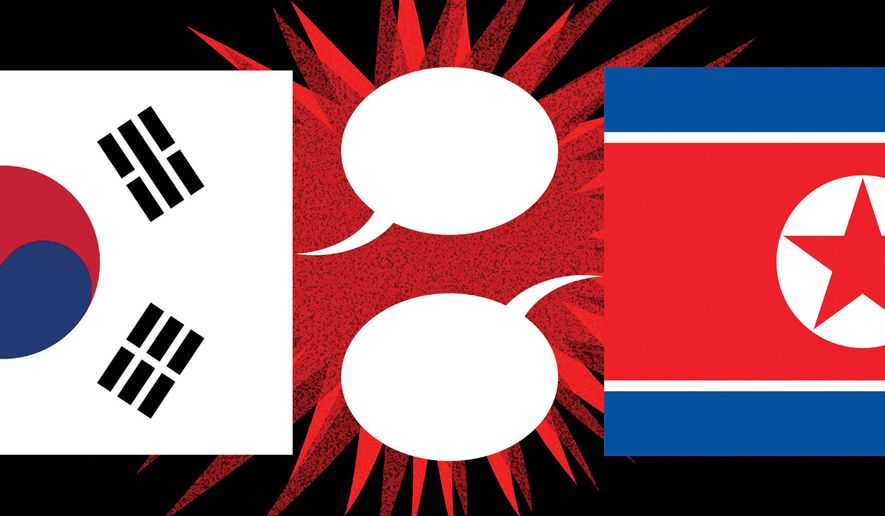
The recent land mine incident in the Korean Demilitarized Zone could escalate into conflict on the peninsula.
South Korea and the United Nations Command said North Korea violated the Korean War armistice with land mine blasts on Sept. 21 on the South Korean side of the DMZ, injuring three South Korean soldiers, two severely.
Kim Yo-jong, sister of North Korean leader Kim Jong-un and department director in the Workers’ Party of Korea, dismissed South Korea’s allegations last week, calling them a “conspiratorial farce.” She threatened immediate and merciless retaliation if South Korean troops opened fire on North Korean workers.
People were interested in these podcasts
Ms. Kim also accused South Korea of fabricating a “self-directed farce,” making groundless claims to justify political and military provocations.
In an Armed Forces Day speech on Oct. 1, South Korean President Lee Jae-myung said: “I hope that the North joins us now on the path of restoring trust and resuming dialogue, following a long interruption … and consistently pursue practical measures to reduce military tensions between the two Koreas.”
Hopefully, the situation does not go the way of an Aug. 18, 1976, incident in which U.S. and South Korean personnel were pruning a tree in the joint security area of the DMZ when North Korean guards, claiming that the tree, said to have been planted by Kim Il-sung, could not be cut, attacked with axes and clubs. U.S. Army Capt. Arthur Bonifas and 1st Lt. Mark Barrett were killed, and others were wounded.
The U.S. response was quick and powerful, mobilizing troops, attack helicopters and B-52 bombers. North Korean leader Kim Il-sung issued an unprecedented statement of regret regarding the killings of two U.S. personnel.
The current situation is markedly different from 1976. North Korea is now a nuclear weapons state with formidable ballistic missiles, and it maintains a military force of nearly 6,000 conventional artillery systems and thousands of rocket launchers within striking distance of Seoul.
Nearly 200,000 special operations personnel are estimated to be tasked with the infiltration, via tunnels and aircraft, of South Korean command centers. North Korea is now closely aligned with Russia, with which it has a mutual defense treaty.
Given that treaty and the progress that Pyongyang has made in building an arsenal of a reported 60 to 120 nuclear warheads, depending on the source, and the ballistic missiles to deliver them, it is fair to assume that Mr. Kim is more confident than his grandfather, Kim Il-sung, was in 1976.
Mr. Kim announced in January 2021 that North Korea would miniaturize nuclear warheads for tactical battlefield use. The next year, North Korean media confirmed that it had simulated tactical nuclear strikes to “wipe out” targets in South Korea.
Indeed, in September 2022, North Korea enacted a nuclear law declaring that its nuclear weapons status was irreversible, authorizing preemptive nuclear strikes if its leadership or command systems were threatened.
In March, North Korea amended its constitution to mandate an automatic and immediate nuclear retaliatory strike if Mr. Kim is assassinated or the country’s command-and-control system is threatened.
Ever since Mr. Lee was elected president of South Korea in June 2025, he has advocated for a resumption of dialogue with North Korea. However, this inter-Korean dialogue ended in June 2020 when North Korea blew up the Inter-Korean Liaison Office in Kaesong, claiming that it was in response to activists in South Korea floating balloons containing anti-regime propaganda pamphlets across the border.
In the absence of dialogue between the two Koreas, with North Korea revising its constitution to say that South Korea is a hostile state and its principal enemy, eliminating any reference to peaceful reunification and national unity, an incident such as the land mine blasts could escalate quickly.
An emboldened leadership in Pyongyang could seize on an incident of this type to escalate tensions with South Korea, potentially triggering another war on the Korean Peninsula.
Resuming an unconditional dialogue with North Korea should be our primary goal.
• The author is a former associate director of national intelligence. All statements of fact, opinion or analysis expressed are those of the author and do not reflect the official positions or views of the U.S. government.
Follow the author


Please read our comment policy before commenting.