



OPINION:
South Korea’s policy toward the U.S. combines friendly and unfriendly moves.
On the one hand, South Korea promises more investment in the U.S., including big projects hailed by President Trump. On the other hand, it discriminates against U.S. companies and moves closer to China, including by making major investments there.
Will this South Korean sleight of hand succeed? Will the country maintain the U.S. as its primary security ally even as South Korea warms to America’s strategic rival?
People were interested in these podcasts
Rep. John Moolenaar, Michigan Republican, is not buying it. Mr. Moolenaar is chairman of the House Select Committee on the Chinese Communist Party. That is a mouthful of a name for the bipartisan congressional group that digs into every aspect of the U.S.-China rivalry, including Beijing’s influence on our allies.
It is from that perch that Mr. Moolenaar wrote recently to Secretary of State Marco Rubio, warning that South Korea’s shift toward China poses “significant risks” to the U.S. Mr. Moolenaar pointed to a “widening gulf” between Seoul and Washington, listing two main areas of concern.
The first is the investments by South Korean companies Samsung and SK Hynix in semiconductor plants in China to produce chips that the U.S. needs. Mr. Moolenaar’s concern is that if a vital supply chain for America starts in China, Beijing could manipulate it or cut it off entirely.
After all, just last year, China threatened to cut off its rare earth exports to the U.S. So it is fair to ask: Are the South Koreans investing in China? Or are they building hostage factories in China?
Second, Mr. Moolenaar pointed to favoritism toward Chinese e-commerce companies, such as Alibaba, and discrimination against U.S.-linked firms, such as Coupang, which is listed on the New York Stock Exchange. This anti-Americanism has been a hot topic on Capitol Hill.
In July, the House Judiciary Committee issued a 34-page report on that country’s sudden hostility toward U.S. companies: “South Korea’s discriminatory treatment of American-owned businesses directly violates its recent trade agreement with the United States” — specifically, the U.S.-Korea Free Trade Agreement. It is bad enough if South Korea is mistreating American companies; it is even worse if the country is dishonoring previous pledges.
Although many observers think that South Korea’s turn is simply the result of hard-left economic ideology, Mr. Moolenaar suggests an even deeper geopolitical motive: appeasing China by shortchanging America. Yet South Korea’s gambit does not seem to be working, because Uncle Sam will not play sucker.
The government of South Korean President Lee Jae-myung asserts that nothing important has changed. Even after Mr. Moolenaar’s letter, his government still insists that Seoul’s relationship with Washington is the “foundation” of the country’s foreign policy.
Yet if, as that House report argued, the country is in violation of past economic pledges, then what future economic or strategic pledges can be trusted? Just last week, we learned that an Alaska liquefied natural gas pipeline project highlighted by Mr. Trump is not a sure thing after all.
So U.S.-South Korean relations are at a fork in the road. To be sure, South Korea is a sovereign nation, free to chart its own course, but so is America.
In the meantime, Americans might point out that the only reason South Korea is free is that the U.S. intervened, at great cost, to rescue South Korea’s freedom. In 1950, South Korea was attacked by North Korea, which nearly conquered the whole of the South until U.S.-led United Nations forces salvaged the situation.
In the three years of the Korean War, we suffered 33,739 fatalities and many more wounded. Today, the U.S. garrison in South Korea numbers some 28,500 troops.
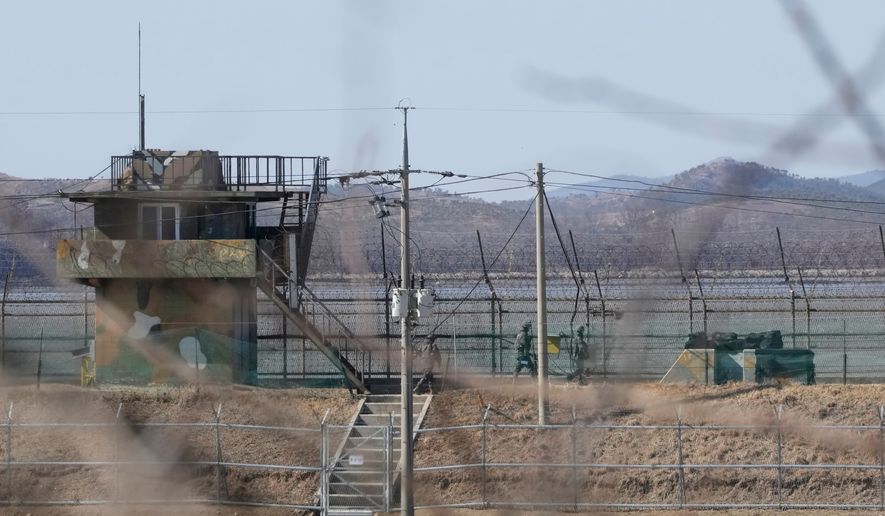
Yet the threat from the North has hardly abated. Not only does North Korea boast a substantial nuclear arsenal, but it also wields an army of some 1.3 million troops, with a large forward element deployed along the Demilitarized Zone, the conflict’s fortified legacy.
In fact, just last month, North Korean land mines in the DMZ exploded, injuring three South Korean soldiers. When South Korea asked for an apology, North Korea responded by calling the South “despicable.”
So, yes, the threat of new fighting hovers over South Korea, including over the U.S. military contingent. Into this risk-filled mix, Mr. Moolenaar has added his words of warning. It will be interesting to see how the Trump administration responds.
It will also be interesting to see whether South Korea responds with anything more substantive than clever words and attempted cunning.
• James P. Pinkerton is a columnist and author who worked in the White House domestic policy offices of Presidents Reagan and George H.W. Bush and on the 1980, 1984, 1988 and 1992 presidential campaigns.

Please read our comment policy before commenting.