



The U.S. Army found systemic safety breakdowns behind last year’s midair collision between an American Airlines jet and a Black Hawk helicopter near Washington, D.C., and recommended changes to prevent future tragedies.
The Army report - completed in May and released publicly Thursday after months of pressure from the victims’ families - identified failures involving air traffic control, helicopter routes, training and safety practices. The Associated Press obtained a copy of the report hours before it was released.
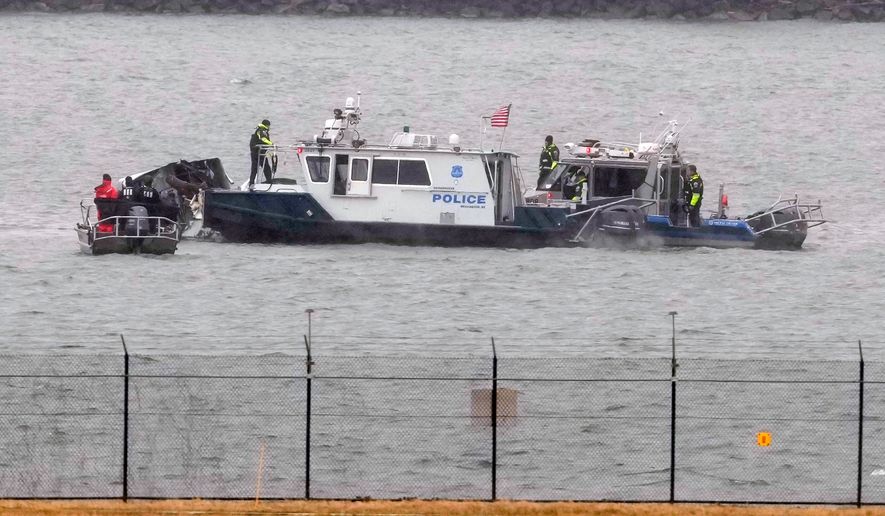
The deadliest plane crash on U.S. soil in over two decades happened when the helicopter collided with the descending airliner as it approached the runway, sending both plummeting into the icy Potomac River and killing 67.
People were interested in these podcasts
The Army report highlighted how the air traffic controller at Reagan could have prevented the crash, but it also acknowledged the military’s own failings and other contributing factors.
Families demand answers from the Army
Tim Lilley, a former Army Black Hawk pilot whose son Sam Lilley was the airliner’s first officer, said the report leaves important questions unanswered. Parts were redacted, and responsibility for the Army’s failures was assigned broadly rather than to individuals.
“The Army owes the families and the American public a full accounting of how these risks were allowed to persist, who was responsible for the decisions that allowed them to persist and what will be done to make sure this never happens again,” said Lilley, now a commercial jet captain.
The Army acknowledged that in a statement Thursday.
“We recognize the families’ need for answers and remain committed to transparency regarding the Army’s review,” it said.
Report identifies key factors in the crash
While the report largely reinforces the National Transportation Safety Board’s conclusions, the civilian investigation was broader and emphasized years of missed warnings by the Federal Aviation Administration along with a weak military safety culture.
The Army faulted the air traffic controller for not giving the helicopter crew more precise information about the approaching jet and for not warning the jet’s pilot about the helicopter. After the crash, the FAA prohibited controllers from relying on pilots to maintain visual separation in busy airspace.
The report recommended looking beyond Washington to examine military helicopter operations in other major cities for similar risks. An Army official said the review of helicopter flights in other cities, including Los Angeles and the Seattle-Tacoma region, is ongoing. The official spoke on condition of anonymity because they were not authorized to discuss the situation publicly.
The lieutenant general who authored the report cited “breakdowns across all layers of conflict management” but singled out two failed radio transmissions that contributed to the helicopter crew not identifying the jet. The military pilots’ night-vision goggles also restricted their view and made it hard to spot the plane amid the city lights.
The poorly designed helicopter route allowed a scant 75 feet (23 meters) of vertical separation between a helicopter and a plane landing on the airport’s secondary runway, assuming helicopters stayed near the riverbank, which the route didn’t require. This did not allow enough separation to account for the accepted level of error in a Black Hawk’s altimeter, and the NTSB found the helicopter was flying nearly 100 feet (30 meters) higher than its instruments read.
NTSB says the Army is making safety changes
The NTSB said in a letter to the Army last week that it was pleased with the Army’s progress on seven of its eight safety recommendations. That contrasts with the FAA’s failure to implement roughly a third of the recommendations aimed at the agency.
The Army said it has strengthened helicopter crew training, and has inspected and reconfigured 3,585 helicopters after discovering the crashed Black Hawk’s ADS-B Out system, which broadcasts its location, hadn’t been working for some time.
The military is also improving its monitoring of safety risks and working with the FAA to share information about close calls.
Victims’ families push Congress for safety reforms
Families of the crash victims said the Army’s findings strengthen their case for legislation requiring aircraft to have technology that helps pilots detect nearby traffic.
“It’s a simple concept anyone can understand: aircraft should be able to see each other in the sky. The technology is proven. All that’s required is the political will to do the right thing,” the Families of Flight 5342 group said in a statement Thursday.
“We have waited long enough. We waited for the NTSB. We waited for the Army. Both investigations are complete, and both make clear that collision avoidance technology must be part of the solution. There is nothing left for Congress to wait for,” they said.
The House and Senate have passed separate aviation safety bills but have yet to agree on a final version.
___
Associated Press writer Konstantin Toropin in Washington contributed.

Please read our comment policy before commenting.