



OPINION:
With the fall academic semester now underway, college campuses are bustling with activity. Students are back in classrooms, faculty are launching new courses and colleges and universities are rolling out their latest initiatives.
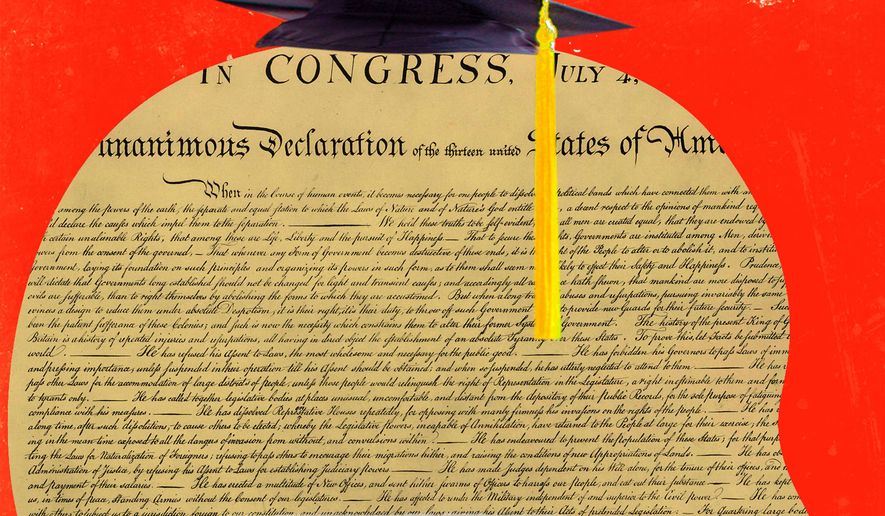
Amid all the bustle, one thing is conspicuously absent: The Declaration of Independence turned 250 this summer, and higher education largely ignored it.
The semiquincentennial should have been a moment for colleges and universities to reflect on the nation’s founding principles. Instead, the response was tepid. A review of campus programming reveals a striking pattern: Only a modest number of institutions organized conferences, symposia, exhibitions or reading series directly focused on the Declaration.
These events were serious, substantive and academically rich — but they were few.
Most campuses did nothing at all.
The silence was not because of a lack of opportunity. Colleges and universities routinely mobilize resources for themed years, social justice initiatives and contemporary policy debates. They create task forces, sponsor lecture series and develop curricular modules around topics they consider important.
Yet when the country reached the 250th anniversary of the document that announced its birth, the vast majority of institutions simply chose not to engage.
The handful of schools that did commemorate the anniversary showed what genuine academic engagement looks like. Yale examined the Declaration’s implications for Indigenous sovereignty. Notre Dame and Catholic University explored natural rights theory and religious liberty.
George Mason University’s law school looked at the various state declarations of rights drafted in 1776. Princeton convened scholars to discuss the Declaration’s relevance to civic education and democratic stability. The University of Virginia displayed original Dunlap broadsides and hosted discussions on the drafting and dissemination of the text.
Ohio University hosted a multiday conference on the Declaration’s promises and legacy. Other institutions — including the University of St. Thomas, the University of Vermont, the University of Southern California, the University of Oxford, Assumption University and St. Johns River State College — also offered programming that directly engaged the document.
These examples show what higher education can do when it chooses to take the nation’s founding seriously, but they also underscore how rare such efforts were.
The neglect reflects a deeper shift in academic culture. Many colleges and universities have moved away from traditional civic commemorations, often viewing founding‑era texts through a narrow interpretive lens that emphasizes exclusion rather than enduring principles.
In some quarters, the Declaration is dismissed as a product of hypocrisy — written by White men who owned slaves, excluded women and denied political rights to many. Critics argue that celebrating the document is celebrating injustice.
These critiques deserve to be heard, but they do not justify ignoring the anniversary of the document that defines the American political tradition.
The Declaration of Independence is not a relic. It articulates the core ideas that shape our constitutional order: equality, inherent rights and government by consent. These concepts remain central to debates about civic education, constitutional interpretation and the responsibilities of institutions and individuals in a free society.
Understanding the Declaration’s limitations does not require dismissing its significance.
President Lincoln understood this better than anyone else. In his Feb. 22, 1861, speech at Philadelphia’s Independence Hall — delivered on the eve of the Civil War — he reminded the nation that the Declaration gave “liberty, not alone to the people of this country, but hope to all the world for all future time.”
That is precisely the kind of insight higher education should be helping students appreciate.
The new academic year gives colleges and universities a chance to reconsider their priorities. The semiquincentennial is not confined to a single day; it is an ongoing period of reflection. Campus communities still have time to engage with the Declaration’s principles and incorporate them into courses, public programming and institutional conversations.
These ideas are not partisan. They are foundational.
The Declaration turned 250 this summer. It is not too late for America’s colleges and universities to remember why that matters.
• Scott Douglas Gerber is Declaration of Independence Center scholar at the University of Mississippi and a fellow at the National Association of Scholars. His most recent book is “The Trafficker.”

Please read our comment policy before commenting.