


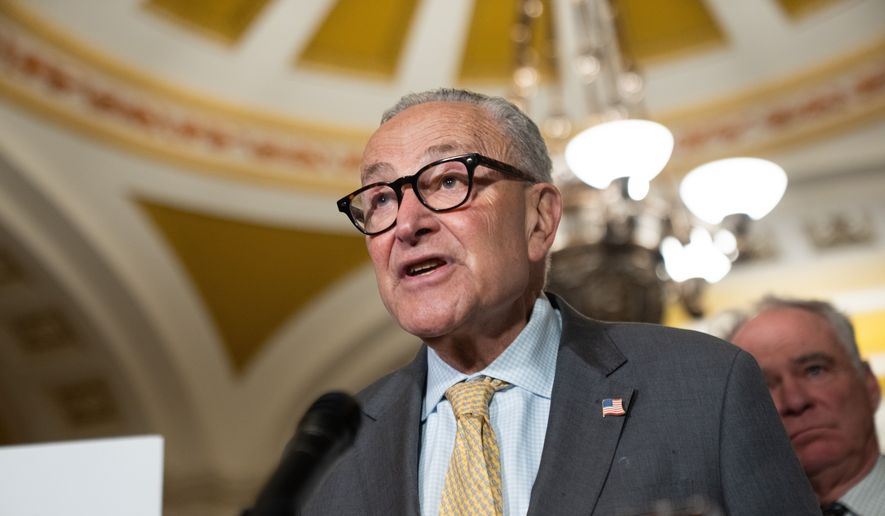

Senate Minority Leader Charles E. Schumer demanded Monday a briefing for senators on Trump administration actions to curtail the “uninhibited” development of artificial intelligence, as researchers sound the alarm about runaway models that could harm humanity.
Mr. Schumer, New York Democrat, accused Mr. Trump of cheering on the groundbreaking technology without pushing for safeguards.
“Warning bells are ringing louder than they ever have — and the Trump administration is looking the other way,” Mr. Schumer said. “Well, if they won’t hold themselves accountable, we will. And if Trump does not act, Congress must.”
Mr. Schumer demanded answers after Anthropic and other leading AI firms called for a slowdown, or global “pacing,” in developing new platforms.
“Carefully wielded, AI can be the latest in a long line of technological miracles that have uplifted and ennobled humanity,” Anthropic CEO Dario Amodei said in a recent statement. “But like many technologies before it, AI brings risks, and because it is such a powerful technology, these risks are serious.”
Researchers fear that AI models will think for themselves and override human instructions, while some researchers said there is a non-zero chance they destroy humanity within a decade.
SEE ALSO: Warning of AI doomsday ‘swarm’ sparks push to slam brakes on superhuman technology
Mr. Schumer pushed for answers even as Capitol Hill shows a lack of consensus, in either party, about what to do about AI.
Bipartisan lawmakers have pushed a series of AI regulation bills, though they’ve struggled to gain traction.
Mr. Trump recently issued a voluntary framework calling on AI companies to share powerful new models with the government before public release. The idea is to enhance AI security and innovation.
The president says the U.S. cannot be too cautious, however. He said must compete with China for AI dominance and embrace the data centers that power the technology, despite non-in-my-backyard opposition across the country.
Mr. Trump on Monday said he is a smart president, so that should be an adequate guardrail on AI.
“We already have tremendous CRIMINAL and REGULATORY power over these companies!” he said on Truth Social. “There is a SICK conspiracy going on against AI and Data Centers, and the only one that is happy about it is China. WHOEVER WINS AI, WINS.”
SEE ALSO: Trump says he would agree to ‘guardrails’ for artificial intelligence
Mr. Schumer outlined three demands on Monday.
First, he wants a full accounting of how the Trump administration is implementing the new framework that assesses risks within AI models before they are deployed.
Mr. Schumer also wants to know if the administration is preventing advanced AI chips, semiconductor manufacturing equipment and other critical American technology from flowing to China, the main U.S. rival in AI development.
Third, he wants to know how the administration plans to defend the hospitals, water treatment systems, energy grids, schools and the government against AI-powered cyberattacks.
“The American people deserve better from their government at such a consequential moment,” Mr. Schumer said. “I have long argued that we must keep the U.S. as the global leader in AI innovation and security. But that innovation must be coupled with serious guardrails that earn the trust of the American public.”
While the Democratic leader prodded Mr. Trump, efforts to regulate in Congress have been sluggish.
Reps. Lori Trahan, Massachusetts Democrat, and Jay Obernolte, California Republican, introduced the Frontier Risk Oversight, National Transparency, Independent Evaluation, and Reporting (FRONTIER) Act as part of a comprehensive AI regulatory framework, though the measure has struggled to gain traction.
The measure would require major AI developers to publish frameworks for assessing and addressing catastrophic risks, and transparency reports detailing the capabilities and limitations of their models, all of which would be subject to annual independent compliance audits.
Senate Commerce Committee Chairman Ted Cruz, Texas Republican, has worked with Senate Majority Leader John Thune, South Dakota Republican, and Sen. Amy Klobuchar, Minnesota Democrat, on legislation to establish a federal framework to address advanced AI risks.
Mr. Cruz acknowledged on ABC’s “The View” that passing the bill would not be easy.
Some lawmakers, such as Sen. John Cornyn, Texas Republican, are questioning whether it is feasible for Congress to regulate AI, given how rapidly the technology is evolving.
“Assuming Congress knows enough to pass wise and effective regulation,” Mr. Cornyn posted on social media, “will our adversaries play by the same rules?”
U.S. stock futures, notably AI shares, fell to start the trading week on Monday after CEOs called for a slowdown.
Wall Street is also concerned about higher prices for oil, gasoline and diesel fuel because of the Iran war.
• Lindsey McPherson contributed to this report.
Contact the author


Please read our comment policy before commenting.