



OPINION:
“Feminism has lied to us all.”
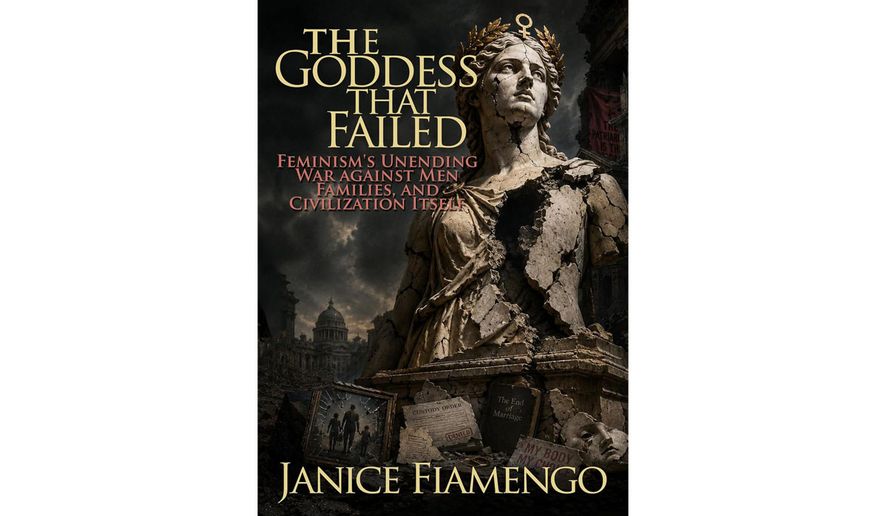
So begins “The Goddess That Failed: Feminism’s Unending War Against Men, Families, and Civilization Itself,” Janice Fiamengo’s new book.
Although Ms. Fiamengo tells readers that the book is not about her, it is worth noting that the Canadian author is a former self-proclaimed feminist and a former University of Ottawa professor who has been protested and “canceled” for lectures in which she dared to expose the dangerous cult that is feminism.
For that is what feminism is, Ms. Fiamengo says. The ideology “has many similarities to a religion. It has an origin story, an account of original sin and faith in the redemptive power of the feminine.”
Even more concerning is its slavish dedication to its socialistic underpinnings. In Chapter 3, “How Universities Radicalized Young Women,” Ms. Fiamengo writes, “Anyone who still thinks that women’s studies started out with the moderate aim of introducing women’s history and perspectives into a primarily male educational environment will be quickly disabused of that notion by glancing at the intemperate, reductionist, anti-scientific, hate-filled agit-prop theories that made up the entirety of” many Second Wave, or 1960s-to-1980s, feminist university courses’ curricula.
One required text: Friedrich Engels’ 1884 book, “The Origin of the Family, Private Property and the State,” in which Engels wrote, “In the family, [the man] is the bourgeois; the wife represents the proletariat.”
Ms. Fiamengo also discusses editor Alice Ginsberg’s introduction to “The Evolution of American Women’s Studies,” in which Ms. Ginsberg derides a 1992 fundraising letter by Pat Robertson.
The evangelist wrote, “The feminist agenda is not about equal rights for women. It is about a socialist, anti-family political movement that encourages women to leave their husbands, kill their children, practice witchcraft, destroy capitalism and become lesbians.”
Part of this 34-year-old excerpt reads as eerily prescient, given the recent mistrial of Lindsay Clancy, the Massachusetts mother who admitted killing her three young children in 2023.
The outpouring of public support that Ms. Clancy has received — the sort that has followed most high-profile cases of women who have admitted to or been suspected of killing their children — reveals feminism’s violent core.
“This is how it is when mothers kill their children,” Ms. Fiamengo writes in Chapter 11, “Mothers Who Kill.” “News reports minimize her agency, inviting readers to empathize with a mother’s suffering and to see her act not as evidence of selfishness or rage, but as an expression of pain. A murderous father is never treated in such a manner.”
Ms. Fiamengo points to a study by criminology professors James Fox and Emma Fridel in which the researchers found that two-thirds of infanticides in the U.S. are perpetrated by women, and 80% of homicides in which the victim is younger than 1 year old are committed by women.
Perhaps this has something to do with feminism’s long-perpetuated core tenet, made famous in recent decades by Betty Friedan’s “The Feminine Mystique” in 1963: that motherhood and domesticity are forms of slavery, and children and husbands are a kind of relentless master.
Friedan — who, according to Ms. Fiamengo, had hired help to take care of her own children and did very little housework herself — urged women to find “a self-chosen purpose” outside marriage and family because domestic work was “monotonous, endless, required no mental concentration, gave no hope of advancement or recognition, was sometimes senseless and controlled by the needs of others.”
This led, Friedan said, to a form of mental derangement.
Ms. Fiamengo’s book also touches on men in women’s sports, an area of rare agreement between ardent feminists and conservatives.
In Chapter 13, “Trans and Other Feminist Asymmetries,” she discusses the case of fencer Stephanie Turner, who in 2025 refused to compete against a biological male in a Maryland fencing tournament and received praise from a variety of groups.
Yet supporting such moves in athletics is hypocritical, according to Ms. Fiamengo. In the 1970s and 1980s, after a federal judge’s ruling in Ludtke v. Kuhn, female reporters began entering male locker rooms.
“In the pre-trans 1970s, most feminists were unfazed by the prospect of lone women working amidst high-testosterone and near-naked men,” Ms. Fiamengo writes. “Activists saw no disadvantage to women in minimizing the facts of sex difference.”
In essence, feminists cannot have it both ways now that some biological men seek access to women’s spaces.
Much more is packed into this relatively brief book, but suffice to say that “The Goddess That Failed” delivers on its promise to unveil “The Big Lie of Feminism.”
• Anath Hartmann is deputy commentary editor for The Washington Times.
• • •
The Goddess That Failed: Feminism’s Unending War Against Men, Families, and Civilization Itself
World Encounter Institute/New English Review Press, $39.99, 215 pages
Follow the author


Please read our comment policy before commenting.