



The U.S. military moved a step closer this week to acquiring a significant fleet of artificial intelligence-enabled, pilotless fighter jets to fly alongside human pilots in combat.
Secretary of the Air Force Troy Meink announced at a major defense conference in Maryland this week that the service branch intends to purchase roughly 1,000 of the aircraft by 2032.
The uncrewed jets fall into two categories — the Collaborative Combat Aircraft (CCA) and the Massed Modular Aircraft (MMA) — and major U.S. defense manufacturers are beginning to roll them off production lines.
The key aspects of both programs: The aircraft are leveraging AI to fly themselves and are significantly less expensive than larger, manned fighter jet platforms such as the F-35.
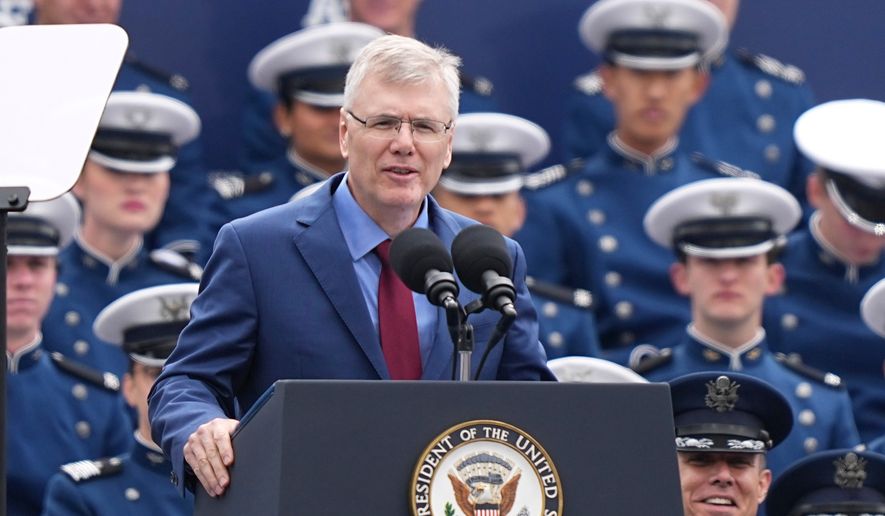
“When we pair manned aircraft with lower-cost autonomous systems, we will be able to unlock combat power at scale,” Mr. Meink said Monday in remarks at the Air and Space Forces Association’s annual Air, Space and Cyber conference at National Harbor in Maryland.
“We will be dramatically increasing our combat power by adding large numbers of highly autonomous systems,” the Air Force secretary said in a keynote address to the conference.
During his remarks, Mr. Meink announced the official names of the CCA: the FQ-42 Vengeance and FQ-44 Fury. He indicated that “at least 500” of the 1,000 drones the Air Force intends to purchase and have airborne by 2032 will consist of either of those two models.
The service in June announced that two California-based companies, General Atomics and Anduril Industries, had been awarded contracts to build the uncrewed jets. Anduril is building the FQ-44 Fury, and General Atomics is building the FQ-42 Vengeance.
“These aircraft went from contract award to first flight in 18 months or earlier,” Mr. Meink said in his remarks this week. “That’s almost unheard of in aircraft development.”
Both are part of the push by the Air Force to build what the Air Force secretary called “cost-effective combat power.” The CCA jets are built specifically to be more easily replaced, what the military calls attritable.
Representatives from Anduril told reporters at this week’s conference that the cost of a single FQ-44 Fury will be well below $20 million. That’s significantly less than the roughly $100 million cost of an F-35 fighter jet, the dominant manned system, whose manufacture is led by Lockheed Martin and includes participation from Northrop Grumman and BAE Systems.
The CCA systems are significantly smaller than major manned fighter jets, and making the uncrewed systems cheaply isn’t just baked into the design.
General Atomics and Anduril are still in competition as suppliers for the new aircraft. Pentagon officials say the competition will continue for who can produce the CCA at scale and deliver it at an acceptable cost for the Air Force.
An eye-opening twist at this week’s conference saw other defense industry players, including Lockheed and Kratos Defense, showing off their own CCA model designs, although General Atomics and Anduril remain the only two companies currently contracted by the Pentagon to manufacture the uncrewed jets.
The Air Force has yet to say how many of the 500 CCAs to be purchased will be from General Atomics and how many will be from Anduril. Representatives of both companies said this week they are already producing the aircraft and capable of making many more in a year than they expect the military to order.
C. Mark Brinkley, a spokesman for General Atomics, told Threat Status at The Washington Times that the company “could build all 500 of those, if asked.”
A representative from Anduril, meanwhile, said the company’s Ohio-based Arsenal 1 facility has already started production meant to reach “150 per year.”
Mr. Meink told reporters at the conference that the design of the CCA is meant to let manufacturers build the systems faster than the Pentagon is prepared to purchase them. “The ability to bring low-cost mass is a driver here,” the Air Force secretary said.
A key upcoming test will center on whether the uncrewed fighter jets can be controlled by a pilot in a crewed jet flying alongside a CCA — something both General Atomics and Anduril say they’ve taken steps toward in recent months.
Mr. Meink emphasized that advanced AI capability is critical to the future of the U.S. Air Force. “Autonomy is one of, if not the, key technology enabling cost-effective combat power,” he said.
While the Air Force secretary touted the U.S. as a leader in AI for warfare, he suggested that adversaries are close behind. “It is up to us to leverage those advantages,” he said. “What we’re going to be judged on is how quickly we’re going to operationalize them.”
General Atomics has long been a leader in major large-scale drone production, having led the defense industry with the production of Predator and Reaper drones in the post-9/11 era.
The company says it has already conducted tests where pre-CCA drone systems were “successfully controlled in flight by human pilots of both F-22 and F-35 fighters.”
“Those demos were awesome and directly support our CCA work,” Mr. Brinkley told The Times.
Where General Atomics has decades of experience and claims to have “invented the drone strike 25 years ago with the Predator,” Anduril is a new entrant to the defense industrial landscape.
Delivering the FQ-44 Fury will be a big test of Anduril’s ability to mass-produce a product. The company says its Ohio facility is meant to “hyperscale” production, which will be critical.
Anduril has already delivered one of the uncrewed jets to the Air Force this year.
The Air Force’s Experimental Operations Unit (EOU) is currently conducting test flights of the CCA and trying to build references and tactics for the rest of the force to use the new platforms.
“They’ve already started flying in formation alongside 5th-Gen fighters,” according to Anduril Senior Vice President of Engineering Jason Levin.
He cited the F-35 as an example during a roundtable discussion with reporters at this week’s conference.
Air Force Lt. Col. Lyndon Bartlett, the director of operations for the experimental unit, emphasized during a panel at the conference how easy the FQ-44 Fury is to maintain.
His air crews were able to carry out maintenance on the uncrewed aircraft with a single person, he said.
“We’re going to learn a lot over the next couple years,” Lt. Col. Bartlett said. “Most of our experimentation has been done on sortie generation, how easy they are to maintain, how small a footprint could be, and we’ve been pleasantly surprised.”
He described “mission autonomy” as the “secret sauce” for whether or not the CCA will be a turning point for the military.
While Lt. Col. Bartlett said the software isn’t quite ready yet, he stressed that his focus is on getting the Air Force prepared for when the new systems become a reality.
“As they make these things,” he said, “from the war fighter-side, we see it as our job right now that beyond the technical specifications of it, we’re experimenting with the more complex things like logistics and C2 [command and control].”
Contact the author


Please read our comment policy before commenting.