


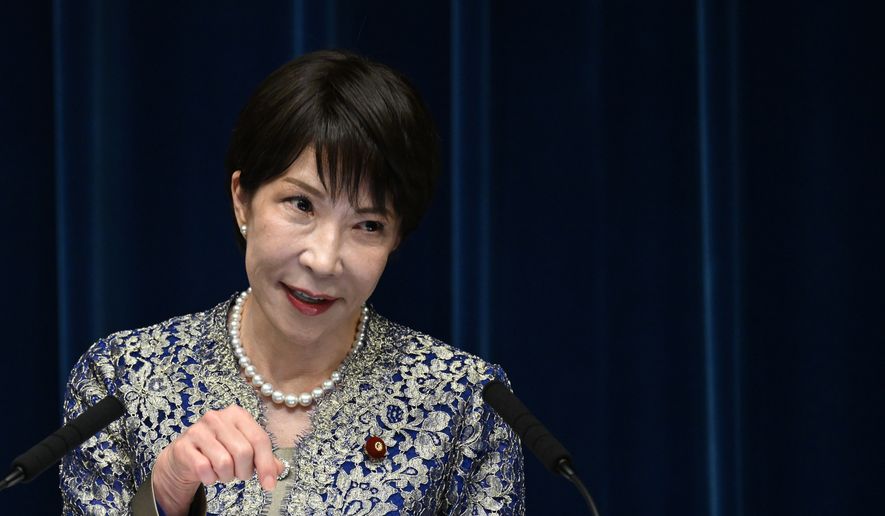

SEOUL, South Korea — Sanae Takaichi is on a winning streak. The hawkish Japanese prime minister has seen her political opposition in Tokyo implode while her conservative party has chalked up a key victory on the strategic island of Okinawa.
The 65-year-old’s domestic rise has unfolded against a worrisome international backdrop for Japan, as both China and Russia have ramped up pressure on Tokyo with a range of cross-domain hybrid tactics.
And though Ms. Takaichi appears to have struck up a good relationship with U.S. President Trump, his focus on the Middle East and the Americas is providing fodder for those who fear the U.S. is losing focus on the Indo-Pacific.
All change in Okinawa
Last weekend, Okinawa’s long-serving governor, Denny Tamaki, lost the gubernatorial election to political newcomer Genta Koja. Mr. Koja, who was backed by Ms. Takaichi, seized a decisive 59% of the vote.
It was an especially sweet win for Ms. Takaichi’s Liberal Democratic Party, long locked out of power on the island. Mr. Tamaki won the governorship of Okinawa in 2018 and held it for two successive terms, during which he sought the downsizing or removal of U.S. bases from the island.
The most recent lightning rod on the island is the planned relocation of U.S. Marine Corps Air Base Futenma from the center of Okinawa’s Ginowan City. Mr. Tamaki opposed the relocation of what has been dubbed “the most dangerous base in the world” due to its city center location: He wants it removed from the island altogether.
That would be an issue for both Japan and U.S. Pacific Command, given Okinawa’s strategic siting.
It is the main island of the Ryukyu Island Chain, which stretches south of the Japanese main islands, to just 70 miles from Taiwan, dominating key straits.
Those are straits that China’s People’s Liberation Army Navy frequently traverses to enter the blue-water Pacific, and would likely become battlegrounds if the PLAN was ever ordered to blockade, surround or assault Taiwan.
In that sense, many see Mr. Koja’s victory as a blow to China.
After Ms. Takaichi told the Diet last November that an attack on Taiwan would represent an “existential threat” to Japan — code for activating the Self Defense Force — an infuriated Beijing has demanded she retract her comments. She has not.
Beijing retaliated by cutting Chinese tourism to Japan, banning Japanese performers and halting Japanese seafood imports.
Chinese media and academia have launched an information campaign questioning Japanese sovereignty over the Ryukyus, which were invaded by samurai in the 17th century and formally annexed by Tokyo in 1879.
It is fair to say that Okinawan soil has provided fertile growth for both anti-Tokyo and anti-American sentiment.
Its strategic location was born out in savage fighting in 1945. Months of Japanese-U.S. combat ended with some 150,000 Okinawans dead — a higher death toll than that of the atomic bombings.
Okinawa was controlled by the U.S. until 1972, and even today, hosts over half of the 50,000-strong U.S. Forces Japan. Occasional crimes by GIs, noisy U.S. bases and related pollution have all become sources of discontent.
Takaichi clears house
The weekend’s electoral results in Okinawa followed another win for Ms. Takaichi, closer to home. On Wednesday, the prime minister’s biggest obstacle in the Diet cratered when the coalition of the Constitutional Democratic Party of Japan and the Buddhist party Komeito officially split.
The breakup expands the already extensive political maneuvering room Ms. Takaichi has enjoyed since taking office in October.
Komeito had previously been in a coalition with Ms. Takaichi’s Liberal Democratic Party. It exited that alliance and partnered with the CDPJ in January.
The Buddhist machine’s defection was seen as a protest against Ms. Takaichi, who represents the wing of the LDP that has pushed for a more muscular, less pacifist approach to Japanese security.
But Ms. Takaichi seems to have suffered little political fallout from Komeito’s defection from her ruling coalition. Instead, she has cemented her leadership with a February 2025 snap election in which she confounded the opposition — and her critics — by earning the biggest Lower House election win, ever.
Ms. Takaichi needs all the resolve she can muster, as China has been joined by Russia in probing Tokyo’s resolve.
In August, Russian President Vladimir Putin made his first-ever visit to the disputed Kuril Islands northeast of Japan. Then, Russia conducted missile drills in the area, and also erected a World War II victory statue that infuriated Ms. Takaichi.
Experts reckon Moscow aims to please economic ally China while fortifying nationalism at home with a low-risk strategy: putting the boot into peaceable Japan, a target that, traditionally, was unlikely to retaliate.
So far, Japan has restricted its responses to provocations from both Russia and China to angry diplomatic rhetoric.
But Tokyo, mindful of both China and North Korea and shocked by the Russian invasion of Ukraine, is engaged in an aggressive build-out of defense capabilities — a shift in Japanese policy driven in part by concerns about the reliability of Washington assurances.
“China and Russia are clearly exploiting the lack of U.S. leadership to probe into areas of vulnerability concerning Japan and elsewhere,” said Paul DeVries, Japan-based author of “Remembering Santayana: The Lessons Unlearnt from the War Against Japan.”
“Japan is responding to the present lack of clarity … by openly debating greater levels of defense capability,” the author said.
Japan is acquiring U.S. Tomahawk cruise missiles and installing a new, drone-based defensive net for the Ryukyus dubbed SHIELD (Synchronized, Hybrid, Integrated and Enhanced Littoral Defense).
SHIELD centers around a “drone wall” of thousands of aerial, surface and sub-surface unmanned vehicles. It is expected to go operational in 2028.
Defense Minister Sanjuro Koizumi has also raised the need for a national debate on a previously taboo subject: nuclear arms.
The American question
Back in Okinawa, Mr. Koja’s governorship looks set to ensure continuance of U.S. basing.
“The victory of Koja over Tamaki can be seen in this context of uncertainty, in the inability of Tamaki to make substantive progress on basing issues over the past eight years, and a general sense of ’base fatigue,’” said Mr. DeVries “A further appeal of Koja is that a central government-aligned governor will be considerably more successful in bringing economic benefits to the prefecture.”
Even so, U.S. bases remain sensitive.
A survey conducted by the national Mainichi Daily newspaper found 45% of Okinawans support or accept the relocation of the Futenma base, but 30% are opposed and 25% undecided.
“Even if the top leader of the prefectural government changes, the base issue has not receded into the background,” editorialized the Mainichi. “The Takaichi administration must not interpret the public will for its own convenience. It must show an attitude of carefully building dialogue with Okinawa residents.”
Contact the author


Please read our comment policy before commenting.