


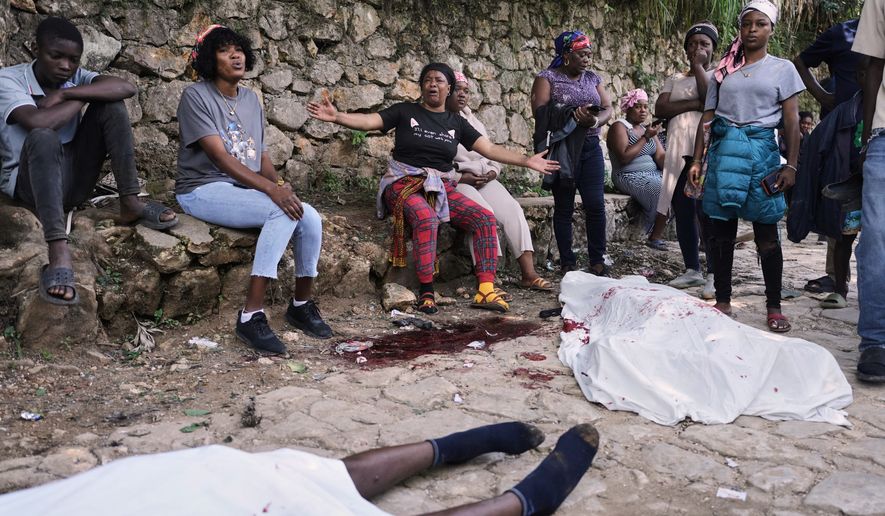

SAN JUAN, Puerto Rico — A human rights group in Haiti has published a report that reveals new details about one of the country’s biggest massacres in recent years and unveils security holes as authorities struggle to contain violent gangs.
The National Human Rights Defense Network said its report is backed by interviews with judges, police officials, armed civilians, the former head of a police station and more than 100 victims and their relatives.
The report provides the most complete account to date of the attacks that gangs recently launched on the once peaceful farming community of Kenscoff near Port-au-Prince, with at least 164 people killed, more than 70 kidnapped and dozens missing.
Strengthening security could have limited killings
The human rights group asserted in its report released Wednesday that a “timely strengthening” of security could have prevented or limited the killings.
“This lack of response is all the more concerning given that available information indicated the existence of a serious and imminent threat to the population,” it said.
A spokesperson for Haiti’s National Police did not immediately respond to a request for comment on Thursday.
The human rights group noted that Kenscoff remained vulnerable after an attack in January 2025 left at least 139 people dead or missing.
“Serious institutional failures that contributed to the perpetration of this massacre had been highlighted. Unsurprisingly, security was never truly restored in the town,” the group said.
It asserted that soldiers and special police units assigned to strategic locations in Kenscoff after the 2025 attack were recalled “for reasons that remain completely unknown.”
Security personnel had been cut
Overall, security personnel in the area were reduced by 60%, according to the report.
By July of this year, gangs attacked Kenscoff again, pulling back only to organize an even bigger attack in late August. A week before the massacre began, an armored vehicle was moved given a lack of personnel, “leaving a new opening for armed terrorist bandits and further weakening the city,” the report found.
Requests from the former head of the Kenscoff police station for two additional armored trucks were ignored prior to the attack, it added.
Days before the massacre, the group said that “armed terrorists” used surveillance drones to track movements and positions of law enforcement. They deployed scouts to the area, then infiltrated it and began monitoring roads, “identifying individuals likely to pose a threat to them.”
The human rights group said government officials told them they did not hear plans about the attack but did notice drones flying over the city hours before it began.
Tree trunks used to block roads
Another warning sign: tree trunks were used to block several roads hours before the massacre.
One of the first victims was a 21-year-old man ordered to carry stones to block a road before he was shot in the head, the report stated.
Among those killed were nearly two dozen people ages 65 to 90; 36 women; and seven children, including a 4-year-old. Victims included farmers, two pastors and a school principal who was beheaded, according to the report.
One man who worked at the Kenscoff police station had his eyes gouged and arms torn off, the report found.
Gang members killed people sheltered at a school and a church, using bodies as barricades as police and civilians battled them for several hours.
The report stated that armed men staged several attacks before entering Kenscoff to lure away police and weaken their defenses.
The human rights group identified the victims and the manner in which they were killed as it called on the government to provide financial, medical and psychological aid to survivors and their families.
Report criticizes police passivity
Between January and August this year, security operations had managed to reduce violence in Kenscoff by 66% prior to the attack, according to the nonprofit Armed Conflict Location & Event Data.
But the report criticized what it called police passivity and the “disdainful disinterest” of high-ranking police officers to protect the people of Kenscoff. It also questioned why a new U.N.-backed gang suppression force “remains barely perceptible on the ground, and its contribution to security operations remains difficult to identify.”
A spokesperson for the force did not immediately respond to a request for comment on Thursday evening.
In late August, the force said it was relieving Haitian police in certain areas to free up units so they could strengthen the protection of communities in Kenscoff.
The human rights group noted that another armed attack was launched within Kenscoff in mid-September.
Kenscoff’s mayor issued a statement on Tuesday warning that drones continued to fly over his community and that disturbing videos and messages are being posted online as threats.
“The convergence of these various signals must not be trivialized or ignored under any circumstances,” he wrote.
___
Associated Press reporter Evens Sanon in Port-au-Prince, Haiti, contributed.

Please read our comment policy before commenting.