


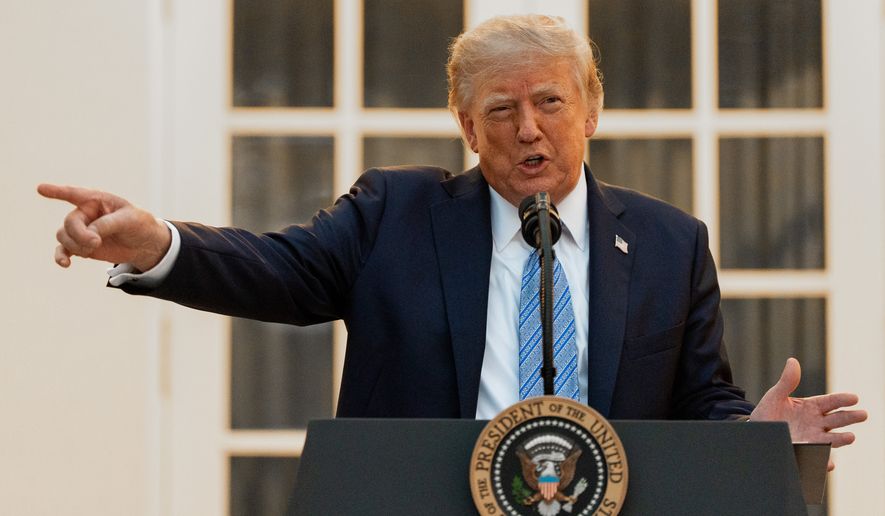

President Trump announced he has banned CNN, MSNOW and Politico from covering the White House, saying they’ve been reporting “fake news.”
The ban went into effect Friday afternoon, Mr. Trump said in a Truth Social post.
Mr. Trump said the ban was “a result of their constant reporting Fake News!”
He added, “Media outlets shouldn’t be able to constantly write or report fiction and lies when they’re covering the President of the United States, the Trump administration or the United States of America.”
The three outlets did not respond to requests for comment. CNN’s team remains at the White House working as if it were a normal Friday afternoon, CNN reporter Brian Stelter said on air.
Mr. Trump has challenged legacy news organizations before, with varying degrees of success, including successfully barring Associated Press reporters from the small press pool spaces at the White House and on Air Force One.
It wasn’t immediately clear how Mr. Trump would enforce the ban on CNN, MSNOW and Politico. Legal challenges are expected from all three outlets plus the White House Correspondents Association.
Jameel Jaffer, executive director of the Knight First Amendment Institute at Columbia University, said the ban runs afoul of the U.S. Constitution.
“If President Trump means to expel these news organizations from the White House press pool, his action is doubly unconstitutional because the press pool is a ’public forum’ under the First Amendment, which means the president can’t exclude journalists from it on the basis of their viewpoints,” he said.
Rep. Frank Pallone, a New Jersey Democrat and frequent Trump critic, called the president’s action “censorship.”
“If Trump thinks banning media outlets from the White House will make this presidency seem less like a failure, he’s delusional,” he wrote on X. “They’ll see right through his censorship.”
Later Friday, Mr. Trump doubled down, saying the three outlets intentionally report false news about his administration.
“You need a fair press and an honest press,” Mr. Trump said at an Oval Office event. “You need a fair press and an honest press.”
He said the news organizations he ousted “purposely write negative news” to damage his administration and Republicans in general.
“You know how fake their reporting is. It’s one-sided. It’s never good,” he said.
Arkansas Gov. Sarah Huckabee Sanders, who was at the Oval Office event touting lower prescription drug prices, vouched for Mr. Trump banning news outlets.
“It’s hard to argue against a free press when you are literally standing in the Oval Office asking questions,” Ms. Sanders told reporters. “You’re standing here asking those questions. I think the president is right to support the First Amendment, but he’s also right to ask you to be honest and fair. That’s not unreasonable.”
Ms. Sanders served as press secretary in Mr. Trump’s first term.
Mr. Trump said he didn’t know if the ban would survive a court challenge, but calling out the biased reporting was important.
He also threatened to soon ban “other fake news media outlets.”
The White House presents a thorny situation for the First Amendment, pitting the press’s claims of access against the chief executive and a building that is both his residence and his office — and his own First Amendment speech rights.
A president has the right to decide to whom he grants interviews and answers questions, but courts have held he cannot retaliate against specific outlets over their viewpoints, which includes their news coverage.
That became an issue last year when the White House barred Associated Press journalists from the Oval Office, Air Force One and other limited-access spaces because the wire service refused to drop “Gulf of Mexico” from its style guide after Mr. Trump changed the body of water’s name to “Gulf of America.”
Federal courts ruled he went too far in targeting the outlet specifically.
But a later White House policy demoting all wire services from guaranteed access and treating all of them as if they were similar to major newspapers has been allowed to stand by a federal appeals court.
The Pentagon has also been involved in a fight over access.
The Defense Department initially barred journalists who would not agree to restrictions on coverage from workspace at the Pentagon.
A judge blocked that policy.
The department then came up with a broader restriction that restricted all journalists’ access to the Pentagon unless they are escorted.
An appeals court has said that policy appears to survive constitutional scrutiny, and has allowed it to remain in effect while the case develops.
In the first Trump administration, the White House yanked the credential of Brian Karen, a Playboy magazine correspondent, after he traded insults with Sebastian Gorka, then a presidential aide, in the White House Rose Garden. A judge later ordered the White House to reinstate Mr. Karem’s credential.
Mr. Trump has also sued outlets over their coverage, including a $10 billion lawsuit against The Wall Street Journal over reporting on a 2003 birthday card he purportedly sent to disgraced sex offender Jeffrey Epstein, and a $15 billion defamation case against The New York Times and four of its reporters alleging a pattern of malicious reporting.
The initial complaints in both cases were tossed, but the judges allowed Mr. Trump to file new versions that are still pending.
Previously, he filed a $20 billion lawsuit against CBS, which resulted in its parent company Paramount agreeing to a $16 million settlement. And ABC News settled a defamation lawsuit with its parent company, Walt Disney Company, agreeing to donate $15 million to Trump’s future presidential library foundation and pay $1 million in legal fees.

Please read our comment policy before commenting.