



OPINION:
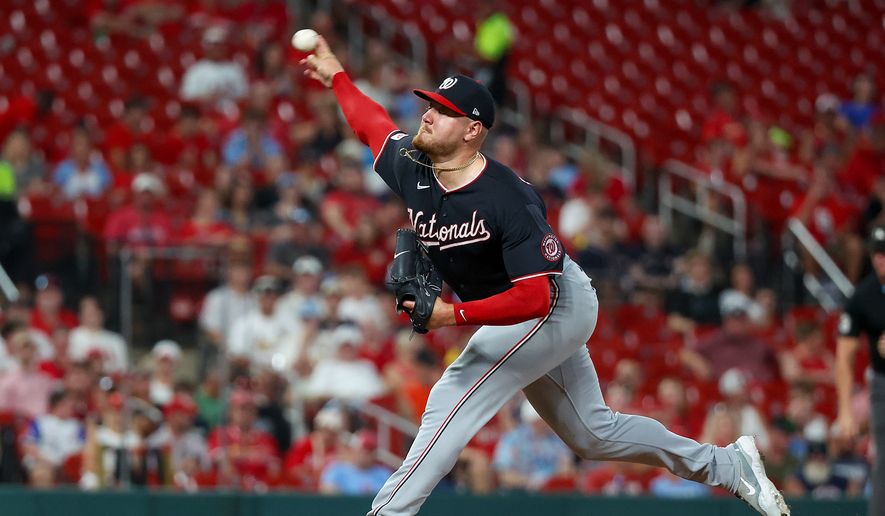
Washington Nationals ace Cade Cavalli last week signed what one of baseball’s most aggressive agents might call a “snuff contract” — a franchise-friendly deal that could dramatically undercut future earnings for the player.
“Great young players are getting what I call ‘snuff contracts,’” super agent Scott Boras told the Los Angeles Times in 2019. “And a snuff contract is that they’re trying to snuff out the market. They know the player is a great player, and he’s exhibited very little performance. So they’re coming to him at 20 and 21, and ’I’m going to snuff out your ability to move, to go anywhere, to do anything, and … I’m going to pay you maybe 40 cents on the dollar to do it.’”
Cavalli is no 21-year-old — he turned 28 in August. But since Washington drafted him in the first round in 2020, he hasn’t had much of a major league track record to invest in — really, just one full year. But it has been an impressive enough 2026 season so far — a 13-5 record with a 3.02 ERA and 200 strikeouts — has been impressive enough to convince the Nationals that they have an ace who will only cost more money in the future. He would then likely wind up on a familiar path for this franchise — traded before he left for free agency to reap the rewards of the market.
So the Nationals convinced Cavalli to take a deal that — if he is the pitcher they believe he is — will pay him less than he would earn through three years of salary arbitration and two years of free agency. The four-year deal includes a $47 million contract extension with a club option for the following year.
According to The Athletic, this is the year-by-year breakdown of the contract: a $4 million signing bonus, $4 million in 2027, $7 million in 2028, $10 million in 2029, $20 million in 2030, then a $25 million club option in 2031 with a $2 million buyout. He also has escalators written into the contract that could pay him up to $5 million more in 2030 and $7.5 million more in 2031 depending on Cy Young Award finishes in 2029 and 2030.
Cavalli may have shortchanged himself. But after a career held up by Tommy John surgery and other health problems, he likely realized no one is promised future earnings and strong seasons, like he had this year.
Cavalii traveled a long road to arrive here, and there is nothing wrong with embracing security.
But this deal is a home run for Nationals President Paul Toboni, his front office, and the owners, the Lerner family, who have been rightfully lambasted for their lack of spending and a willingness to watch talented players leave for greener pastures.
They took victory laps — rightfully so — in a press release.
“We couldn’t be more excited to have Cade with us for the long haul,” Toboni said. “We’ve seen firsthand the work he’s put in, the challenges he’s overcome and the way he continues to grow as a pitcher, a person and a leader. Our organization has tremendous belief in Cade, and, more importantly, we’re incredibly proud to have him represent the Washington Nationals for years to come. We’re so excited to watch the next chapter of his career unfold here with us.”
From Mark Lerner, managing principal owner: “We are thrilled that Cade and his family will remain part of the Washington Nationals for years to come. Since we drafted Cade in 2020, we’ve been continually impressed with who he is as a baseball player and as a human being. He’s shown that he not only has the talent to excel as a Major Leaguer, but he also possesses the high character and leadership qualities that make him a beloved member of our clubhouse and in the community.”
That “we” when it came to drafting Cavalli was a little generous. It was former general manager Mike Rizzo who selected Cavalli.
But I can understand why Mark Lerner would want to strut his stuff. This deal is far better than the last contract extension the family made with a pitcher.
That was Mark’s father, the late Ted Lerner, who, two months after Stephen Strasburg’s MVP performance in the 2019 World Series, made a deal behind Rizzo’s back with Boras, Strasburg’s agent — a seven-year, $245 million contract extension.
Strasburg would only pitch in eight games over the next three seasons and then never again, his career finished by injuries. But they have been paying Strasburg all those years. The contract ends this season with the final $35 million payout.
Now that was a snuff contract — for the Nationals. The owners closed their wallets after that, fielding low-budget payrolls ever since.
The money off the books from the Strasburg contract should put the Lerners in position to spend some money. Those Nationals fans remaining will be watching to see if they do. The players who might be targets for extensions will cost a lot more than Cavalli did.
Don’t expect any snuff contract deals with slugger James Wood, who won’t be eligible for free agency until after the 2030 season. He’s a Boras client.
The one to watch is their other All-Star, infielder CJ Abrams, who is eighth in the National League with 31 home runs and fifth with 99 RBIS. He also has 33 stolen bases, putting him in the 30-30 club for home runs and stolen bases.
He is not a Boras client. Instead, he is represented by Roc Nation Sports. Unlike Wood, Abrams may be signable.
The decision to sign or trade him will likely come this winter, as he still has two years of club control, with free agency after the 2028 season.
This is the winter of his value if he is to be dealt, although the uncertainty of a shutdown due to the labor dispute between owners and players may create chaos for the trade market.
• You can hear Thom Loverro on “The Kevin Sheehan Show” podcast.
Follow the author


Please read our comment policy before commenting.