


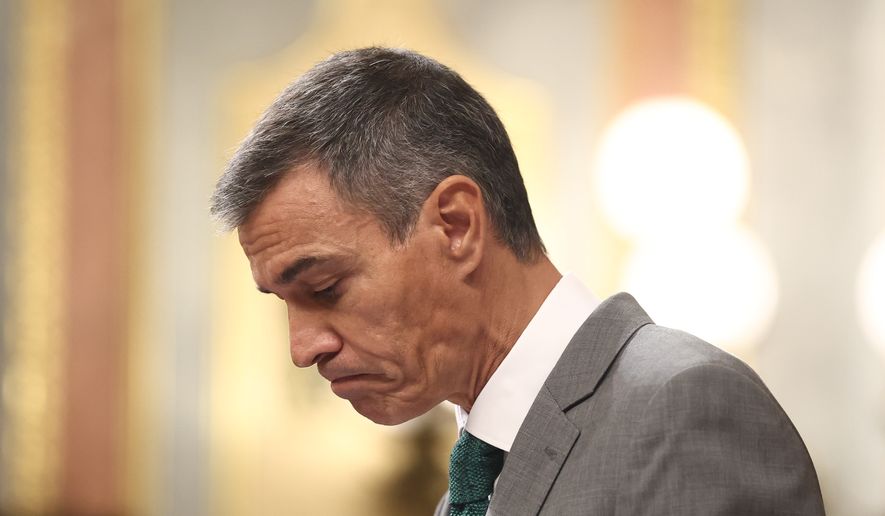

MADRID — A day after tens of thousands of Spaniards protested the government’s handling of the Ceuta border crisis, Prime Minister Pedro Sanchez struggled to field lawmakers’ questions about the matter, including what role Morocco played in the deadly mass crossing in July.
Five weeks after the incident, it remains unclear how 72,000 people were able to stream across the border shared by the Spanish exclave in North Africa and Morocco in the first place. While rejecting suggestions that Moroccan authorities helped orchestrate the incident, Mr. Sanchez said Moroccan police “allowed the border to be crossed.”
Mr. Sanchez said his government would release key reports about the border breach, but did not say when they would be made public or what they would entail.
People were interested in these podcasts
He also elevated the official death toll from the event to 141 people, up significantly from the most-recent estimate of a total 96 in Spain and Morocco, provided by authorities in Ceuta and Morocco’s National Human Rights Council. He cited the revised figure twice, but neither his office nor the interior ministry could say how it had been tallied when contacted by The Associated Press.
Mr. Sanchez is facing mounting scrutiny amid a prolonged humanitarian crisis in Ceuta, where the flood of thousands of migrants has angered residents in the tiny community, which is ill-equipped to handle such an influx.
Top government officials have at times provided conflicting information about the event. Last week, the defense ministry said Spain’s intelligence agency provided prior warning of the border rush, while the interior ministry and others said it had not.
Spaniards on Wednesday joined protests in support of Ceuta, demanding solutions to the city’s ongoing tensions and calling for Mr. Sanchez to step down. The crisis is shaping up to be one of the most serious threats his government has faced. Mr. Sanchez faced a barrage of questions on Thursday from lawmakers after his opening address alongside calls for early elections.
“The people of Ceuta have been without normality, without security and without answers for over a month. And we Spaniards are at the same time perplexed and outraged in the face of the violation of our territorial integrity,” said opposition leader Alberto Núnez Feijoo of the center-right Popular Party.
“Why are you afraid of Morocco?” Mr. Feijoo asked.
Most of the migrants who crossed into Ceuta in late July returned to neighboring Morocco or were ushered back within days. But around 5,000 people, including 1,200 minors, remain in the city weeks later, according to the national government. Ceuta’s local government cites a higher figure of about 9,000 people.
Mr. Sanchez, who faces an election next year, has said a misinterpretation of a Supreme Court ruling and disinformation on social media encouraged people to rush the border.
The prime minister has also accused social media accounts linked to Russia and Israel and right-wing groups of exploiting and amplifying the Ceuta crisis after it happened on July 30 and 31. Israel and Russia have denied the claim.
Mr. Sanchez also maintained there was no evidence Morocco’s government was behind the mass crossing.
Mr. Sanchez acknowledged that for a 10-hour period on July 30 when migrant arrivals peaked, Morocco’s Gendarmerie police “allowed the border to be crossed” in Ceuta, but said the same force effectively took control of it later.
As questions have grown on the right and left in Spain about Morocco’s role in the event, the Spanish leader said he would wait until there was solid evidence.
He condemned comments from two Moroccan ministers questioning the sovereignty of Ceuta and Melilla, Spain’s other territory in North Africa.
The two exclaves have the European Union’s only land borders with Africa.

Please read our comment policy before commenting.