



OPINION:
Some people who visit a concentration camp expect to feel anger, sadness and confusion. Although I understand those expectations, each visit leaves me feeling strength, resilience and a deep sense of resistance.
Each time I go to Auschwitz, I am confronted with the horror of the Nazi killing machine. Each time I remember the willpower and strength of those who survived, I see a space honoring those who died at the hands of evil.
I see the forces of nature in tension with the remnants of good and evil at Auschwitz.
People were interested in these podcasts
Two years ago, I accompanied a group of students on a trip to the death camp. As a visitor, I find it difficult to juxtapose the haunting beauty of Birkenau and the remnants of Nazi destruction.
The expectations people have when they visit a concentration camp are at odds with the reality. Where people expect a space that reflects horror, nature often intervenes, creating a landscape that contradicts history.
I knew I was walking on grounds where 1.1 million people were murdered, but I acknowledged and listened to the stillness that surrounded Auschwitz.
Seeing lush grass, free-roaming animals and the beauty of the woods, I found it hard to comprehend that more than 80 years ago, Nazis attempted to tame the landscape to control prisoners and eradicate those they deemed subhuman.
Although our guide told us that “nature always wins,” students questioned the present-day beauty around us. We left that day angry at those who participated in such atrocities, confused that such acts could have been committed and humbled because we now knew part of the story.
Eva Mozes Kor inspired my first trip to Poland. In 2016, after watching the documentary about her, “Forgiving Mengele,” I applied for a teacher scholarship sponsored by CANDLES Holocaust Museum and Education Center in Terre Haute, Indiana.
In Poland, I met Eva, a survivor who defied everything.
Deported from Portz, Romania, to Auschwitz in 1944, Eva and her twin sister, Miriam, were the only survivors of their immediate family. Chief SS physician Josef Mengele conducted horrendous medical experiments on thousands of twins, including Eva and Miriam.
In her book, “Surviving the Angel of Death,” Eva recounts what she and Miriam endured. One injection landed Eva in the “infirmary,” where she heard Mengele say that she would die in two weeks. It was her tenacity and connection to Miriam that helped her survive.
Traveling with CANDLES to this memorial site was different. We were introduced to the camp as Eva was at the train platform in Birkenau, Auschwitz’s reception center. As Eva led us through the site, she told us about the last moments with her family and life at Auschwitz.
Standing in front of a cattle car, she read letters she wrote to her parents, an act of remembrance and forgiveness.
Listening to Eva, I remembered a recording she made in 1985, the first time she came back to Auschwitz. She made a promise: “Mom, I will tell our story because the world must know.”
I observed the desolation and hollowness of the camp, abandoned chimneys and the remains of prisoner barracks. A sign marked the location of the twin barracks. I stood in the space where Eva was at the mercy of the Nazis.
Standing on the same ground and listening to a survivor changes a person. It is not that I became part of the story; I became another voice to help keep history alive.
In 2019, Eva died doing what she loved: traveling to Poland and Auschwitz, educating people. I feel her presence each time I visit. In the memories of her walking the platform, standing at the site of the twin barracks and recalling her pain, fear, anger and hope, Eva is present.
Her mission to educate people about the atrocities of the Holocaust as well as survival, forgiveness, hope, healing and resilience lives on through those who know her story.
Eva’s legacy illustrates the forces that held people together to survive each day. Still, forces that created the business of death remain present. Block 25, called the waiting room for gas, is one example of those dark forces of death.
Women deemed unfit for forced labor were sent there. This was the last stop on the way to the crematorium. A courtyard enclosed the barracks, and barred windows prevented escape. There was no food and often no clothing. This block represented the extremes to which the Nazis were willing to go to inflict pain and torture.
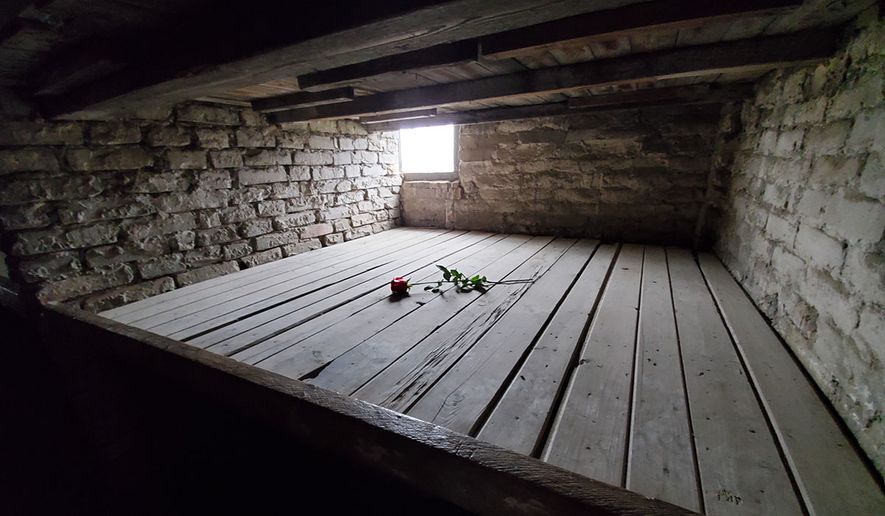
When I stepped inside Block 25, I could not fathom the suffering the women endured. In 2020, the 75th anniversary of the liberation of Auschwitz, roses were scattered on some bunks. As I walked through, I found no words.
Silence — reverence — was all I could offer.
We are told that nature always wins, but maybe it is nature that allows us to see the truth. Nature, which emulates survival, is one constant that helps bring Auschwitz full circle. The rest is up to us. We remember, we honor and we protect the memory of those who suffered and perished at the camp.
Eva’s story remains very much alive, exemplifying how tenacity can be a force for truth and transformation. Eva once told me that she was not a victim; she was a victorious survivor.
I think about that each time I walk through Auschwitz.
• Katherine Prange has worked as a high school English teacher in Gillespie, Illinois, holds a master’s degree in Holocaust and genocide studies and serves on the board of CANDLES Holocaust Museum and Education Center.

Please read our comment policy before commenting.