


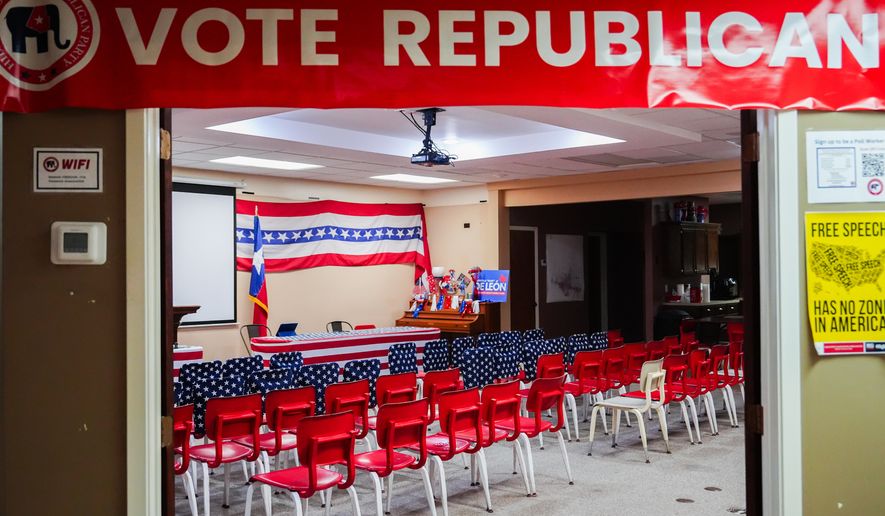

HARLINGEN, Texas —Eric Flores, a former federal prosecutor and Army National Guard infantry captain, was one of the Republican Party’s prized recruits in this year’s midterm elections. With help from a redrawn congressional map in Texas, he seemed primed to dislodge longtime Democratic Rep. Vicente Gonzalez in a region that swung toward Donald Trump in the last presidential election.
Now Flores is one of several candidates in tougher races than originally envisioned as Republican-run states heeded Trump’s call to begin an unusual round of redistricting to help retain control of the U.S. House.
Republicans hoped to pick up as many as nine seats combined in Texas and Florida. But even though the districts were redrawn to make them easier to win for Republicans, the party is weighed down by the public’s dissatisfaction with Trump, the economy, the war with Iran that has raised gas prices, and the president’s deportation agenda.
People were interested in these podcasts
The political landscape is competitive enough that Vice President JD Vance was in Texas on Wednesday, appearing with Flores and promoting him up as “a fighter.” Acknowledging the broader discontentment with high prices, Vance blamed it on the “hole that Joe Biden left us,” saying the previous Democratic administration “created the problems and we’re solving them.” Vance plans to visit Florida on Thursday.
The House Democrats’ national campaign chair, Rep. Suzan DelBene, recently was in Florida districts that Republicans are hoping to claim.
“Republicans arrogantly thought they were going to redistrict seats to pick up more,” DelBene said in an interview during her trip. “Instead, what they have is people across the state souring on the Republican agenda.”
Mike Marinella, the House Republicans’ campaign spokesman, said the party can still capitalize this year “with a more favorable map, historic fundraising and spending advantages, stronger candidates and a common-sense agenda.”
House seats are up for grabs in Texas
Republicans won 25 of Texas’ 38 seats in the U.S. House as Trump returned to the White House two years ago. Partially using that election as a baseline, the redrawn map was intended to help Republicans win up to 30 seats.
Key to this plan was the Rio Grande Valley, a heavily Latino region on the southern tip of Texas that had shifted toward Trump.
The 34th Congressional District, where Flores is running, includes some of the valley, and it went for Trump by 10 percentage points over Democratic nominee Kamala Harris. But Flores said he expected his race to be close, which he credits to his opponent’s five terms in office.
Flores received Trump’s endorsement and it is still pinned to his X account, and he spoke at his unusual midterm convention in Dallas. But Flores also removed from his website a promise to “SUPPORT PRESIDENT TRUMP’S AGENDA” as he looked toward general election voters and widening his base of support.
“If I tell them the red meat issues or I tell them, you know, oh, Republican, Democrat, or anything like that, you lose them,” he told The Associated Press. “I just sell them myself, sell them what I stand for.”
Republicans in Washington acknowledge that inflation, Trump’s tariffs and the war in Iran have made their path harder. Latino voters’ discontent with Trump’s immigration agenda further scrambles their efforts.
Republicans are also facing the potential loss of an incumbent who represents a redrawn district. Rep. Monica De La Cruz, who is running for a third term, has a strong challenge from musician Bobby Pulido. A Latin Grammy winner whose top song on Spotify has 619 million streams, Pulido does not face the usual first-time candidates’ challenge of establishing name ID.
“I want a picture!” Eloise Ibarra, 42, exclaimed as Pulido walked through the crowd at a high school football game. Ibarra later said she “probably” would vote for Pulido after sitting out the last presidential race.
“I don’t really like his policies,” she said about Trump. “It’s very expensive, I go to the grocery store and buy $50 worth of stuff and it’s like five items.”
Democrats argue that Republicans miscalculated this year.
“I think Republicans counted on Hispanics, and they counted on rural Texas, to deliver votes for them, and these are the two places that are hurting the most,” said Terri Burke of the Texas Democratic Party. Speaking of redistricting, she said, “this is really no longer such a slam dunk for the Republicans anywhere.”
Democrats see opportunity in Florida
Republicans already had 20 out of Florida’s 28 House seats, and they wanted to boost that to 24 with their new congressional map. But much like in Texas, their plan was based on 2024 results, when voters, including many Latinos, were dissatisfied with Biden on the economy and immigration.
Republicans went after Rep. Kathy Castor in metro Tampa and Rep. Darren Soto in the Orlando area, while putting South Florida Reps. Jared Moskowitz and Debbie Wasserman Schultz into the same district.
Moskowitz shifted to a nearby Republican-leaning district, and Wasserman Schultz ran for another term in a separate, heavily Democratic district. Castor and Soto face longer odds in their redrawn districts, though DelBene believes they have a shot in the current environment.
The new map did not stop Pia Dandiya, an Ivy League-educated school principal whose parents immigrated from India, from making her first House campaign for Congress.
She is running in the 22nd Congressional District, where Trump won by double digits in 2024 and where Republicans had hoped to pit Moskowitz against Wasserman Schultz.
But Dandiya notes that Biden outpaced Trump in the same collection of precincts in 2020, and she calls herself “a happy road warrior” as she travels 150-plus miles between campaign stops.
“The way this district has been drawn just shows yet again that we are living in a world where elected officials are choosing voters instead of voters choosing elected officials, and it should never be that way,” she said. DelBene and the Democratic Congressional Campaign Committee tapped her as one of their “Red to Blue” priority candidates.
Dandiya said voters’ current circumstances matter more than how they voted two years ago.
“Cost of living is not an issue that is exclusively impacting Democrats. It is an issue that is ubiquitous,” she said, adding that she hears the same concerns even in her district’s more conservative communities.
___
Barrow reported from Fort Lauderdale, Fla., and Atlanta.

Please read our comment policy before commenting.