



Senate Democrats on Wednesday blocked a House-passed bill to protect consumers from data center-driven electricity rate increases, arguing it was “toothless” and that Republicans have already agreed to stronger language in a separate deal.
The Ratepayer Protection Act passed the House earlier this month in an overwhelming 417-3 vote, but failed to advance in the Senate on Wednesday.
The 57-43 procedural vote fell short of the 60 needed to end a filibuster and begin debate on the bill.
People were interested in these podcasts
Four Democrats — Jon Ossoff and Raphael G. Warnock of Georgia, Margaret Wood Hassan of New Hampshire and Amy Klobuchar of Minnesota — joined all Republicans in voting for the bill.
Mr. Ossoff is the only incumbent Democrat up for reelection in November who is considered vulnerable, but Mr. Warnock and Ms. Hassan are often considered in danger when they are in cycle. Ms. Klobuchar is running for governor in Minnesota.
Senators have had separate negotiations on the data center electricity cost issue as part of an energy permitting deal expected to get a vote when the chamber returns after the Nov. 3 midterm elections.
But election-year politics in the Senate were mostly to blame for Wednesday’s procedural vote failing.
Senate Republicans, after devoting floor time recently to legislation on college sports and cryptocurrency, wanted to hold a vote that would show voters they’re listening to their concerns about rising costs and the artificial intelligence boom’s impact on local communities.
Sen. Jon Husted, Ohio Republican and the bill’s lead sponsor, called the measure “the most meaningful bipartisan step Congress can take to protect the American people from paying higher prices for electricity.”
He added in a floor speech ahead of the vote, “If Democrats block this bill, they will prove beyond a shadow of a doubt that they do not care about affordability and they will not do anything to take action to help.”
Democrats slammed the measure as an ineffective show vote designed to aid Mr. Husted in his reelection campaign against former Sen. Sherrod Brown, who has attacked the incumbent for driving data centers to Ohio through “sweetheart tax cuts” he backed as lieutenant governor.
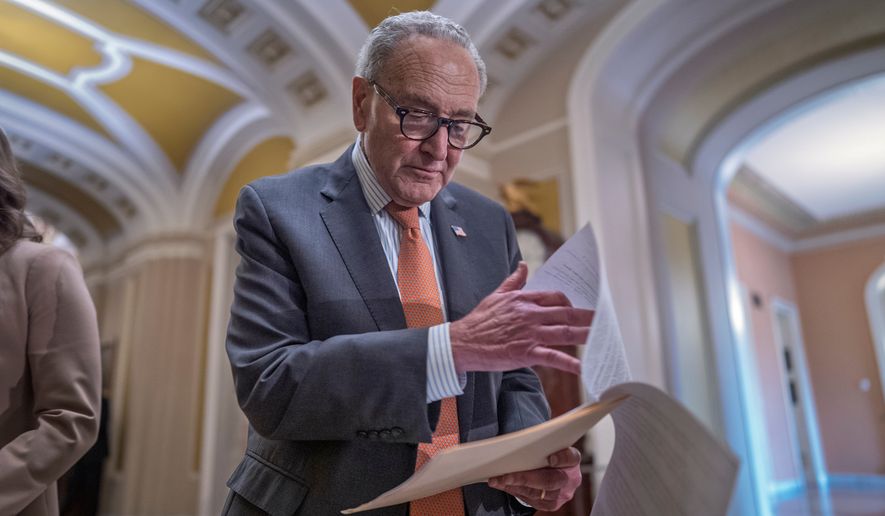
“Republicans’ toothless data center bill completely misses the mark,” Senate Minority Leader Charles E. Schumer said, noting the bill suggests data centers should cover their own costs but does not mandate it. “A guardrail without teeth isn’t a guardrail.”
The New York Democrat said Republicans are intentionally pushing a “shoddy bill” because they’re afraid to stand up to the Big Tech companies opposed to regulation.
Republicans seized on the fact that Senate Democrats’ opposition to the bill stands in contrast to widespread backing from their House counterparts.
“Given the overwhelming support for this measure in the House, it’s difficult to conclude that Senate Democrats blocked this bill for any reason other than the desire to deny Republicans another win in an election year,” said Senate Majority Leader John Thune.
The South Dakota Republican said that “is a pretty poor reason for opposing a measure to protect Americans from higher energy costs.”
Mr. Schumer said Americans will understand because they want more than just “another hollow messaging bill.”
He added, “They don’t want to watch Senate Republicans give themselves a pat on the back when they have accomplished nothing.”
Democrats said their primary reason for opposing the bill was because they don’t believe it would prevent data center-driven electricity cost increases.
The bill requires state utility regulators and nonregulated utilities to only “consider” whether to make data centers pay for any infrastructure upgrades or other costs associated with their high electricity demand.
“If voluntary pledges and suggestions worked, families and small businesses wouldn’t already be staring down rate hikes right now,” said New Mexico Sen. Martin Heinrich, the top Democrat on the Energy and Natural Resources Committee.
Mr. Heinrich has his own bill that would require data centers to pay their own way and has helped negotiate the language on that in separate energy-permitting legislation that senators want to pass after the midterms.
That language would require the Federal Energy Regulatory Commission to establish a rule ensuring data centers are responsible for the infrastructure and transmission costs of the loads they add to the grid, according to Rhode Island Sen. Sheldon Whitehouse, another Democratic negotiator.
He called it “interesting” that Republicans are trying to push a weaker data center bill when they’ve agreed to stronger language in the permitting deal.
Two of the Republican negotiators, Sens. Shelley Moore Capito of West Virginia and Alan Armstrong of Oklahoma, said the data center provisions in the permitting package should not undermine the effort to pass Mr. Husted’s bill, which could immediately become law.
“It just further strengthens it, very aligned on that,” Mr. Armstrong said.
Contact the author


Please read our comment policy before commenting.