



OPINION:
Twenty-five years ago this week, our nation was attacked on the orders of al Qaeda leader Osama bin Laden. Almost 3,000 people were murdered, setting in motion a decades-long Global War on Terror.
The opening salvo of U.S. strikes in this war was launched from submarines and aircraft carriers, and 10 years later, justice was delivered at the hands of Navy special forces in Operation Neptune Spear.
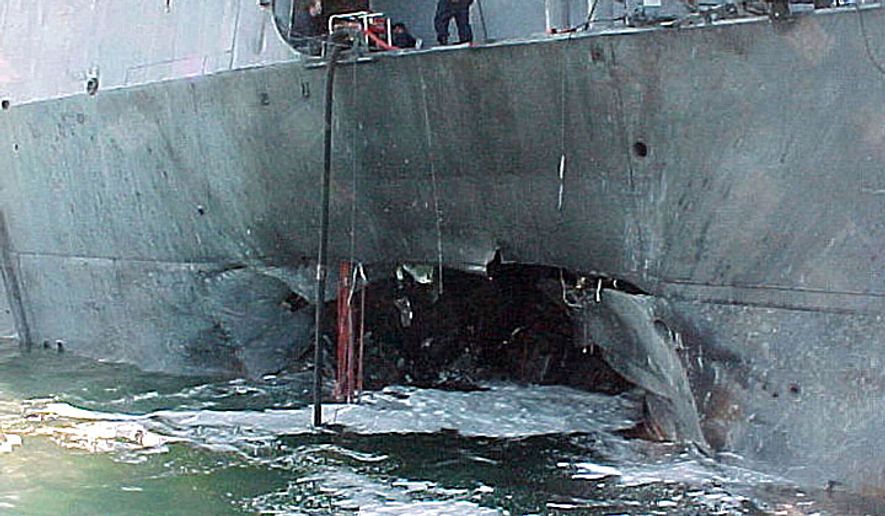
For the Navy, however, al Qaeda drew first blood almost a year earlier when it attacked the USS Cole while the destroyer was refueling in Yemen. That attack killed 17 sailors and would have sunk the ship, had it not been for the heroic efforts of the crew.
People were interested in these podcasts
The Navy played an active role throughout the Global War on Terror, despite much of the fighting occurring on land, often hundreds of miles from the nearest ocean. This included over 70,000 sailors backfilling the Army in combat zones like Iraq and Afghanistan.
Sometimes the unique technical and operational experiences of these sailors resulted in unexpected battlefield successes, such as devising innovative methods to neutralize enemy IEDs — improvised explosive devices, also known as roadside bombs.
At the same time, as the Navy was downsizing under budget cuts, Operation Blue to Green opened a path many took to continue their service with the Army. The point, of course, was that the Navy was fighting the war not just from its ships, but shoulder-to-shoulder with its Army and Marine Corps shipmates at some of the darkest moments of the war.
It was one team, one fight.
The Navy’s special forces, the SEALs, played a particularly noteworthy and active role throughout the war. From interdicting al Qaeda fleeing across the Arabian Sea to the Horn of Africa to supporting Philippine forces fighting the local al Qaeda affiliate Abu Sayyaf.
Tragedy struck when a small SEAL team in Afghanistan during Operation Red Wings, led by Lt. Michael Murphy, was overwhelmed by Taliban fighters aligned with al Qaeda, made famous in the movie “Lone Survivor.”
At sea, the most intense moments of the war occurred in the first months of Operation Enduring Freedom and Operation Iraqi Freedom.
For the initial strikes and then invasion of Afghanistan, the Navy committed six carrier strike groups, four amphibious ready groups with 13,000 Marines aboard. However, the Navy maintained a robust carrier presence in the Arabian Sea throughout the war for intelligence collection, counter-piracy/smuggling operations, and naval airpower.
While the Navy’s role in the Global War on Terror was far from over, the 2011 killing of bin Laden in Pakistan closed a violent chapter opened with the attack on the Cole. Yet the Navy remains active today, conducting maritime intercept operations and providing homeland defense off America’s coasts.
Immediately after the Sept. 11 attacks, the Navy — working with the Coast Guard — sent coastal patrol ships to protect high-value maritime assets and ports of entry. Given the challenges of covering many major ports and maritime borders, the Navy mobilized Naval Coastal Warfare reserve units to the West Coast.
The legacy of those homeland defense missions has persisted, informed by wartime experiences. Most notably, the tracking and recovery of a downed Chinese spy balloon in February 2023 off the South Carolina coast. And the November and December 2024 hysteria regarding swarms of drones near sensitive military facilities made clear that the Navy was still needed to perform coastal defense as executed during the early days of the Global War on Terror.
Twenty-five years later, the Navy is in the midst of a shift back to a focus on traditional navy-versus-navy warfare at sea. This is driven by the necessity to confront China’s rapidly growing modern fleet.
However, as we reflect on the naval experiences of the Global War on Terror, there are important lessons and capabilities that must not be forgotten — some being put to good use today against the so-called Dark Fleet of illicit shipping and combat operations in the Persian Gulf.
On this solemn anniversary, we can be grateful for the Navy’s steadfast efforts — then and now.
• Brent D. Sadler is a senior research fellow specializing in naval warfare and advanced technology at The Heritage Foundation’s Allison Center for National Defense.

Please read our comment policy before commenting.