



OPINION:
Former New York Gov. George Pataki told the New York Post this month that he has a lung condition tied to his time at ground zero.
But Mr. Pataki, who led New York through the Sept. 11, 2001, attacks and the months that followed, calls himself lucky.
“The people who were with me at ground zero over and over for months after those attacks, many of them have serious illnesses, far more serious than anything I might be experiencing,” he said.
He’s right. And that is the story of this anniversary.
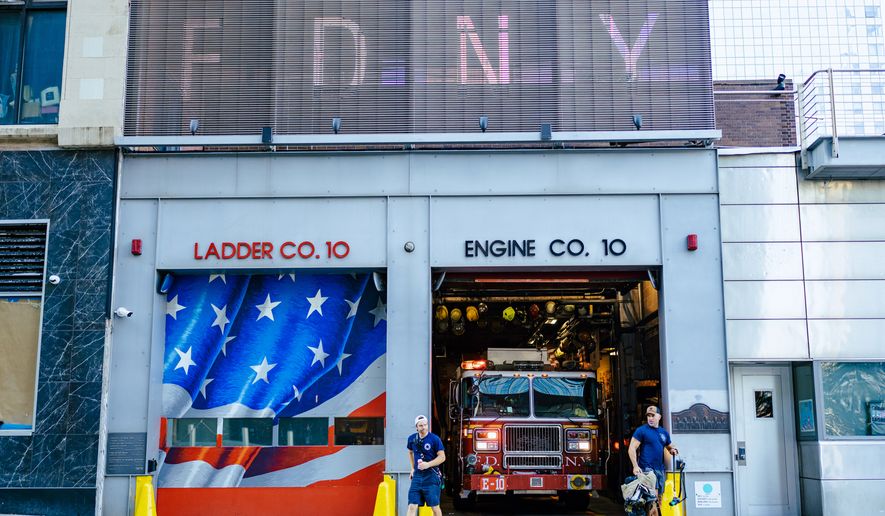
Twenty-five years ago, 343 New York City firefighters were killed at the World Trade Center. Their names are marked at the National 9/11 Memorial and read aloud every September 11. And they should be.
But that number has been quietly overtaken.
More than 400 Fire Department of New York (FDNY) members have now died from illnesses — mostly cancer — tied to what they breathed at ground zero. The World Trade Center Health Program now certifies a new 9/11-related cancer about every 50 minutes.
Mr. Pataki’s diagnosis is a reminder that ground zero exposure did not care about position or title. It reached firefighters and police officers, iron workers and search volunteers, journalists and clergy and the officials who managed the response.
Some are still with us. Many are not. That sacrifice is still being counted a generation later.
But ground zero also exposed a problem that extends well beyond 9/11.
Firefighters begin absorbing known carcinogens on their first shift and keep doing so: diesel exhaust in the apparatus bay, burning plastics and synthetics inside structure fires, contamination that comes back to the station on turnout gear.
Occupational cancer is now the leading cause of line-of-duty death in the American fire service.
Yet no national cancer screening recommendation has ever been written specifically for firefighters. Existing recommendations are age-averaged for the general public, built for a population whose exposure profile looks nothing like theirs.
A 25-year-old rookie is on the same screening timeline as a 25-year-old accountant.
The Firefighter Cancer Support Network (FCSN) is working to close that gap through the Initiative for Firefighter Cancer Screening Recommendations, the first serious effort in this country to build screening guidance around the way firefighters get sick. Oncologists, epidemiologists, occupational medicine physicians and fire service leaders are drafting recommendations to publish in 2027.
That is also why FCSN launched “The Sacrifice Didn’t End on 9/11,” a 25th-anniversary campaign sharing the stories of firefighters and first responders still living with the consequences of that day. More information is available at TheSacrificeContinues.com.
Congress has been moving too. Last December, President Trump signed the Honoring Our Fallen Heroes Act into law as part of the National Defense Authorization Act, recognizing occupational cancer as a line-of-duty death for federal benefits purposes. The vote was 312 in the House and 77 in the Senate, rare bipartisan agreement that underscores how important this issue is.
The Justice Department’s Public Safety Officers’ Benefits program should implement the Honor Act quickly so that surviving families see the benefits Congress intended without years of delay.
The Nation Institute of Occupational Safety and Health’s firefighter cancer research — including the National Firefighter Registry Congress ordered in 2018 — must be protected so the data keeps improving.
And when FCSN’s recommendations are published, federal agencies, including the U.S. Preventive Services Task Force and the Department of Veterans Affairs, should give them real weight and support.
I am not a firefighter. I got to know the fire service through years on the parent board of my local volunteer fire company, the Glen Echo (Maryland) Fire Department, including as president, and later through national advocacy campaigns with firefighters, police officers and EMS crews.
I have learned that the people who do this work do not ask for parades. They ask the country to notice when the job catches up with them.
That is also why I recently joined the FCSN board. This is a fight the fire service needs help winning.
A quarter of a century after Sept. 11, the toll from that day is still, sadly, climbing. The best way to honor everyone we lost on that day and since is to ensure that another generation of firefighters is not lost the same way.
• Andy O’Brien is a partner at DCI Group, a Washington-based public affairs firm. He serves on the board of the Firefighter Cancer Support Network.

Please read our comment policy before commenting.