


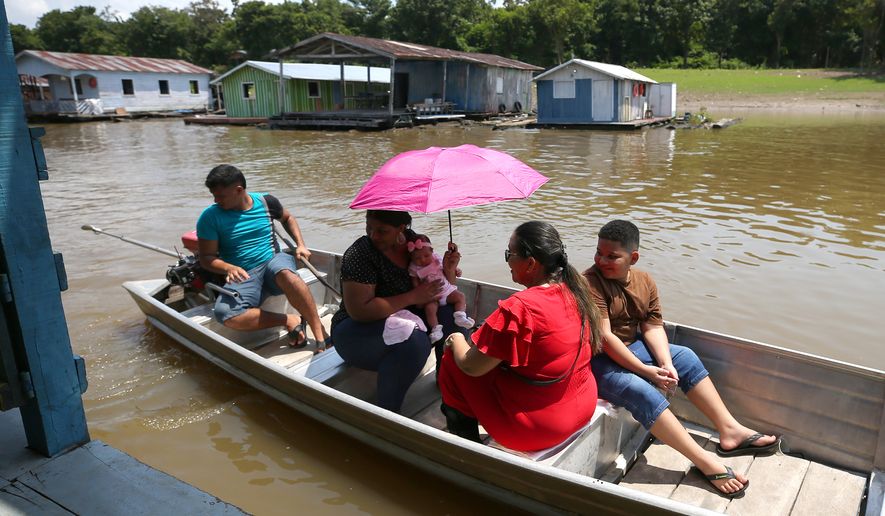

SAO PAULO — Indigenous communities in the Brazilian Amazon fear a lack of transportation will prevent them from voting in Sunday’s election runoff. The Amazonas state electoral court on Tuesday rejected a petition for transportation assistance filed by Univaja, an association representing Indigenous peoples of the Javari Valley in northern Brazil.
Voters in Amazonas state will choose a governor and president in Sunday’s runoff between President Luiz Inácio Lula da Silva and Sen. Flávio Bolsonaro, a far-right candidate and son of former President Jair Bolsonaro.
Recent polls suggest a tight race, with Bolsonaro ahead. In the first round, Bolsonaro won in Manaus, the state capital and largest city, while Lula prevailed in interior municipalities, including those in the Javari Valley. Deforestation surged by 60% under former President Bolsonaro while Lula’s government announced the lowest Amazon deforestation rate on record last week.
People were interested in these podcasts
Most people in the Amazon live in urban areas, but thousands reside in tiny villages several days from the nearest city by boat, including the Javari Valley, one of the Amazon’s most remote regions and home to several Indigenous communities living in isolation. Its population is estimated at about 6,300, according to official data.
Brazilian electoral rules guarantee transportation for remote Indigenous communities. In the Javari Valley, some villages serve as voting hubs for surrounding communities. But some voters live as far as 895 kilometers (556 miles) from their polling places, requiring boat trips of three to five days.
“We usually help the electoral authorities organize the logistics so these voters can get to the polls,” said Eliesio Marubo, an Indigenous lawyer with Univaja. “This year was very different: the electoral authorities made no contact about organizing transportation. We had a very high abstention rate in the first round.”
PHOTOS: Indigenous voters in Brazil's Amazon fear missing runoff after court denies transportation
So the organization reached out directly and filed a petition on Oct. 13. On Tuesday, the Amazonas state electoral court rejected it, saying it could not accommodate the request on such short notice, citing the vast distances and low river levels that would require slower boats, making it impossible to arrange transportation in time.
The judge also said the region posed such unusual logistical challenges that military aircraft need to transport voting machines and election workers because of “access barriers.”
“Meeting the needs of the Javari Valley communities depends entirely on complex, time-consuming river transportation during the dry season. Public authorities lack the resources to do so in the time remaining,” the judge added.
The Indigenous rights unit at the Amazonas Public Defender’s Office said it has also petitioned authorities after they received reports from Indigenous leaders and organizations about difficulties reaching polling places for the election runoff.
Voting machines travel thousands of miles to Indigenous communities
Access to voting has been an ongoing issue for this region.
Until 2012, the region’s only voting centers were in the city of Atalaia do Norte. That year, a mayoral candidate distributed gasoline to about 1,200 Indigenous people from the Javari Valley Indigenous Territory so they could make the multiday trip downriver to vote.
The candidate hadn’t provided enough fuel for their return trip, however. They were stranded on the riverbanks for weeks without proper sanitation, prompting a rotavirus outbreak. Five Kanamari babies died and some 100 people were hospitalized.
That changed in 2014, when villages in the Javari Valley territory received their first voting centers thanks to the efforts of Bruno Pereira, the Indigenous expert who died in 2022 on assignment at the Javari Valley alongside British journalist Dom Phillips.
Back then, Pereira led the local bureau of Brazil’s agency for Indigenous affairs and provided them with food and water, and coordinated a quarantine to prevent the virus from reaching Indigenous villages. Later, he and local Indigenous leaders developed a plan for transporting electronic voting machines to remote villages.
The Amazonas electoral court, the Brazilian Superior Electoral Court and the Indigenous affairs agency did not respond to a request for comment from The Associated Press.
Marubo of Univaja said he did not know how many Indigenous voters would be affected, but they remain concerned about not being able to vote.
“The right to vote and run for office is guaranteed by the Constitution. That right is not being guaranteed, because authorities are responsible for organizing the logistics so everyone can exercise it without difficulty,” he said.
___
The Associated Press’ climate and environmental coverage receives financial support from multiple private foundations. AP is solely responsible for all content. Find AP’s standards for working with philanthropies, a list of supporters and funded coverage areas at AP.org.

Please read our comment policy before commenting.