


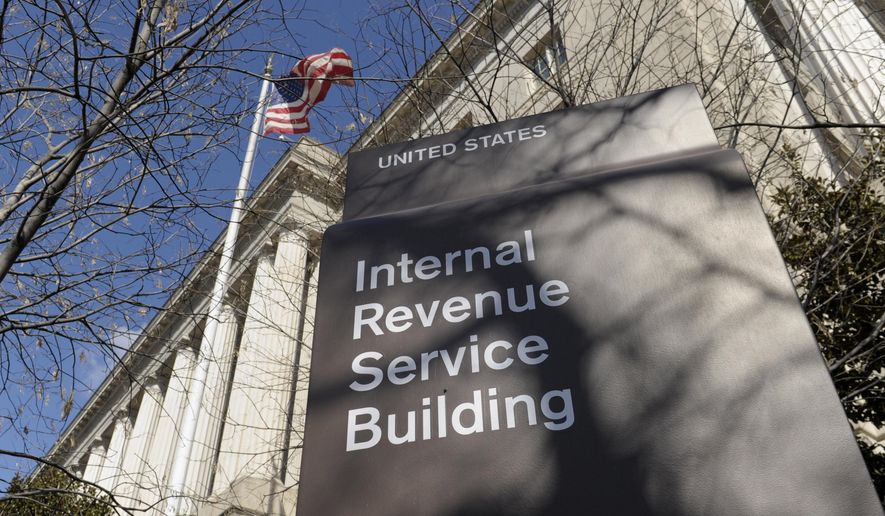

The IRS is a prime target for fraudsters, who bilk the tax agency out of as much as $300 billion a year in refunds or underpayments on taxes owed, according to a new analysis by Congress’ top watchdog.
Scammers include average people or firms who intentionally underpay their taxes, but it also includes criminals — and international operations — who steal identities and file completely fabricated tax claims in their names.
The Government Accountability Office said the IRS is vulnerable to all of that. Not only does it lack a fraud coordinator, it doesn’t even have an antifraud strategy, GAO said.
Rebecca Shea, GAO’s director of forensic audits, and Jared B. Smith, director of applied research and methods, said that’s a mistake.
“An antifraud strategy — either at the agency-wide or division level — would help IRS coordinate and communicate its overall approach to tax fraud risk management to ultimately mitigate such risks and reduce revenue lost to fraud,” they wrote in the report, released Friday.
It comes amid a new national focus on fraud by the Trump administration.
Most of that effort has been aimed at benefit fraud, such as those who made bogus claims for pandemic assistance or who bill government medical programs for fake services.
But tax fraud is massive and appears to be growing.
GAO used modeling from 2018 to 2024 to calculate the rate, and concluded the IRS loses between 2% and 6% to fraud a year. That works out to between $116 billion and $304 billion.
The large range reflects the difficulty of trying to track tax fraud. GAO estimated how much money changes hands in the “shadow economy” that evades tax payments, and used work from Britain and Australia, which have done their own recent tax fraud studies.
The fraud figure is different than the “tax gap,” which is the estimated amount of taxes owed that aren’t paid in full and on time. That includes fraud, but it also includes unintentional errors and other non-fraud reasons for noncompliance.
IRS CEO Frank Bisignano, in an official response to the audit, said they do spot “billions of dollars in tax discrepancies” every year and go after them where they can.
He also objected to the audit’s complaint that IRS fraud prevention is fragmented, saying that’s by design.
“Responsibility for tax fraud prevention, detection and treatment is appropriately distributed across multiple organizations because tax fraud risks vary by tax administration function and evolve over time,” he wrote.
He said before the agency centralizes its antifraud efforts, it must study the issue.
As with benefit fraud, the IRS struggles to recoup tax fraud losses.
In 2024, the agency reported opening 2,600 criminal fraud investigations and assessing 1,400 civil fraud penalties totaling $115 million.
One case the IRS did pursue was Carl Delano Torjagbo, who submitted two tax returns in 2021 — using different Social Security numbers and dates of birth — and claiming millions of dollars in losses tied to an African gold mine business. The IRS paid nearly $3.4 million in a refund.
Torjagbo also stole $9.6 million from a pandemic loan program.
He was slapped with nearly 15 years in prison.
Contact the author


Please read our comment policy before commenting.