


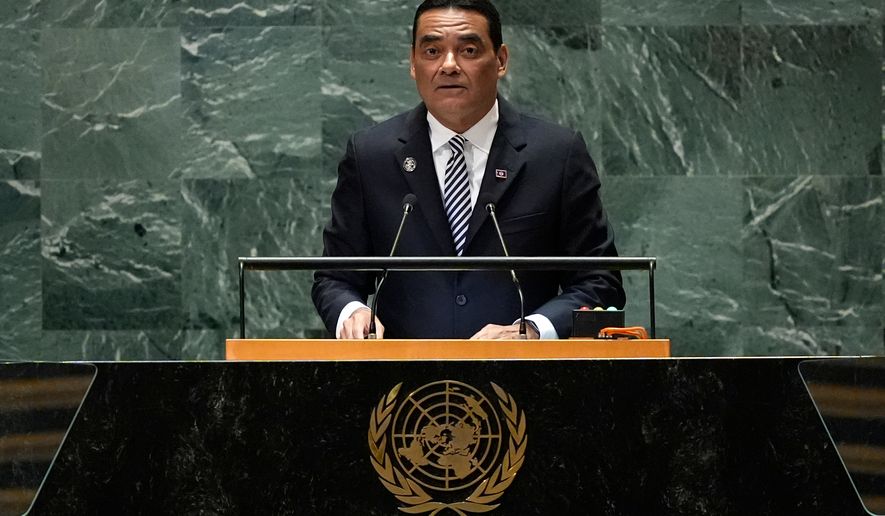

TAIPEI, Taiwan — China sanctioned Paraguay’s communications minister and Belize’s foreign minister on Monday over ties with Taiwan, the island democracy Beijing claims as its own.
The sanctions against Gustavo Villate of Paraguay and Francis Fonseca of Belize serve to safeguard China’s “national sovereignty, security, and development interests, and to oppose separatist acts seeking ‘Taiwan independence,’” the Chinese Foreign Ministry said on its website.
“Certain politicians in Paraguay and Belize have willingly served as pawns of the Taiwan authorities in their attempts to seek Taiwan independence by soliciting external forces,” said Foreign Ministry spokesperson Mao Ning.
People were interested in these podcasts
She added that the foreign officials had visited Taiwan and received visits by “Taiwan independence separatists,” as well as “spread disinformation about Chinese cyberattacks to smear and attack China, creating a seriously negative international impact.”
Paraguay and Belize are among the last 12 remaining diplomatic allies of Taiwan, an island democracy China sees as its own territory, to be annexed by force if necessary.
In recent years, Beijing has increased its military pressure on the island, sending warplanes and military ships near it almost daily. It has also ramped up a campaign of winning over its diplomatic partners. Countries including Nauru, Honduras and Nicaragua have switched allegiances from Taiwan to Beijing in recent years.
Taipei’s remaining diplomatic allies are mostly smaller countries in Central America, the Caribbean and South Pacific, along with Eswatini in southern Africa and Vatican City.
The sanctions against Villate and Fonseca are mostly symbolic, as officials from countries that have ties with Taiwan do not generally travel to China. The curbs include freezing any assets the officials might have in China; denial of visas and entry into China; prohibiting any Chinese individuals and organizations from cooperating with them.
The governments of Belize and Paraguay did not immediately react to the sanctions.
In July, Paraguay and the U.S. Embassy in its capital, Asunción, said cybersecurity attacks linked to the Chinese government had compromised Paraguay’s state systems. China vehemently denied the accusations.
Taiwanese President Lai Ching-te in a speech marking Taiwan’s National Day on Saturday said the island values peace but will not give up its freedom. He said Taiwan’s boost in defense spending is intended to deter war with Beijing, not provoke it.
China criticized Lai’s speech, accusing him of disregarding facts and misleading the public.
China and Taiwan have been governed separately since 1949, when a civil war brought the Communist Party to power in Beijing. Defeated Nationalist Party forces fled to Taiwan. The island has operated with its own government since then.
___
Associated Press video producer Liu Zheng in Beijing contributed to this report.

Please read our comment policy before commenting.