


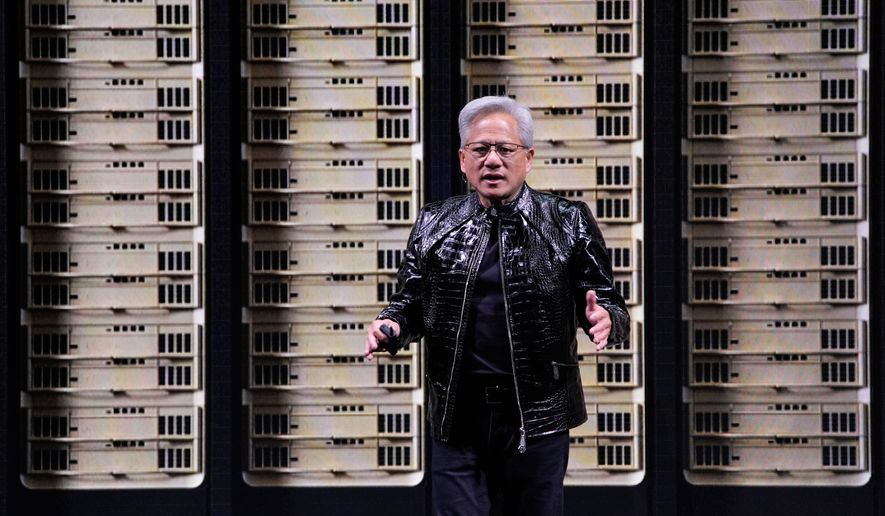

Former CEO Jensen Huang publicly offered to return to Nvidia on Tuesday but the chipmaker said it had no desire to have him back, as it reported robust growth in third-quarter earnings.
Harvey Jones, the chairman of the Nvidia board of directors, opened an earnings call by acknowledging the firestorm around “personal behavior” revelations about Mr. Huang, an allusion to his extramarital affairs — including with a subordinate and another with suspected Chinese spy.
“The Nvidia board unanimously accepted his resignation and does not intend to reinstate Jensen as CEO,” Mr. Jones said at the outset of the earnings call, adding the company would not field questions about the scandal.
People were interested in these podcasts
Mr. Jones said Nvidia planned to look at internal and external candidates for the CEO job and install the choice “as quickly as possible,” though it would not rush the process.
Nvidia earned more than $115 billion for the quarter, more than double the $57 billion it reaped in the same quarter last year, the company said in a highly anticipated earnings report — the first since Mr. Huang’s departure.
“Our momentum is real,” interim CEO Colette Kress told investors. “Our ambition will not change.”
Mr. Huang, writing on X, had suggested that he would return to the company if the board wanted it, marking his first public comments since resigning from Nvidia on Thursday.
“Since my departure, I’ve seen an outpouring of calls from Nvidia’s employees, investors, business partners, and customers for me to return as CEO,” Mr. Huang said. “If the Board of Directors decides that my return is in the best interest of our shareholders, our employees, the company, and America, I would be honored to answer these calls and return as CEO.”
Mr. Huang transformed Nvidia from a gaming supplier to a multitrillion-dollar behemoth during his 30 years in charge. The chipmaker is the engine behind the artificial intelligence boom, but his infidelities caused major upheaval for the company, Wall Street and Washington.
Congressional lawmakers want to know if his relationship with Alice Huang, the suspected spy, compromised national security or led to the diversion of chips to China because of her role at Megaspeed, a Singapore-based cloud computing company.
The Republican chairmen of the House committees on foreign affairs, intelligence and China announced Tuesday that Mr. Huang and Nvidia’s general counsel, Tim Teter, will appear for transcribed interviews on Dec. 1 and Dec. 2.
“We look forward to hearing from Jensen Huang and Tim Teter on their roles in a potential breach of our national security,” the lawmakers said.
A federal investigation into Megaspeed, Nvidia’s major buyer in Southeast Asia, began in 2024, the Commerce Department and the Department of Justice said Monday in a joint statement.
The timeline was released by the agencies to counter what they called inaccurate public reporting, amid questions about whether Washington moved fast enough against suspected diversion of advanced AI chips toward China.
No charges have been announced in the case, and Megaspeed denies wrongdoing. Megaspeed said Sunday that Ms. Huang left the company effective Aug. 30, 2025, and it hired outside lawyers for an internal investigation.
Nvidia, meanwhile, enlisted a law firm to investigate the Alice Huang situation. Then, Mr. Huang’s admitted affair with an Nvidia executive who reported to him increased the pressure on him to step down.
“I did not live up to the standards expected of everyone at NVIDIA, and I have made serious mistakes in my personal life,” Mr. Huang wrote Tuesday. “I created problems for the Board that I deeply regret. I own my mistakes completely, and I am committed to cooperating with the Board’s independent investigation.”
Yet some tech leaders and online petitioners say Nvidia was hasty in ousting Mr. Huang, given his outsized influence on the company and the tech sector at large.
Nvidia said Tuesday it formed a National Security and Export Control Oversight Committee, a panel responsible for board-level oversight of the company’s national security policies, export-control compliance and global trade risk management.
The committee will report directly to Ms. Kress.
Elsewhere, the Commerce Department responded to the Nvidia scandal by releasing an interim rule restricting China’s use of data centers in third-party countries, moving to close a loophole that allowed Beijing to tap into computing power from Nvidia’s advanced chips.
Beijing reacted angrily on Tuesday, accusing the U.S. of interfering with normal trade.
“China is strongly dissatisfied with this and firmly opposes it,” the Chinese commerce ministry said. “If the U.S. persists in its unilateral course, China will take countermeasures to resolutely safeguard its national sovereignty, security, and development interests.”
• Mary McCue Bell and George Caldwell contributed to this article.
Contact the author


Please read our comment policy before commenting.