


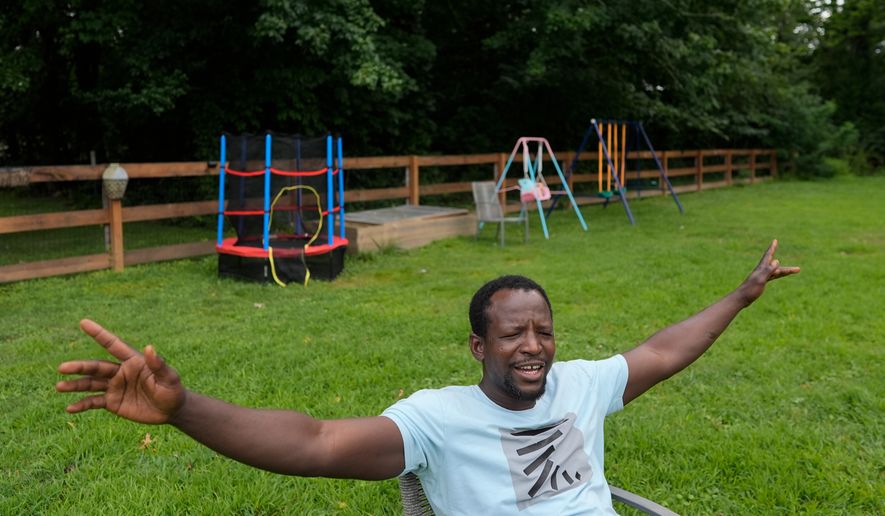

LOCKLAND, Ohio — He keeps his American clothes in the closet: jeans, T-shirts, a hard hat for his job at a meatpacking plant.
He folds his African clothes - including the blue robe he had shipped from home, the one he jokes makes him look like a king - and tucks them into a suitcase stashed in a corner.
Samba Diallo needs those less often in this new life he’s building in the United States, and space is tight in the two-bedroom apartment that he shares with four other men.
That’s a big improvement from when they arrived from Mauritania three years ago. More than twice as many people crowded into this apartment in Lockland, Ohio, a small town on the outskirts of Cincinnati. In 2023, Diallo and roughly 2,000 of his countrymen arrived here, increasing the town’s population by more than 50%, so suddenly it seemed to some that it happened overnight.
They arrived as people from more countries than ever before entered the U.S. through the southern border, an unprecedented surge of 4.5 million migrants, according to government data from October 2018 to July 2025 analyzed exclusively by The Associated Press.
Many headed to smaller cities: People arrived in Cincinnati and its suburbs from nearly every inhabited region of the world. They came from Togo, Turkey, Ukraine, Uzbekistan, Congo, Colombia, around 75 countries that span the globe.
They turned even the unlikeliest of towns, like Lockland, into new American melting pots.
“My only thought,” Diallo wrote later in immigration court papers, “was to get to the safety of America.”
Many arrived with only the clothes on their backs
Diallo, like many from Mauritania, had fled a country where he was persecuted for opposing the country’s repressive government.
Word spread through social media that a new route to the U.S. had opened – allowing Mauritanians to get into the country via an arduous journey through South and Central America. They scrambled to leave while the window was open. Many said they sold everything they had – land, cattle – for the trip, which cost $10,000 or more. They spent weeks making their way through a half-dozen countries on buses, on foot, through the jungle and across rivers, until they finally walked across the U.S. southern border and asked for asylum.
They traveled on to Lockland. No one knew they were coming, and Lockland has no formal services for immigrants. But a small, established community of several hundred of their countrymen agreed to take them in.
Diallo, 36, arrived with nothing; they all did. Many said U.S. federal officials took their backpacks at the border.
They were almost all men - desperate to work, but asylum seekers must wait months for a work permit. They piled into apartments, sometimes 12 or 15 in a space designed for a single family. They slept on mattresses pressed side by side on the floor.
“I was a very poor man,” said Diallo, who’d been a math teacher in Mauritania. He, like many of the others who arrived, spoke four languages, but none of them English.
He marvels at that now. The American dream is still real, he thinks: He has the meatpacking plant job, where he works 10 hours a day, six days a week. He has a car, which he always drives under the speed limit to avoid giving the government a reason to send him away.
And he has friends. They gather around the corner from his apartment on Friday afternoons, at a bicycle shop run by Vincent Wilson, a local who’s become Diallo’s closest friend.
When Diallo is nervous about check-ins with Immigration and Customs Enforcement, Wilson goes with him and holds his car keys, in case he’s detained.
The influx of immigrants shocked this small town
Lockland had for decades been home to a small population of West Africans who’d come to Ohio in the 1990s because of political and racial oppression in Mauritania. The government was executing and exiling Black citizens; some had escaped slavery.
One evening in 2023, Wilson arrived to teach an English class at a Christian-run center next to his bike shop. Instead of the group of a dozen or so West Africans he’d known for years, 160 people lined up around the building. Down the street, the lobby at a food and clothing pantry was packed, another line stretching out the door. No one spoke English, and the volunteers didn’t know where they’d come from.
“It was crazy,” Wilson said - a sentiment echoed by both the immigrants and those who found themselves trying to help.
The pantry, Valley Interfaith Community Resource Center, recognized the men’s conundrum. They asked if the men would like to volunteer there. They couldn’t pay them but could offer leftover food or clothing. Many showed up every morning, unloading pallets of potatoes, working the front desk, helping others who came for food.
Wilson couldn’t go anywhere without seeing these men walking around. He mapped out their needs - their apartments, English class, the food pantry, grocery store - and realized they were walking miles a day.
He was well-connected in the city’s bike culture. He put out a request for people to donate old, unused bikes; piled a few into the back of a pickup truck; and took them to the apartment complex where the men lived. As he unloaded them to see if anyone was interested, dozens came out.
So he got more donated, broken bikes and some tools. He said anyone who wanted one could come - if they helped fix them up, they could have them. Many arrived, far more than he could manage.
Some could pick up spare parts and assemble a bike from scratch. One man could fix a bent wheel with only a screwdriver and a hammer, for a problem that Wilson says he would have needed a half-dozen tools.
They didn’t speak much English at first, but Wilson figured out that the language of bicycles is universal: point, grunt, giggle and everyone understands.
More people showed up every week. Many who’d already gotten a bike returned, to offer help and to ask for it. They had paperwork they needed to fill out: immigration papers, Social Security documents.
In Mauritania, these men suffered discrimination and many were jailed
Wilson started learning the men’s stories. Almost all had wives and children back home. Some had degrees or professional licenses; others had no education and couldn’t read or write. They were teachers, tailors, farmers, mechanics, musicians. Nearly all had fled because they resisted the government’s discrimination against Black Mauritanians.
Though around 70% of Mauritania is Black, the government is run by its Arab minority. It was among the last countries to abolish slavery, in 1981, but the practice persists: The Global Slavery Index ranks the country third in the world for prevalence of slavery.
Everyone who came to the bike shop was Fulani, an ethnic group of Black Africans who speak the language Pular. In Mauritania, Black citizens suffer extraordinary discrimination and are often jailed without charge, the U.S. State Department has found.
Wilson calls his help informal and says he stumbled into the center of this community as a “bored white guy” who liked bikes and meeting new people.
They moved to a bigger space. Wilson hung a sign outside with his free bike program’s name: “Bikes and Stuff.”
“Stuff” meant whatever they needed: a television to watch a soccer game, a folding chair to rest on, help navigating America’s tax, insurance or legal bureaucracy.
He helped Diallo write his story to try to convince a judge he deserves asylum.
Diallo had been an acolyte of Souvi Ould Jibril Ould Cheine, a human rights leader and anti-slavery activist who died in police custody in February 2023. An autopsy found he’d been strangled.
Diallo ran a group chat where he organized about 180 people and rallied them to join him at a protest, he said. He captured on video the police tear-gassing protesters and posted it online, he said.
They arrested him, and he spent a week in jail, he said. He returned to the protests and was detained again, he swore in the documents he submitted to an immigration judge, in a windowless cell with no food or water. He went into hiding.
“It was so scary,” he said. “If they catch me another time, it is finished for me. Maybe they’ll kill me, maybe I will stay in jail forever.”
Diallo, like so many other men who found their way to Wilson’s bike shop, brought him gifts. They invited him to their homes and cooked him meals.
Diallo saved up his money, had a full African ensemble sent from back home and gave it to Wilson. He had him over for dinner, and they sat on the floor around a mat and shared a meal. They ate with their fingers - Wilson said he wanted to experience it the true African way.
As the 2024 political season heated up, rumors and lies spread
The Mauritanians became more visible in the community, walking around town, often in groups, sometimes wearing traditional robes unusual on American streets, just as the 2024 presidential campaign revved into full gear.
President Donald Trump denigrated immigrants, particularly Black newcomers. He spread false claims that Haitians in Springfield, Ohio, an hour north of Lockland, were eating their neighbors’ dogs and cats.
Rumors began circulating that the newcomers to Lockland were eating the ducks in the city park. The locals who knew them laughed at the absurdity – the ducks had migrated south for winter – but they also worried about the political fervor.
City leaders started sounding the alarm. The West Africans weren’t committing serious crimes, officials told the local media. They were devout Muslims, a religion that forbids drinking, so they weren’t out carousing. The major concern was their overcrowded living conditions: The fire chief warned there had been some small fires – they were unaccustomed to American stoves – and in a crammed apartment complex, this could pose a serious hazard.
Right-wing media reported about what was happening here as an “invasion.” KKK flyers started showing up, complaining of “illegal immigrants” and calling on “red-blooded white Americans” to “take your stand.” A group of neo-Nazis arrived from out of town, waving swastikas on a highway overpass.
Khalidou Sy, a well-known hip-hop artist back home, realized they were facing a problem.
He’d arrived like the rest of them, but with one advantage: He spoke perfect English. He became the Mauritanian community’s unofficial mayor.
He spoke at churches and community meetings, explaining who all these new neighbors were. He told his story: He’d been jailed for his music critical of the government, even featured in a French documentary about the country’s underground hip-hop movement for freedom. He’d always been enchanted by America, and thought it was the American thing to do to speak out against oppression, even if it costs you.
He went on the local news.
He also did some schooling of his fellow countrymen, he said. Mauritania is a more casual society, and here people strictly follow rules, he remembers scolding. Don’t whistle at women. Cross the street at the crosswalk.
“Believe in the law of the universe,” he recalls saying. “Whatever you plant is the same seed you’re going to harvest. Whatever energy you put out is the same you’re gonna receive.”
To some, they are part of the ‘melting pot,’ an American tradition
Work permits started rolling in. Most of the men speak French, so French students from a local school came to Wilson’s shop every week to help with paperwork. One man started teaching people how to drive. A retired executive helped with resumes. An intern at the food pantry filled out countless job applications. Everyone got everywhere on Wilson’s bikes.
People got jobs quickly, Sy said, at warehouses and factories, as janitors, stocking and packing for big-box stores.
Sy - whose own fingers are bruised from stamping metal at a factory on the overnight shift - estimates that 90% of those who arrived with him are working now. The food pantry said it doesn’t see them often anymore.
Some moved away, but most stayed nearby, at least close enough to bike to town: “If you want to see somebody you come to Lockland,” Sy said.
A house came open on Wilson’s street, and Sy had saved up enough to buy it.
Although most of the Mauritanian men came alone, Sy had sold his land and cars, scraping together $20,000 to bring his wife and their son, now 5. They’ve since had a girl, 2, and are expecting their third.
When he speaks to his son in Pular, his son usually answers in English: “I want to catch thieves!” the boy squeals, to say he wants to be a police officer when he grows up.
Sy feels like he’s part of a great American tradition, the “melting pot,” he said, like the Irish and Italians before him. But he’s yet to put up an American flag his realtor gave him.
“I love it, I wish I was American so I could hang it outside, but I cannot pretend,” he said. Maybe one day - his asylum application is still pending.
At immigration check-ins, new routines unfold
Samba Diallo rode in the passenger seat, a red folder containing his immigration paperwork on his lap. One form asks whether a person requesting asylum fears they will be tortured if they’re returned home. Diallo had checked “yes.”
He likes to stick a photo of his wife on the inside of the windshield. He had to leave her back in Mauritania; he misses her and likes to feel like she’s nearby.
The sun was still rising as they headed for the Immigration and Customs Enforcement office for Diallo’s regular appointment.
This has become an unexpected tradition for Wilson, who goes to ICE check-ins with half a dozen men. They give him a list of people to call and have him hold their car keys before they walk inside, in case they are detained.
At English classes, they’re incorporating new homework: Memorize the address and phone numbers of trusted friends, give them contact information for family back home and share automatic billing information so they can turn off utilities.
Wilson said the odds seem stacked against his new friends. They’ve heard of only one person whose asylum application was approved. Most, once they get before a judge, are told they can’t stay. Wilson routinely checks the inmate roster of a local jail, which contracts with ICE to detain migrants, to see whether people he knows have been picked up.
So far, two people Wilson knows have been deported. Some have considered leaving for states they think of as more friendly to immigrants. A handful have left for Canada.
“From what we have experienced, the line between being an asylum seeker and the line being deported is basically a bunch of paperwork,” Wilson said. “You’re not immediately deportable, but you’re also not hard to deport, which is pretty brutal math.”
Sometimes, it seems, he’s more worried than those facing possible deportation. They often say it is in God’s hands, that their destiny will be designed by him. Wilson, a devout Christian, admires that.
When they arrived, he walked Diallo to the door of the nondescript brick building but had to wait outside. Only those with appointments are let in.
Wilson says he has “horse blinders”: He can’t bring himself to think about how ICE is detaining people at check-ins, that Diallo could walk in one day and not walk out.
But less than 30 minutes later, Diallo emerged smiling.
He likes to chronicle his American life in photos, and he asked an ICE officer to pose for a picture with him. The officer shook his hand, and they both looked into the camera and smiled.
___
AP journalists Aaron Kessler and Carolyn Kaster contributed.

Please read our comment policy before commenting.