



OPINION:
In recent weeks, authorities in Tehran have stepped up the execution of political opponents, deepened the persecution of religious minorities and imbued the country’s domestic repression apparatus with new authority and freedom.
Still, they have also done something else.
In keeping with the understanding that control of information is essential to maintaining its grip on power, the Iranian leadership is working overtime to seal off the country’s population from the outside world.
On Aug. 16, the Majles, Iran’s rubber-stamp legislature, approved a framework bill that effectively criminalizes ordinary contact with “hostile” foreign media — that is, any outlet tied to the United States or Israel.
Under the new law, citizens must also notify Iran’s Intelligence Ministry before speaking to other international media outlets.
Sending videos, photographs or audio recordings to non-state outlets can mean six months to two years in prison, with punishment of infractions handled by the regime’s feared Revolutionary Courts.
The law, formally framed as a measure to “counter foreign infiltration,” is far more than an effort to limit media contacts. It extends to academic collaboration, cultural production and scientific exchange.
Organizers of workshops deemed “incompatible with Iranian culture” face five to 10 years behind bars. Unauthorized contacts with foreign institutions can cost those intrepid enough to attempt such contacts both their social standing and fines.
Less than two weeks after the law was introduced, the regime raised the stakes even further. In a published statement, a spokesman for the country’s military announced that Persian-language outlets operating abroad — explicitly singling out the BBC’s Persian Service, opposition channel Iran International and the U.S. government-funded Radio Farda — had been placed in Iran’s “military target bank.”
These outlets, the spokesman declared, are not media at all, but “soldiers of Zionism and America.” As such, they are fair game for military targeting by virtue of being “directly connected to Mossad, CIA and enemy intelligence organizations.”
These steps are not a departure from the norm. They represent the logical next phase of a deepening campaign for information control on the part of the regime in Tehran.
Indeed, after the start of grassroots protests late last year, the Iranian regime shut down the internet inside the country and proceeded to wage a brutal campaign of repression under the cover of digital darkness.
The disruptions persisted. During the course of the current conflict, Iranian authorities have relied on sophisticated jamming technology provided by Russia and China to frustrate Western efforts to restore connectivity to the Iranian people via high-tech tools such as Starlink.
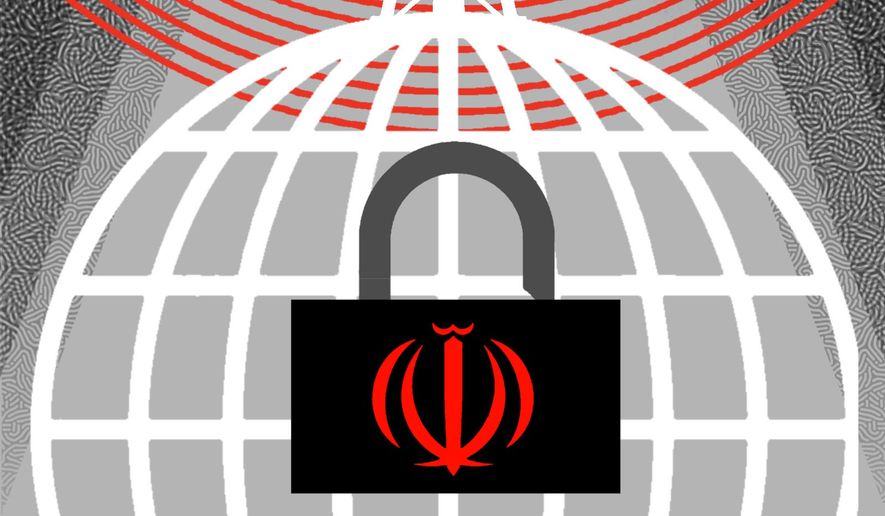
Still, the regime’s ambitions for digital control are much bigger. As a longer-term solution, Iran is constructing a closed domestic network — the National Information Network — to wall off its citizens from the world.”
This system is estimated to be only 60% complete, in spite of massive infusions of capital from the regime’s chronically cash-strapped coffers in recent years. Even so, its objective is already clear: to enable authorities to curate the online reality of Iranian netizens via homegrown alternatives to platforms such as Facebook and YouTube, and thereby complicate Iranians’ access to the outside world.
The two latest measures — one legislative, the other strategic — fit squarely into this continuum. By criminalizing contact with Western media outlets, authorities in Tehran are seeking to deter ordinary Iranians from accessing potentially subversive content from platforms beyond their control, or telling their stories to the outside world.
By putting Persian-language Western outlets on notice that they are considered military targets, Tehran is signaling that it sees information as a discrete domain of battle — and is willing to act decisively to eliminate threats emanating from that domain.
The U.S. and other Western governments would do well to take notice. They would do even better to treat the issue of information as seriously as the Iranians do.
• Ilan Berman is senior vice president of the American Foreign Policy Council in Washington.

Please read our comment policy before commenting.