


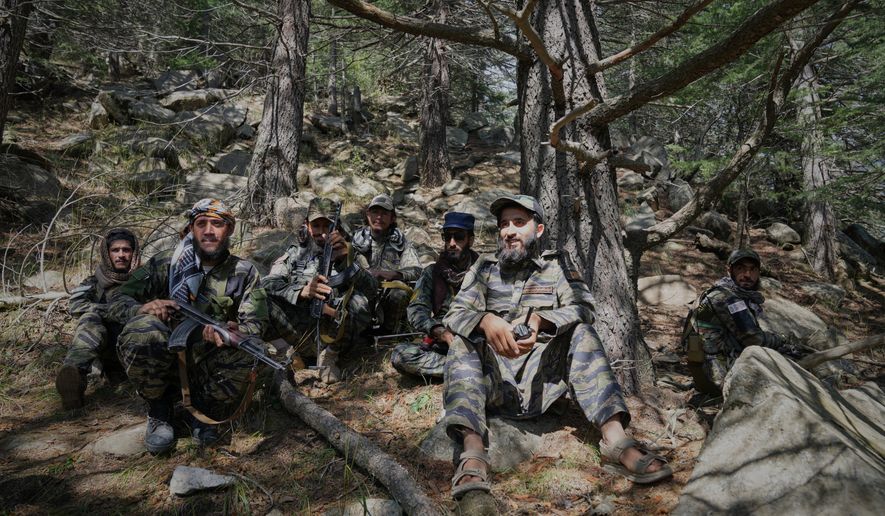

CHALAS, Afghanistan — Deep in the mountains of eastern Afghanistan, a police unit is on patrol. In military fatigues and with automatic rifles slung over their shoulders, the men clamber up steep slopes and trek through deep ravines for days.
They belong to the Green Units, a special task force established by the Taliban government to safeguard Afghanistan’s last remaining forests.
From the air, vast swaths of land appear devoid of vegetation. Ridge after barren ridge, Afghanistan’s mountains stretch into the distance, hues of brown unbroken by any hint of green. Four decades of war, climate change, uncontrolled logging and timber smuggling have decimated its forests, sometimes resulting in deadly flooding and landslides.
People were interested in these podcasts
The most severe deforestation occurred between the Soviet invasion in 1979 and the fall of the first Taliban regime in 2001, when Afghanistan lost an estimated 50% of its forests, said Mohammad Nasir Shalizi, research assistant professor at North Carolina State University’s Department of Forestry and Wildlife Resources.
Much of that was due to illegal logging and timber smuggling, particularly of high-value oak, cedar and other conifers in the eastern provinces, while war, fires and a heavy reliance on wood for heating, cooking and construction also played a part, according to the U.N. Food and Agriculture Organization. Climate change, agricultural growth, construction and mining also contributed.
Centuries ago, forests covered about 5% of what is now Afghanistan, while woodland dominated by pistachios, almonds and junipers covered around 33%, the FAO said. Currently, forests and shrubland account for just 2.8%.
Afghanistan is among the nations most vulnerable to climate change caused mainly by the burning of gas and oil, and among the least prepared to adapt, according to the U.N.
Deforestation is something Afghanistan can ill afford.
Afghan officials were invited to attend the U.N.’s climate summit, COP31 in Turkey, as observers for the second since the Taliban came to power.
A lack of trees exacerbates the risk
Sparse tree cover is already raising temperatures in Afghanistan, said Abdul Hadi Achakzai, head of the Environmental Protection Training and Development Organization, a nongovernmental organization focused on climate change adaptation and ecology in Afghanistan.
Tree roots help to prevent soil erosion, so deforestation can have deadly consequences in Afghanistan, where avalanches and flood-triggered landslides often claim hundreds of lives. With climate change driving frequent extreme weather events, forest regeneration is critical.
The Aga Khan Foundation has several forest-planting projects in Afghanistan’s mountains, prioritizing areas where communities live below treeless slopes. The projects are essentially “disaster-proofing the communities,” said Apoorva Oza, the foundation’s global program lead for agriculture and climate change.
It’s “not only a livelihood or an environmental thing,” Oza said. “It is actually a life-saving intervention.”
Successive governments seek to protect and regenerate forests
Successive governments in Afghanistan have backed efforts to safeguard the remaining trees and regenerate lost woodland. Both the current government and the previous U.S.-backed one enforced laws to protect forests and supported tree-planting efforts.
The rate of deforestation has slowed considerably in the past two decades, and there are indications that forests are slowly returning in some areas, Shalizi said.
After the Taliban seized power in 2021, it created the forest patrol units. And in the five years since, authorities have planted around 126 million seedlings and cuttings, according to Sher Mohammad Hatami, spokesperson for the Ministry of Agriculture, Irrigation and Livestock.
Mohammad Halim Rafi, spokesperson for Afghanistan’s National Statistics and Information Authority, said forest cover has increased by 427,000 hectares (1.06 million acres) over the past 15 years.
But Shalizi, who was also on the faculty of Kabul University’s Forestry and Natural Resources department from 2009 to 2015, cautioned that the planting won’t necessarily result in healthy forest regeneration.
“They plant trees, they have those numbers, but they do not come back and check how many of those trees that they planted survive,” he said. “Usually … the mortality rate is very high.”
The main threat forests now face is gradual degradation from mismanagement, such as allowing livestock to graze on saplings, Shalizi said. A forest patrol “helps with the deforestation, like a direct deforestation or material cutting of trees. But it’s not going to help with degradation.”
The Taliban’s Green Units patrol to protect the forests
The eastern province of Kunar, bordering Pakistan, is one of the few parts of Afghanistan where sizable forests remain.
A bone-jarring three-hour drive along a rough dirt road through the mountains leads to one of the areas where Green Units patrol to prevent the illegal logging of pine, oak and cedar trees.
“I can now provide full assurance regarding our forests: no one in Kunar is currently able to cause them any harm,” said Sgt. Khair Ul Rahman, who at 22 has been with a Green Unit for five years.
Each 10-man unit patrols for around 10 to 12 days at a time, often working alongside locals who know the mountains well. Countrywide, about 1,000 men serve in forest patrols, said Hatami from the Agriculture Ministry.
For Master Sgt. Mohammad Naeem, Kunar is far removed from his home province of Helmand, a largely desert region in southern Afghanistan.
“Forests possess great beauty, which is why I came here,” said Naeem, who has been serving in Kunar for two years. “I am very happy in my role here, surrounded by all this beauty.”
Cutting down live trees is strictly prohibited, and even felling dead ones requires a permit, explained Kunar police command spokesperson Maj. Faridullah Dehqan.
Humans “have a vital need for oxygen and clean air, a need that can be met solely and exclusively by forests,” he said. “Therefore, the protection and preservation of forests are of great importance, and it is a duty incumbent upon all of us to protect them.”
While the previous U.S.-backed Afghan government also strictly controlled logging, a lucrative wood-smuggling trade still flourished across the Pakistan border. Authorities say their crackdown has curbed that smuggling.
Outreach programs seek to educate local communities
The Green Units also are involved in community outreach and education. That includes explaining a hunting ban to encourage wildlife to return, said Rahman with the Kunar unit.
“We visit forested areas, gather people together and speak to them about the importance of forests and the harmful consequences of cutting down trees,” he explained, saying the public awareness campaign is not just a directive from Kabul but also in line with the teachings of the Prophet Muhammad.
“In an Islamic society,” he said, “obeying such directives is a mandatory duty.”
___
Read more of AP’s climate coverage.
___
The Associated Press’ climate and environmental coverage receives financial support from multiple private foundations. AP is solely responsible for all content. Find AP’s standards for working with philanthropies, a list of supporters and funded coverage areas at AP.org.

Please read our comment policy before commenting.