


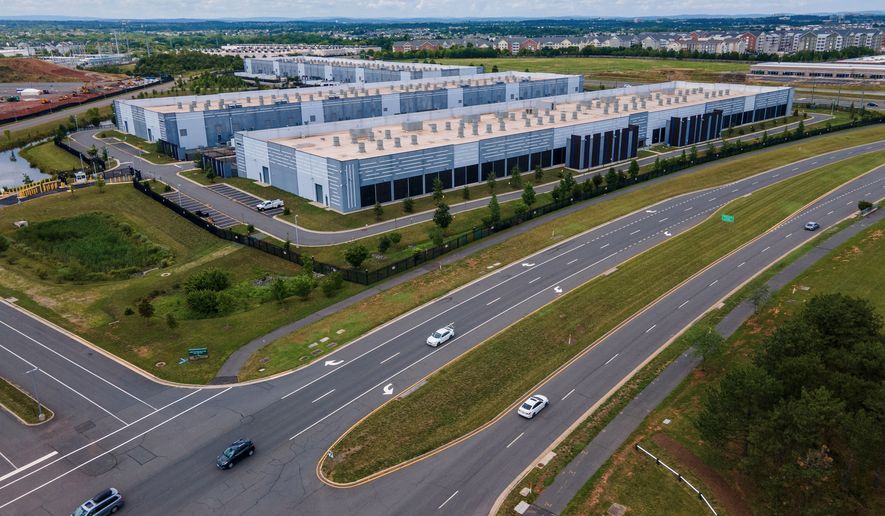

Maryland landowners have rushed to the Supreme Court to ask the justices to step in and halt a power company’s attempt to survey their land in preparation for transmission lines that residents say will be used to build more power-sucking data centers in the metropolitan region.
It could be the first in a wave of cases pitting data centers and their infrastructure needs against residents, increasingly antsy about what those demands will mean for their communities.
Those data centers rely on water and power, and anti-data-center forces are lining up landowners to challenge access to both.
People were interested in these podcasts
That includes nuisance law and environmental law, but perhaps the biggest battles right now are over eminent domain, which is the power of a state or local government to force the sale of property to complete a public project.
Courts are being asked to decide whether private data centers — and the power needed to run them — are public goods.
In the specific case filed with the Supreme Court on Wednesday, PSEG Renewable Transmission LLC v. Arentz Family, LP, et al., a lower court granted PSEG Renewable Transmission, the power company, access to landowners’ property for its investigations even before a decision has been made on whether PSEG can exercise Maryland’s eminent domain powers.
The Pacific Legal Foundation, which is handling the case for the landowners, said the lower court prematurely “authorized a physical invasion of Marylanders’ homes and businesses.”
“Courts have the responsibility to interpret the law, not invent hypotheticals that give private companies clearance to wield government powers against Americans,” said Aaron Newell, a lawyer at the foundation.
Artificial intelligence and cryptocurrency, with their massive needs, are driving a surge in demand for the centers.
Still, anger is growing.
Exit polling in the elections Tuesday showed that more than 75% of voters opposed building a data center in their communities. They also were not much sold on AI itself, with 57% saying it “mostly hurts” society.
It is no wonder legal fights are brewing as Americans seek ways to slow things down, as the Maryland residents are trying to do.
PSEG wants to build a 67-mile high-voltage line through Baltimore, Carroll and Frederick counties. Opponents figure it will help drive expansion of data centers in Northern Virginia and Maryland.
Some landowners tried to keep PSEG from surveying their land. PSEG went to court to seek a preliminary injunction in the event of eminent domain. The ruling granted access even though there has been no actual condemnation yet.
The 4th U.S. Circuit Court of Appeals upheld the injunction.
“Although the case involves an electric transmission project rather than the direct condemnation of property for a data center, the implications extend well beyond Maryland,” Roger A. McEowen, a professor who specializes in agricultural law and taxation at Washburn University in Kansas, said in an analysis after the court filing.
“For agricultural landowners, the case raises an important question: Can the infrastructure demands of private commercial development justify allowing private companies to intrude upon privately owned agricultural property before they have established their legal authority to do so?” Mr. McEowen wrote.
To qualify for eminent domain, a project must generally be intended for public use.
The Supreme Court, in a landmark 2005 case, Kelo v. City of London, allowed a local government to seize property for the benefit of a private land development.
That case spurred a backlash in states, most of which rushed to tighten their rules to limit what counts as public use.
Some state courts, in cases predating the data center fight, affirmed power companies’ seizures. Others have been skeptical.
PSEG declined to comment on the filing with the justices.
There’s reason to believe the high court may take a pass on the case.
Under the injunction, PSEG has been carrying out its survey work across the several hundred properties in question, and the survey is nearly complete. By the time the justices confront the case, they may no longer have a live issue to ponder.
Other cases are also bubbling up, though they are in the early stages.
Some challenge data centers as nuisances, citing factors such as noise levels. Others use environmental law. Still others boil down to basic zoning disputes.
The Trump administration has been bullish on data centers, seeing them as part of the infrastructure needed to prevail in an AI arms race with China, with national security implications at stake.
Contact the author


Please read our comment policy before commenting.