


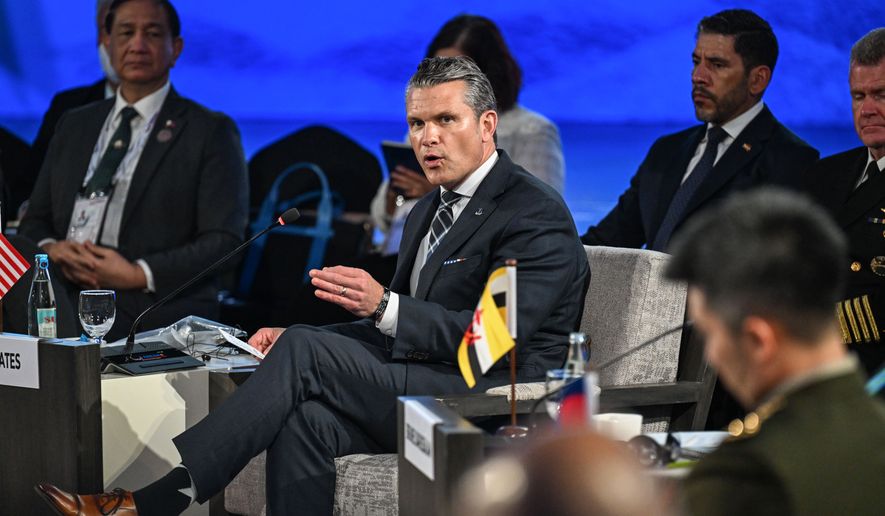

High-level meetings such as the recent informal defense ministers’ meeting in the Philippines or the upcoming Reagan National Defense Forum in California facilitate the kind of consequential back-channel diplomacy that often helps get deals done and provides a forum for direct meetings of heads of state and other key decision-makers.
Defense Secretary Pete Hegseth met with officials from more than a half-dozen countries during his Philippines trip last month. The commander of U.S. Pacific Command, Adm. Samuel J. Paparo, was a part of many of those discussions. Partners and allies from across the region discussed base logistics, bilateral command-and-control efforts and intelligence-sharing, focused largely on the First Island Chain off China’s southern coast
The meetings offered Mr. Hegseth’s staff a chance to build connective tissue between Trump administration officials and their counterparts from around the world. The Washington Times traveled with Mr. Hegseth on the trip.
People were interested in these podcasts
Administration staffers held sidebar conversations all around Cebu, Philippines, during the informal defense ministers meeting of the Association of Southeast Asian Nations, or ASEAN. Members of the U.S. Army’s Foreign Area Officer program and officers from the U.S. Navy met for lunch meetings with local counterparts in the lobby restaurant of the hotel that Mr. Hegseth’s team used as their main meeting space. Local embassy representatives, from the U.S. and nearly every country represented at the event, traded business cards outside the meeting rooms where defense ministers and secretaries gathered.
Specialists say those events play a crucial part in U.S. diplomacy.
“There’s a few things like that,” said Michael O’Hanlon, director of research for the foreign policy program at the Brookings Institution. “The Shangri-La Dialogue, the ASEAN Regional Forum, in Europe, the Munich Security Conference … where a lot of people just plan on going.”
The Pentagon used the event as an opportunity to meet with regional partners, specifically the defense chiefs of Japan and Australia, two countries that are considered “dialogue partners” to the ASEAN meeting, not actual members. These events gave them a messaging platform for what Mr. Hegseth called a “force posture shift” in the Pacific.
All eyes on Reagan forum
Mr. O’Hanlon cited next month’s Reagan National Defense Forum as another example.
The annual event at the Ronald Reagan Presidential Library in Simi Valley, California, will include a speech by President Trump to a room full of some of the most influential American decision-makers. Last year’s event featured a full range of back-channel discussions among lawmakers, senior military officials and defense industry executives.
Members of Congress from both sides of the aisle, and specifically those on the armed services committees in both the House and Senate, are expected to attend. So, too, are the CEOs of nearly every major defense contractor and the heads of several major banking and investment institutions.
CIA Director John Ratcliffe is attending the Simi Valley event, as are the ambassadors from allied countries around the world.
At ASEAN, the inclusion of U.S. government personnel far down the line from Mr. Hegseth highlighted one of the key aspects of the Trump administration’s approach to international cooperation and security. In that approach, top leaders such as Mr. Hegseth make the more pointed statements in public, while officials meet privately with counterparts to work through specific issues with more conversation and flexibility.
Mr. Hegseth gave a nod to those dynamics in his closely watched ASEAN address.
“Above the waterline or below, and I would encourage a lot of people when you look at these partnerships — there are things happening under the surface, that happen behind closed doors with understandings between countries,” Mr. Hegseth told The Times in Cebu.
Many of these meetings aren’t made public for security reasons, but small details slipped into releases, readouts and speeches are “meant to create dilemmas to ensure that the status quo doesn’t change,” Mr. Hegseth said.
Mr. O’Hanlon, the Brookings Institution scholar, described the calendar of global defense gatherings as “a nice opportunity to show people that you’re a committed ally.
“You know, to show up on their home turf a little bit,” he said.
The current approach reflects something of a shift from earlier in the Trump administration when officials bemoaned international gatherings.
At last year’s Shangri-La Dialogue in Singapore, Mr. Hegseth said the U.S. and its allies “don’t need more conferences. We need more combat power.”
“I’m sorry to say this here. Less Shangri-La. More ships, more subs,” he said.
At that same event, he held bilateral and trilateral meetings with Pacific countries and allies.
Early in the Trump administration, official participation by military personnel in the annual Aspen Security Forum was completely banned. The recent Halifax International Security Forum was just the second time no Pentagon officials or State Department personnel officially participated.
That position may be untenable, as Mr. O’Hanlon sees the policy “loosening up a little bit.”
“Everybody has their own thing. Some of them are more top tier and more where the secretary would generally go,” Mr. O’Hanlon said. “Others are more hit or miss. He would go if he felt like there was a particular purpose but not necessarily go to each and every one, because there’s sort of one a month somewhere in the world, more or less.”
Sideline meetings at this year’s Munich Security Conference are believed to have helped establish communication channels that led to Mr. Trump’s recent meetings with Chinese President Xi Jinping and Russian President Vladimir Putin. Those meetings came on the sidelines of another major international event, the Asia-Pacific Economic Cooperation (APEC) Summit.
The conversation between Mr. Trump and his political and defense interlocutors at the upcoming Reagan National Defense Forum on Dec. 4 and the Dec. 14-15 Group of 20 summit in Miami will be some of the last chances to establish relationships between staff before a Democratic-led Congress takes office in January.
The conversations in ASEAN were so important that Mr. Hegseth flew 20 hours to get to Cebu, where he spent less than 24 hours on the ground before returning to Washington via a 16-hour nonstop flight, with in-air refueling both ways.
“None of it’s surprising, but it’s all useful,” Mr. O’Hanlon said of Mr. Hegseth’s trip. “It doesn’t take that much effort, but it’s still a way to send a message of commitment even while your main preoccupation is elsewhere.”
Contact the author


Please read our comment policy before commenting.