


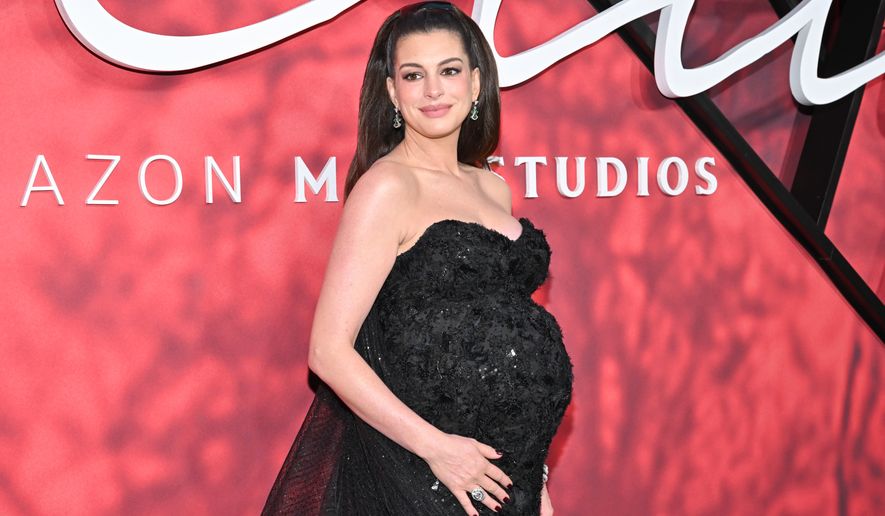

Actresses Anne Hathaway and Hilary Swank are preparing to give birth after the age of 40, highlighting a trend of U.S. women bearing children later in life.
Ms. Hathaway, 43, and Ms. Swank, 52, are joining other celebrities such as singers Gwen Stefani and Mariah Carey and actresses Halle Berry and Eva Mendes, who opted to give birth after 40.
In fact, this marks Ms. Swank’s second post-40 pregnancy: She gave birth to twins at age 48. She recently pushed back on criticism of her decision to give birth now.
People were interested in these podcasts
“It was a good time for me because I feel like I had this career that was a baby of mine, that I wanted to really give to and devote my time to, and not share,” the Oscar-winning actress said on “The Drew Barrymore Show.” “Now, I can totally devote to my children.”

Her sentiments apparently are shared by a growing number of women. The fertility rate for U.S. women 40 and older has increased 24% over the past decade — from 5.8 births per 1,000 women in 2015 to 7.2 in 2024, according to the National Center for Health Statistics.
What’s more, women older than 40 are having more children than teenagers for the first time ever, the center’s data show.
Dr. Richard J. Paulson, an OB/GYN professor at the University of Southern California, says women are increasingly delaying childbirth to focus on careers, choose the right partner and develop their personal lives. And fertility technologies can help them in that decision, he adds.
“This is why women are increasingly freezing their eggs at the age of 30 so that when they want a child at 40, they will have that option using their own genetics. Otherwise, many of them have to use donor eggs,” Dr. Paulson told The Washington Times.
Many women opt to freeze their eggs in their early to mid-30s, but they can still harvest viable eggs up to age 40, he said.
“There’s a big difference between 40 and 45. At 45, pregnancy rates are virtually zero; at 40, they’re still present but not great. You can complete two or three IVF cycles and have a baby from that,” said Dr. Paulson, chief of reproductive endocrinology and infertility at USC.
There are risks to having children at an older age, including miscarriage, gestational diabetes, postpartum hemorrhage, preeclampsia and delivery via C-section.
Still, Dr. Paulson is not suggesting that women rush to freeze their eggs at 20 years old. “Give yourself a little chance,” he said.
“If somebody is healthy, doesn’t have any medical problems, and they’re in good physical shape, they really do quite well pregnancy-wise at the age of 40,” he said. “It’s just that a lot of women at the age of 40 already have some underlying situation. It’s either a medical problem or they develop a GYN problem.”
Dr. Paulson says the best age for egg retrieval and freezing is 30, when one retrieval session usually yields enough eggs for two babies. At 40, an average woman needs three retrievals to conceive one baby, he says.
And results can vary for women attempting to conceive naturally.
“There are some women who are quite fertile at 38, and there are other women who are quite infertile at 38. You do not know,” Dr. Paulson said. “Most women are fertile at 30, and most women are infertile at 45. And in between there is a big gray zone, and some women do very well at 38, and they get pregnant the first time they try.”
Dr. Paulson said older women can achieve full-term pregnancies with younger eggs or embryos, most likely from freezing or donors. The uterus remains capable of supporting pregnancy as it ages, he said.
He said he often sees couples waiting for the perfect opportunity to have a child, but he tells them there is no best time.
“There’s never a convenient time to have a child. It is magical. Embrace it and do it now,” he said.
Contact the author


Please read our comment policy before commenting.