


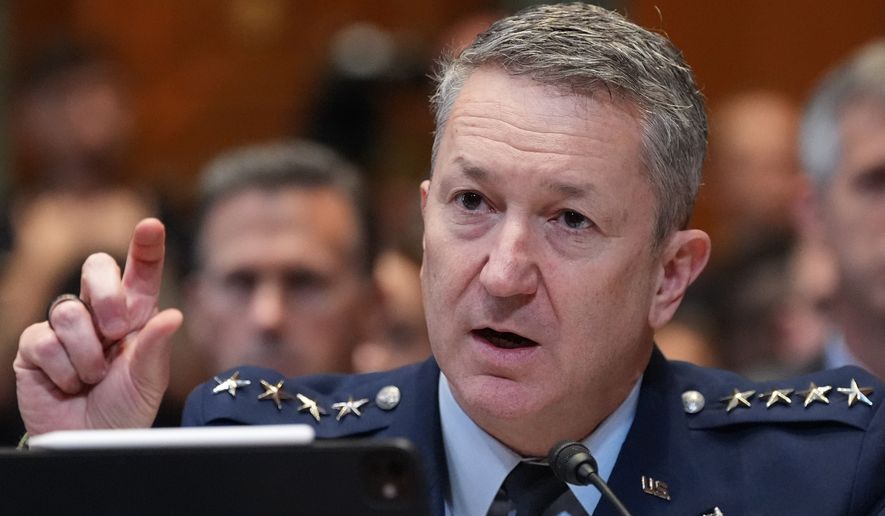

Air Force Gen. Dan Caine, chairman of the Joint Chiefs of Staff, said the 9/11 attacks on the U.S. by al Qaeda largely set the pace of American combat over the past 25 years.
American forces waged a counter-insurgency war in Iraq and Afghanistan and held air superiority that ensured freedom of maneuver on the ground.
That experience shaped a generation of war fighters and produced hard-earned experience on the battlefield, Gen. Caine said Wednesday in his keynote address to the Air and Space Forces Association’s Air, Space, and Cyber Conference at the Gaylord National Resort and Convention Center in Oxon Hill, Maryland.
“But it also focused much of our forces on missions conducted from positions of relative strength,” he said.
Future conflicts against near-peer adversaries like Russia and China will require U.S. troops to operate without air superiority, secured rear areas or uninterrupted supplies. And such demands on today’s military are not theoretical, Gen. Caine said.
“We have enduring national security imperatives to defend our homeland, secure our borders and protect U.S. interests throughout our own hemisphere, while also facing persistent kinetic operations in the Middle East, sustained competition in the Pacific and nearly a five-year war in Europe,” he said, referring to the Russia-Ukraine conflict.
The potential enemies faced by the U.S. military today are not isolated from each other, Gen. Caine said.
“Our adversaries may be geographically distributed and dispersed, but they’re increasingly connected. They share technology, intelligence, weapons and economic support,” he said. “They’re studying our battlefields in the past and our battlefields currently. They’re adapting quickly and seeking new ways to challenge our advantages.”
While the fundamental nature of war — a clash of human wills — remains timeless, the character of war — how it’s conducted — is rapidly evolving. American troops must be able to adapt to the new battlefield, Gen. Caine said.
“Leader decision time has compressed from weeks down to days down to seconds,” he said. “In the future fight, the advantage will go to the side who can see first, who can understand fire, decide first and act first.”
Gen. Caine cited artificial intelligence and advanced cyber capabilities as changing the pace of modern warfare.
“AI is here now, and it’s already changing the way militaries see, sense, decide and act,” he said. “Across the joint force, we’re putting AI to work every single day to move faster and to make better decisions.”
Russia’s invasion of Ukraine in 2022 has triggered an evolution in combat operations. First-person-view drones with AI-enabled computer vision can strike targets on a heavily contested battlefield even when GPS isn’t available.
“The results are stark. In certain locations … the life expectancy of a new Russian recruit arriving on the front line is as little as 20 to 30 minutes,” Gen. Caine said. “This is what happens when low-cost precision is fielded fast, adapted quickly and scaled across the battlefield. The price of lethal exchange is decreasing day after day.”
The U.S. military needs to assume that its formations will be hunted by autonomous systems, jammed across the electromagnetic spectrum, and tracked in real time, Gen. Caine said.
He said senior military leaders must remove barriers preventing troops from finding immediate solutions to the challenges ahead of them and to accept “smart risks” so they can “go get after it.”
“In the end, our joint forces’ ability to deliver on these challenges comes down to one thing: American leadership. We all have critical roles to play right now,” Gen. Caine said.
Contact the author


Please read our comment policy before commenting.