By James A. Lyons
By arming the rebels, we're aiding al Qaeda

The Supreme Court struck down an Arizona law Monday that required proof of U.S. citizenship when registering to vote while signing up for a driver's license.

The Supreme Court ruled Monday that the federal government can pre-empt a state and require that it use a national voter registration form, in a decision that punctured part of Arizona's far-reaching voter-check laws.

Nothing is more personal than the blueprint of life itself, encoded in the DNA that comes with the gift of birth. Advances in medical technology have given scientists the power to read what's written in those genes, and there's the problem.

A sharply divided Supreme Court on Monday said police can routinely take DNA from people they arrest, equating a DNA cheek swab to other common jailhouse procedures like fingerprinting.

A divided U.S. Supreme Court ruled Monday that police can collect DNA samples from people arrested in — but not yet convicted of — serious crimes without first obtaining a warrant, likening the effective technique used by police in more than half the 50 states to fingerprinting or photographing of suspects.

"It is plainly true that in our society blacks have suffered discrimination immeasurably greater than any directed at other racial groups."

The Supreme Court appeared divided Monday as it wrestled with the right of the U.S. government to ask for a pledge against prostitution and sex trafficking as a condition for HIV/AIDS organizations to get taxpayers' money.

The Supreme Court is trying to sort out a wrenching adoption case involving a American Indian child, a biological father who first renounced any interest in her, and adoptive parents who eventually were ordered to hand her over to the father.

President Obama's record on nominating federal judges lags behind those of his predecessors, and nowhere is his failure more glaring than on the prestigious U.S. Court of Appeals for the D.C. Circuit.

Gay marriage is on trial but it was the Obama administration facing the heat as the Supreme Court began the second of two days of landmark oral arguments on the constitutionality of gay marriage.

With a 5-4 vote, the U.S. Supreme Court clamped down on the power of police to use drug-sniffing dogs on private residences.

Religious fervor collided with secular ambition this week as the stakes in the gay marriage battle were laid bare in dramatic testimony before the Supreme Court.
The Supreme Court ruled Tuesday that textbooks and other goods made and sold abroad can be re-sold online and in discount stores without violating U.S. copyright law. The outcome was a huge relief to eBay, Costco and other businesses that trade in products made outside the U.S.
Arizona Attorney General Thomas C. Horne told the Supreme Court on Monday that states carry the "burden" of determining voter eligibility and they can demand residents prove their citizenship before registering to vote.

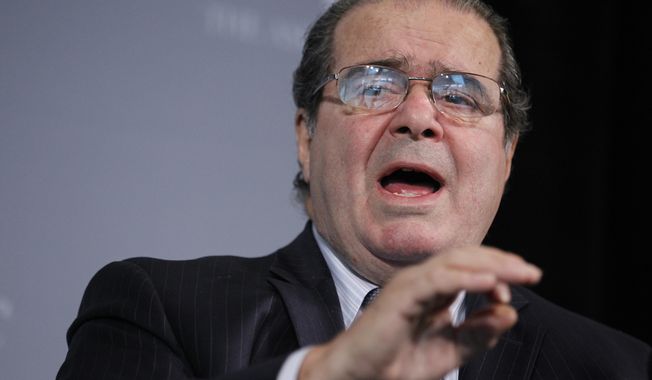
A suggestion by Supreme Court Justice Antonin Scalia that a key 1960s-era voting rights law aimed at ending Jim Crow-era voter discrimination against blacks perpetuates "racial entitlement" has drawn outrage from civil rights leaders and others.
"Solving unsolved crimes is a noble objective, but it occupies a lower place in the American pantheon of noble objectives than the protection of our people from suspicionless law-enforcement searches," Justice Scalia wrote.
Supreme Court upholds police authority to take DNA samples →
"Make no mistake about it: because of today's decision, your DNA can be taken and entered into a national database if you are ever arrested, rightly or wrongly, and for whatever reason," conservative Justice Antonin Scalia said in a sharp dissent which he read aloud in the courtroom.