By Douglas Holtz-Eakin
The young drop coverage to avoid higher premiums
Independent voices from the TWT Communities

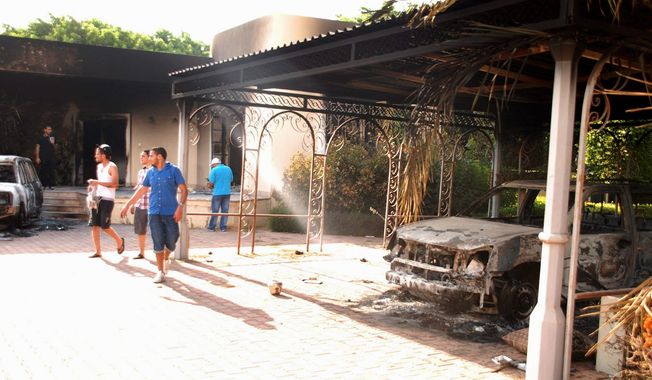
The tragedy of Benghazi, where a U.S. ambassador and three other Americans were killed, seemed a cut-and-dried story in the days after a mob attacked the State Department's mission in eastern Libya. Today, the public knows that those early administration pronouncements were false.

U.S. Africa Command will get a new Marine Corps rapid response force as part of a plan to beef up its crisis response capabilities.

Four years after its startup, U.S. Africa Command has it own fast-reaction commando force — based at Fort Carson, Colo., thousands of miles from the troubled continent.

The Pentagon on Friday released a timeline of its response to the Sept. 11 terrorist attack on the U.S. Consulate in Benghazi, Libya, pushing back arguments that the Defense Department did not move fast enough to thwart the assault.

As Americans fought for their lives in Benghazi, Libya, the Pentagon's options for direct intervention were narrowed to one: a fleet of F-16 fighters parked across the Mediterranean at NATO's air base in Aviano, Italy.

The chairman of the Joint Chiefs of Staff on Monday dispelled rumors that the chief of U.S. Africa Command is being replaced because of the Sept. 11 terrorist attack on the U.S. Consulate in Benghazi, Libya.

As U.S. Africa Command waited for any order to rescue Americans on Sept. 11 at the besieged consulate and CIA annex in Benghazi, Libya, it was missing a key unit that the Pentagon gives every regional four-star commander — an emergency strike force.

The U.S. is carefully expanding efforts to provide intelligence, training and at times small numbers of forces to African nations to help counter terrorist activities in the region, the top American military commander for Africa said Monday.

The head of the U.S. Africa Command has warned against the threats to stability in Africa from militant groups and proliferating weapons.

By the time U.S. military forces left Somalia in 1994 after entering the lawless nation more than a year earlier to stop a famine, 44 Army soldiers, Marines and airmen had been killed and dozens more wounded.

The military mission in Libya is largely complete and NATO's involvement could begin to wrap up as soon as next week after allied leaders meet in Brussels, according to the top U.S. commander for Africa.

An Army general who co-directed a Pentagon study on ending the ban on gays serving openly in the military said Wednesday that repeal is likely to prove "pretty inconsequential."

The foreign ministers of Algeria and other North African nations met Wednesday to discuss how to confront terrorism in the vast desolate regions of the Sahara Desert.

When the intervention in Libya began, President Obama insisted no American ground forces would be involved. On Thursday, the U.S. Africa Command combatant commander speculated that troops may be needed, even if he considered it a bad idea.

Rebel fighters claimed that NATO airstrikes blasted their forces Thursday in another apparent mistake that sharply escalated anger about the military alliance's efforts to cripple Libyan forces. At least five rebels were killed and more than 20 injured, a doctor said.
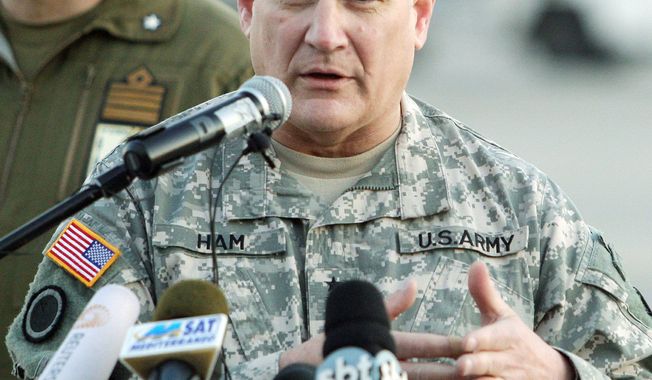
Africom was also looking to station other special operations teams in three strategic locations in southern Europe, and east and west Africa to bolster the command’s response capabilities, Gen. Ham said.
Marine Corps rapid-response team ordered to Africa to thwart another Benghazi attack →
Gen. Ham, Defense Secretary Leon E. Panetta and Army Gen. Martin E. Dempsey, chairman of the Joint Chiefs of Staff, agreed that the picture on the ground was too clouded to order an airstrike.
Behind the crisis in Benghazi, a commander's lack of firepower →