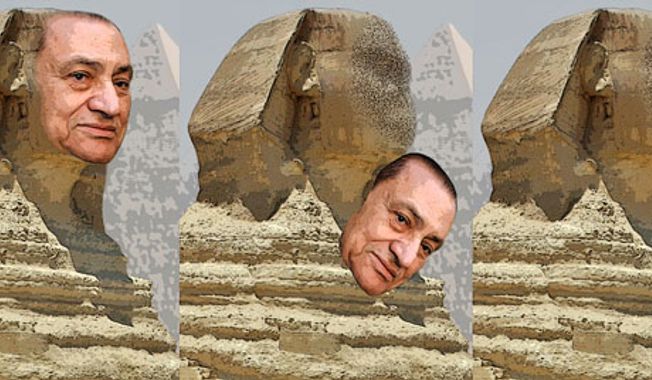
'Your papers, please' must never be heard in America

The health of ousted Egyptian President Hosni Mubarak deteriorated sharply on Tuesday, three days after a court sentenced him to life imprisonment in connection to the killing of protesters, a security official said.

Ousted Egyptian President Hosni Mubarak was put under detention in his hospital room Wednesday for investigation on accusations of corruption, abuse of power, and the killing of protesters in a dramatic step that brought celebrations from the movement that drove him from office.

The detention of an Egyptian industrial leader is raising new fears that those who prospered under the regime of ousted President Hosni Mubarak will face revolutionary justice despite the West's hope that Egypt will emerge as a democracy.

Egypt's vice president met a broad representation of major opposition groups for the first time Sunday and offered new concessions including freedom of the press, release of those detained since anti-government protests began nearly two weeks ago and the eventual lifting of the country's hated emergency laws.
What began as a leaderless movement in the streets of Cairo has evolved into a crowded field of would-be power brokers hoping to lead a new government in Egypt.

The top leadership body of Egypt's ruling party resigned Saturday, including the president's son, but the regime appeared to be digging in its heels, calculating that it can ride out street protests and keep President Hosni Mubarak in office.

Before Cairo fell into chaos, the U.S. Embassy in Egypt was worried about the stability of President Hosni Mubarak's regime and its perpetually poor human rights record.

Thousands of anti-government protesters, some hurling rocks and climbing atop an armored police truck, clashed with riot police Tuesday in the center of Cairo in a Tunisia-inspired demonstration to demand the end of President Hosni Mubarak's nearly 30 years in power.
A Baghdad military spokesman said security officials are investigating the possibility of removing some of the hundreds of checkpoints across the city, in a sign of the improving security situation.

An Egyptian-American dissident who was one of the first to criticize the possibility of hereditary succession in Egypt has broken with the opposition by signing a petition calling on the president's son to run for election.
"Sometime in the next 20, 30, 40 years" an Egyptian wag speculated some time ago, "Muba-rak may no longer be the president." Recent reports indicate, however, that Mr. Mubarak, 82 and in his 29th year of rule, is seriously ill, although official sources deny it. An Egypt without Mr. Mubarak is a potential nightmare, even if long anticipated.
and his regime is very important, but what is superimportant is the political future of Egypt and what kind of political system we want to have," he said.
Still, he said, Egypt faces a long road to ensure the transition period leads to real democracy.