



OPINION:
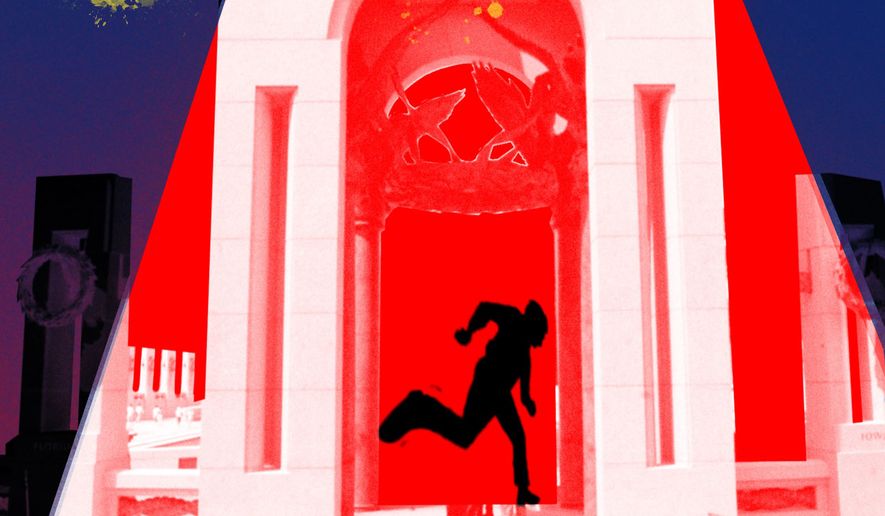
Last Thursday, the National World War II Memorial on the National Mall was vandalized. Its Atlantic pavilion was spray-painted and its fountain filled with soap and foam.
It was a desecration of sacred ground and it drew swift condemnation. President Trump declared, “There can be no greater insult to those American heroes who died in World War II” and federal prosecutors filed two felony charges the next day.
That response was right, and it was necessary. A monument built to honor more than 400,000 Americans who gave their lives (and the 16 million who served) deserves nothing less.
People were interested in these podcasts
But the episode is also a reminder of something larger: Our monuments, memorials, statues and historic places are not just stone and bronze. They are the physical memory of a country — places where Americans can stand in the presence of what their forebears sacrificed.
When we let them fall into disrepair or fail to tell their full story, we lose something that cannot easily be rebuilt. Preserving them and getting their history right is not a small civic task. It is the way in which one generation hands the truth to the next.
We should be as serious about preserving what our monuments mean as we are about preserving the stone from which they are built.
That conviction is what led me, as a historian, to spend the past several years researching a chapter of World War II history too often overlooked in popular accounts: the record of Black American soldiers who served under Gen. George S. Patton.
In October 1944, the 761st Tank Battalion landed in France and joined Patton’s Third Army. Patton met the battalion himself and told them plainly that he expected nothing less than their best, because he had “nothing but the best in my army.” The 761st — soon nicknamed the “Black Panthers” — spent the next 183 consecutive days in combat, fighting in the Battle of the Bulge and later helping break through the Siegfried Line.
By war’s end, the battalion had reached Austria, where its soldiers participated in the liberation of Gunskirchen, a sub-camp of Mauthausen. The battalion was awarded a Presidential Unit Citation in 1978. In 1997, Staff Sergeant Ruben Rivers was posthumously awarded the Medal of Honor for extraordinary heroism in combat, including covering his company’s withdrawal at the cost of his life.
The 761st was one part of a much larger story. More than 1 million Black Americans served in World War II, across every branch of service and every theater of the conflict. Black troops drove supply trucks, built roads and bridges, manned artillery, flew combat missions, crewed tanks and fought as infantry — helping sustain American forces from North Africa and Europe to the Pacific.
Their courage, discipline and sacrifice were part of the same total victory the country commemorated this August, 81 years after the end of World War II.
A vandalized wall can be cleaned. An overlooked chapter of history takes longer to restore — but it is no less worth the effort. Our monuments and our history books tell the same story, or they should: that the Greatest Generation was as large and as varied as the country it saved.
• Dr. Jimmy Lee Tillman II is a historian and the founder and president of the Martin Luther King Republicans. He is the author of “Tillman’s Handbook on General Patton and WWII Black American Patriots” and “Tillman’s Handbook of Great Black American Patriots” (Tillman Family Press).

Please read our comment policy before commenting.