



A version of this story appeared in the daily Threat Status newsletter from The Washington Times. Click here to receive Threat Status delivered directly to your inbox each weekday.
OPINION:
Treasury Secretary Scott Bessent on Monday announced Operation Economic Outcast, promising that new measures against Iran will result in its unprecedented economic isolation.
These measures, introduced as the U.S. naval blockade of Iranian ports continues, are the latest in a series of sanctions packages intended to break Tehran’s will.
Rather than capitulate, however, Iran’s leaders have defiantly responded to previous designations. Unless Washington severs or disrupts the economic lifeline that Beijing and Moscow are providing to Tehran, there is little reason to think this round of sanctions will yield better results.
People were interested in these podcasts
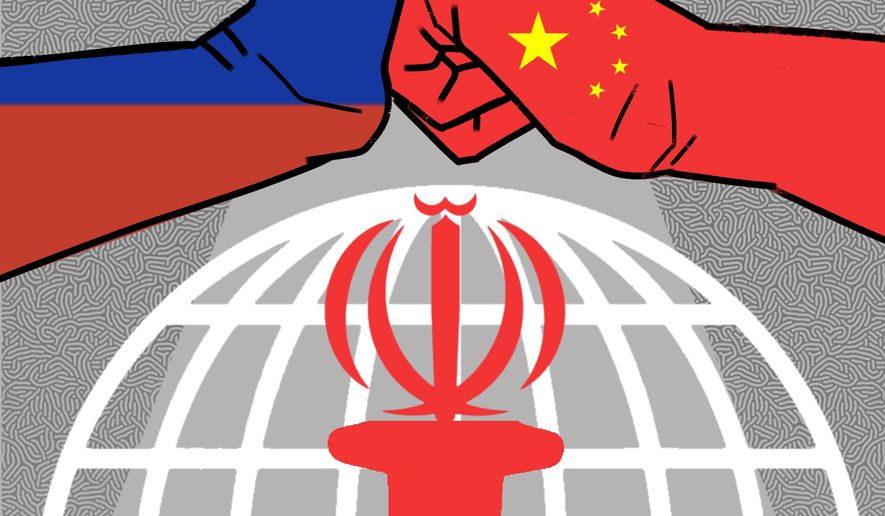
Beijing and Moscow have quietly become the two largest underwriters of Iran’s economic survival, and neither shows signs of stopping.
This is the central problem with U.S. policy toward Iran: Sanctions are a tool for isolating a country from the global economy, but they work only if the target is actually isolated. Iran is not. It is part of a parallel economic system that China has built and Russia has reinforced.
Until U.S. policy takes direct aim at that architecture, the latest designations (and future rounds) will continue to disappoint.
China remains Iran’s largest trading partner, and the relationship has proved remarkably durable. For years, Chinese “teapot” refineries — small, privately owned oil refineries — have bought large quantities of Iranian crude, moved by a shadow fleet that has kept export volumes high despite sanctions.
Last year, more than 80% of Iran’s oil exports went to China, earning Iran’s regime roughly $31 billion. In exchange for Tehran selling oil at a discount, Beijing provides goods, technology and infrastructure investment.
The U.S. naval blockade on Iranian ports has disrupted this flow of oil to China, but during the one-month pause in the blockade from mid-June to mid-July, Iran sent China more than 60 tankers carrying oil exports worth roughly $6 billion.
Underpinning China’s economic ties with Iran are the payment and clearing systems Beijing has established. These are insulated from the Western financial system, allowing Chinese entities to transact with Iran, North Korea, Russia and other sanctioned states without touching U.S.-dollar infrastructure.
This is why designating exchange houses and front companies individually has failed to change Iranian behavior.
Russia, by contrast, supports Iran’s economy by helping fund the extensive sanctions evasion architecture — which includes alternative payment channels, flag-of-convenience shipping and insurance workarounds — on which Iran depends.
This support was teetering before the war, when Iran drove up energy prices by closing the Strait of Hormuz — a move that allowed the Kremlin to refill its coffers. In February, Russian oil export earnings were less than $10 billion — its lowest level since the pandemic crisis — and the Kremlin was preparing a 10% cut to non-security spending.
The war with Iran reversed that trajectory almost overnight. A European think tank now estimates that Russia could receive as much as $252 billion more in export earnings this year compared with last year because of the disruptions to global energy markets caused by the war with Iran.
A fiscally comfortable Russia is a more effective patron of the sanctions evasion ecosystem, which is critical to the Iranian regime’s survival.
If Washington’s goal is to change Tehran’s behavior, U.S. policy must set its sights on the financial and logistical system that allows Iran to operate beyond the reach of Western enforcement.
First, targeting the Chinese financial institutions that clear transactions will be more effective in disrupting financial flows between Iran and its partners than designating individual exchange houses and shipping intermediaries. Second, ensuring that sanctions on refiners and insurers are consistently — rather than sporadically — enforced will be more likely to change the risk calculus of Iran’s customers.
Third, supporting congressional moves toward tougher sanctions on Russian energy and finance would, as a side effect, tighten the same channels that Iran uses. This is because the countries most exposed to secondary pressure over Russia trade, such as China and India, are also the ones that enable Iranian exports.
Iran’s economy has survived not because U.S. sanctions are toothless, but because Iran no longer relies solely on the system those sanctions are built to police. Fixing that problem requires Washington to treat Beijing and Moscow’s financial infrastructure — not Tehran’s front companies — as the actual target.
• Michele Kernitsky is an adjunct fellow at the Foundation for Defense of Democracies with 26 years of service in the CIA, State Department and White House.

Please read our comment policy before commenting.