



A version of this story appeared in the daily Threat Status newsletter from The Washington Times. Click here to receive Threat Status delivered directly to your inbox each weekday.
OPINION:
The most important security development in East Asia this year did not involve an aircraft carrier, a missile test or another Chinese military exercise around Taiwan. It involved two white-hulled coast guard vessels.
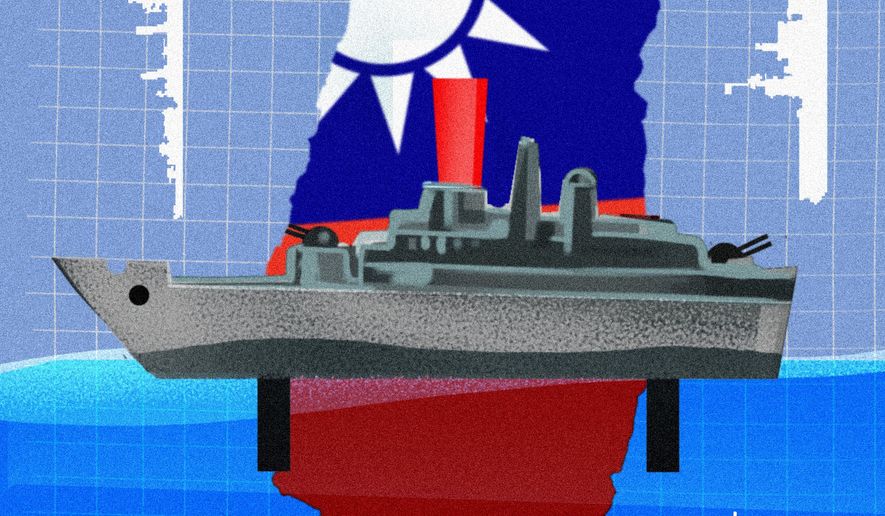
For the first time, the United States publicly acknowledged that the U.S. Coast Guard and the Taiwan coast guard had conducted joint patrols in the Taiwan Strait, releasing photographs and details of the operation. To many observers, it appeared to be a modest law enforcement exercise. It was nothing of the sort. It was the first visible step toward restoring the maritime presence that kept peace in the Taiwan Strait for nearly two decades, and whose disappearance has allowed Beijing to wage its campaign of maritime coercion ever since.
The Taiwan Strait is not merely another body of water. It is one of the world’s most consequential international waterways, connecting Northeast Asia with the South China Sea and carrying a substantial share of global commerce. Whether it remains an international waterway or becomes a Chinese-controlled corridor will shape the strategic balance of the Indo-Pacific.
The central truth is that the United States preserved peace in the Taiwan Strait by maintaining a visible, continuous maritime presence, and instability grew after that presence was withdrawn. For almost 20 years after the outbreak of the Korean War in 1950, a crucial part of America’s Taiwan policy was the U.S. 7th Fleet’s Taiwan Patrol Force, which conducted continuous patrols in the Taiwan Strait. American destroyers and other capital warships sailed there as a matter of routine. Their mission was not simply to deter war between Beijing and Taipei. It was to demonstrate that the strait remained open to international navigation and beyond the unilateral control of either side.
The results spoke for themselves. During the patrol era, despite repeated crises in 1954-1955, 1958 and the early 1960s, Beijing never succeeded in asserting jurisdiction over the strait. American presence made such claims strategically meaningless.
That changed in June 1969.
Seeking a strategic opening to Beijing, primarily motivated by a desire to extricate the U.S. from the Vietnam War, President Nixon ordered the termination of the 7th Fleet’s permanent Taiwan Strait Patrol Force. Regular patrols gave way to intermittent transits of lesser ships, partly to provide Beijing with diplomatic “face” as Washington pursued rapprochement. Subsequent policy decisions, such as lifting the strategic embargo on China in June 1971 and diplomatic normalization in 1979, deepened the shift in American strategy.
The decision may have appeared tactically useful in the context of the Cold War. Strategically, however, it marked the beginning of a long retreat from visible American maritime leadership in the Taiwan Strait.
Beijing gradually exploited the resulting vacuum.
Today, the Chinese Communist Party routinely claims that the Taiwan Strait is not fully international waters but waters under Chinese jurisdiction. Chinese coast guard vessels harass commercial shipping, intimidate fishermen, shadow Taiwanese vessels, rehearse blockade operations and attempt to enforce Beijing’s unilateral interpretation of maritime law. These are not acts of conventional naval warfare. They are instruments of “gray-zone” coercion designed to change facts without firing a shot.
That is precisely why the recent U.S.-Taiwan coast guard patrol matters.
Unlike naval exercises, coast guard operations occupy the legal and operational space where China’s gray-zone campaign actually unfolds. Maritime law enforcement, search and rescue, fisheries protection, counter-smuggling, humanitarian assistance, and maritime domain awareness are all areas in which Beijing has sought to transform political assertions into operational control. By conducting joint patrols with Taiwan’s Coast Guard, Washington is contesting that strategy where it is most active — not with rhetoric, but with presence. Most important, the newly demonstrated American resolve in joint coast guard patrols with Taiwan has silenced the CCP without any meaningful ritualistic outbursts of anger and protests. It remains historically and geopolitically true that once the U.S. shows its teeth with strategic clarity, the PRC regime must change its behavior, for America is the only country of consequence that, if willing, can deter China’s expansionist ambitions.
Equally important, the patrol publicly recognizes Taiwan’s coast guard as a legitimate maritime law enforcement authority. That may seem symbolic, but symbols backed by ships matter in international politics. The operation demonstrates that the United States does not accept Beijing’s claim that Taiwan’s surrounding waters are merely Chinese domestic waters administered by Chinese agencies. It affirms, through action rather than declaration, that Taiwan exercises lawful maritime jurisdiction in its own waters and that those waters remain part of an international maritime commons.
The strategic implications extend well beyond Taiwan.
China’s maritime coercion increasingly threatens Japan in the East China Sea, the Philippines in the South China Sea, and Taiwan in the Taiwan Strait. These are no longer separate disputes. Japanese leaders have argued that Taiwan’s security directly affects Japan’s own security. Philippine Defense Secretary Gilberto Teodoro Jr. has reached the same conclusion, declaring that the Philippines cannot remain neutral if China attacks Taiwan because geography makes neutrality impossible. The First Island Chain is becoming a single, integrated strategic theater in which instability in the Taiwan Strait would inevitably reverberate across the East and South China seas.
For that reason, the United States should resist the temptation to treat the recent coast guard patrol as a one-off event or symbolic gesture. It should instead become the foundation of a permanent maritime strategy.
The objective is not provocation. Nor is it a return to Cold War nostalgia. It is the restoration of routine.
The most effective deterrence is often the least dramatic. Continuous American maritime presence — through a complementary mix of Navy and Coast Guard operations conducted alongside allies and partners — would make clear that the Taiwan Strait remains an international waterway open to lawful navigation. Such a posture would complicate Beijing’s gray-zone campaign, reassure allies, reinforce international maritime law, and reduce the likelihood that China could gradually normalize coercive control through incremental encroachment.
History demonstrates that sustained maritime presence preserved peace more effectively than periodic shows of force. The 7th Fleet’s routine patrols prevented strategic ambiguity from becoming strategic surrender. Today’s Coast Guard patrol points in the same direction, adapted for 21st-century challenges.
The lesson is straightforward. Peace in the Taiwan Strait cannot rest on communiques or diplomatic formulas alone. It depends on ships at sea, operating routinely, visibly and lawfully.
America did not preserve stability in Asia by withdrawing from contested waters. It preserved stability by remaining there.
It is time to do so again.
• Miles Yu is the director of the China Center at the Hudson Institute. His “Red Horizon” column appears every other Tuesday in The Washington Times. He can be reached at mmilesyu@gmail.com.

Please read our comment policy before commenting.