



OPINION:
“Which is better — to be ruled by one tyrant 3,000 miles away or by 3,000 tyrants one mile away?” — Rev. Mather Byles (1706-1788)
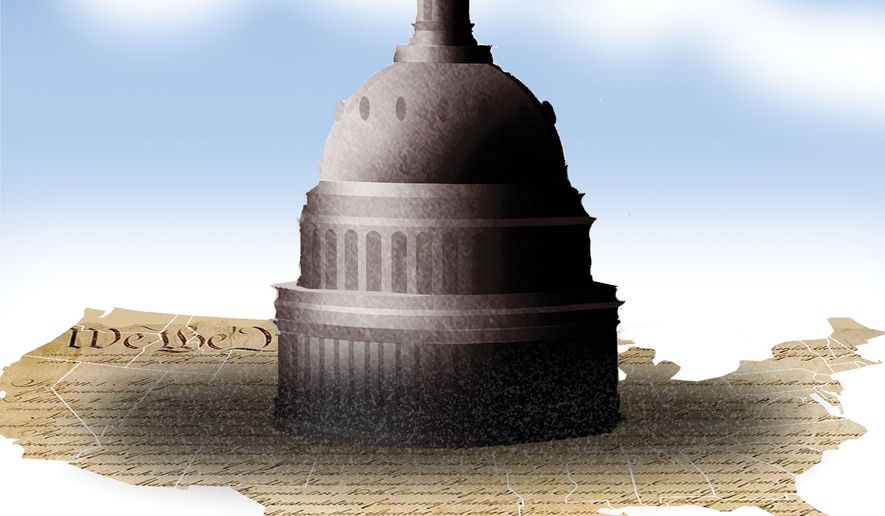
Does it really matter whether the instrument curtailing liberty is a monarch or a popularly elected legislature? This conundrum, along with the witty version of it put to a Boston crowd in 1775 by the little-known Colonial-era preacher with the famous uncle (Cotton Mather), addresses the age-old question of whether liberty can long survive in a democracy.
Byles was a loyalist who, along with about one-third of the American adult White male population in 1776, opposed the American Revolution and favored continued governance by Great Britain.
People were interested in these podcasts
He did not fight for the king or agitate against George Washington’s troops; he merely warned of the dangers of too much democracy.
Many of us who monitor federal excess are fearful of out-of-control democracy, which is what we have in America today. Yet there remain in our federal structure a few safeguards against runaway federal tyranny, such as the equal state representation in the Senate, the Electoral College, the state control of federal elections, the remnants of state sovereignty and life-tenured federal judges and justices.
Of course, the Senate, as originally crafted, did not consist of popularly elected senators. Rather, they were appointed by state legislatures to represent the sovereign states as states, not the people in them.
Part of James Madison’s genius was the construction of the federal government as a three-sided table. The first side represented the people — the House of Representatives. The second side represented the sovereign states that created the federal government by surrendering limited powers to it — the Senate.
The third side manifests the nation-state: the presidency, which is both head of state and head of the executive branch of the federal government.
The judiciary, whose prominent role today was unthinkable in 1789, was not part of this mix.
In his famous Bank Speech, Madison argued eloquently against legislation chartering a national bank because the authority to create a bank was not in the Constitution and thus was retained by the states and reserved to them.
In that speech, he warned that expansion of the federal government would trample the powers of the states and also the unenumerated natural rights of the people that he would soon protect in the Ninth Amendment.
Madison gave the Bank Speech in February 1791, 11 months before the addition of the Bill of Rights (the first 10 amendments) to the Constitution. Given the popular fears of a new central government, Madison assumed that the Bill of Rights would be quickly ratified. He was right.
Had Madison been alive during the presidency of the anti-Madisonian Woodrow Wilson — who gave us World War I, the Federal Reserve, the administrative state of government by experts, the popular election of senators, the judicially sanctioned suppression of political speech and the federal income tax — he would have recoiled at a president destroying the three-sided table.
Wilson did that by leading the campaign to amend the Constitution so as to provide for the direct popular election of senators.
Part of Madison’s genius was to craft anti-democratic elements into the Constitution as well. Some of them, such as state sovereignty, created laboratories of liberty, since some states protect more personal liberties than the Bill of Rights does.
President Reagan reminded the American public in his first inaugural address that the states formed the federal government, not the other way around. Had I been the scrivener of that speech, I would have encouraged him to add: “And the powers that the states gave to the feds, they can take back!” Of course they can.
Reagan also famously said that we could vote with our feet. If you do not like the over-the-top regulations in Massachusetts, you can move to New Hampshire. If you are fed up with the highest state taxes in the union in New Jersey, you can move to Pennsylvania.
Yet the more state sovereignty the feds absorb — the more state governance is federalized — the fewer differences there are among the regulatory and taxing structures of the states. This has happened because Congress has become a general legislature without regard for the constitutional limits imposed on it.
If Congress wants to regulate an area of governance that is clearly beyond its constitutional competence, it bribes the states to do so with borrowed or Federal Reserve-created cash.
Thus, it offered hundreds of millions of dollars to the states to lower their speed limits on highways and to lower the acceptable blood alcohol level in people’s veins before a presumption of DWI could be argued. It was all in return for cash to pave state-maintained highways.
The states are partly to blame for this. They take whatever cash Congress offers, and they accept the strings that come with it. They, too, are tyrants. The states, not the feds, mandated the unconstitutional and crippling COVID-19 lockdowns of 2020-2021.
The states, not the feds, should be paying the political and financial consequences of their misdeeds. They took property and liberty without paying for it, as the Constitution requires them to do. Of course, some of the states maintained legal protections for slavery.
Byles feared a government of 3,000. Today, the feds employ close to 3 million. Thomas Jefferson warned that when the federal treasury becomes a federal trough, and the people recognize it as such, they will send to Washington only politicians who, faithless to the Constitution, promise to bring home the most cash.
In a democracy, a faithless majority will take whatever it wants from the minority, including its liberty and property. That is where we are today, on the 250th anniversary of the start of this Jeffersonian and Madisonian experiment: We are a country the Founders would not recognize as their creation.
• To learn more about Judge Andrew Napolitano, visit https://JudgeNap.com.
Follow the author

Please read our comment policy before commenting.