



A version of this story appeared in the daily Threat Status newsletter from The Washington Times. Click here to receive Threat Status delivered directly to your inbox each weekday.
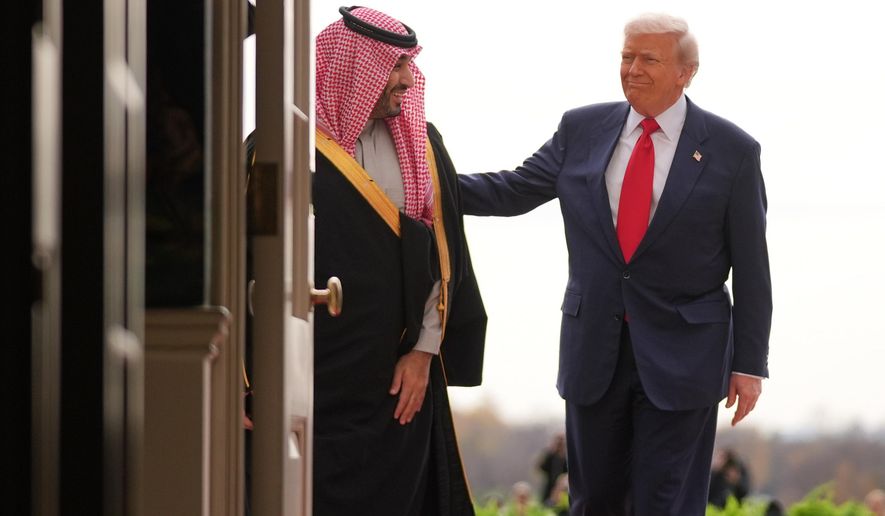
Any nuclear deal between the U.S. and Saudi Arabia would be contingent on Riyadh normalizing relations with Israel and would prohibit the production of atomic weapons, President Trump said Thursday. Mr. Trump made the statement one day after the agreement, signed Wednesday in Washington, set off alarms in both Israel and the United States.
Critics of the deal underscored what was not mentioned in the document: Saudi Arabia’s future relationship with Israel. Yair Golan, chairman of Israel’s left-wing Democrats party, blamed Israeli Prime Minister Benjamin Netanyahu for the omission.
Mr. Golan said normalization with Saudi Arabia has been a strategic goal for Israeli leaders across the board, but the Trump-brokered deal is lacking.
People were interested in these podcasts
“Netanyahu succeeded in doing the impossible: he both lost the normalization with Saudi Arabia and enabled it to gain nuclear capabilities,” said Mr. Golan, a former Israel Defense Forces deputy chief of staff. “Now, one of the main incentives for normalization has been handed over without Israel being a part of the deal.”

Mr. Trump posted on Truth Social to clarify the civil nuclear deal between the U.S. and Saudi Arabia. He insisted there would be no uranium enrichment and that any assistance from Washington would be for nonmilitary purposes. He stressed that the deal would not go forward unless Riyadh joins the “very respected and successful” Abraham Accords, the 2020 agreements that normalized relations between Israel and several Arab nations.
The United Arab Emirates, Bahrain, Morocco and Kazakhstan have signed the accords; Sudan signed the general declaration but has not completed bilateral normalization.
Mr. Netanyahu said the joint U.S. and Israeli airstrikes against Iran created the opportunity for an expansion of “the circle of peace.”
“As President Trump has said, Saudi Arabia’s joining of the Abraham Accords would be a historic leap forward for peace in the Middle East,” Mr. Netanyahu said in a statement.
During a stop at the Environmental Protection Agency, Mr. Trump said Iran still wants to make a deal with the U.S. over its nuclear ambitions, but he said Iranian officials have not been trustworthy.
“They would like to do something. But I say they’re not ready yet. They need more of the same,” he said, alluding to military force. “They’re not ready yet. They have some evil intentions. We cannot let them have a nuclear weapon.”
Secretary of State Marco Rubio said Saudi Arabia is an important strategic partner of the U.S., but any nuclear energy deal would have to go through the congressional notification process before it can be enacted.
“We’re not the only country in the world that offers nuclear technology. And when countries decide that they want to pursue a peaceful civil nuclear program, we’d prefer them to do it with us than do it with some other country,” Mr. Rubio said during a stop in the Philippines. “It allows us to have influence over the direction that it goes. It allows us to make sure that there are safeguards in place.”
He said the U.S. would not enter into a civil nuclear deal with another country if there was any way for it to be used for military purposes.
“One of the best safeguards is to make sure that American technology and American companies are the ones that are involved in doing it,” Mr. Rubio said. “If, on the other hand, a country pursues nuclear technology with another country, well then we don’t really control those safeguards.”
Energy Secretary Chris Wright said the nuclear cooperation deal, commonly known as a 123 Agreement, lays the legal foundation for a decades-long, multibillion-dollar partnership between the U.S. and Saudi Arabia. “These agreements reflect our two nations’ shared commitment to strengthening U.S.-Saudi commercial relations, delivering prosperity at home and security to our allies abroad,” Mr. Wright said Wednesday. “These agreements uphold the highest standards of nuclear safety and nonproliferation.”
Avigdor Lieberman, a former Israeli defense minister who leads the right-wing Yisrael Beiteinu party, was not buying Washington’s assurances that the deal with Saudi Arabia would serve only peaceful purposes.
“We must all understand that Saudi Arabia’s civilian nuclear program will end in nuclear weapons and lead to a mad arms race across the entire Middle East,” Mr. Lieberman said on X. “The State of Israel must make it clear and unequivocal: We will oppose this with all our might.”
Mr. Rubio said the U.S. wants to be the “partner of choice” for countries exploring peaceful, civilian nuclear energy.
“We’re always looking for opportunities to make sure that our technology and our companies are the ones that are providing that,” he said.
Tensions remain high in the Middle East as Iran has launched attacks on U.S. military bases in Jordan, Bahrain, Kuwait and Iraq. At least 15 U.S. service members have been killed and more than 543 have been wounded in the ongoing Iran war, according to Pentagon and CENTCOM figures.
Mr. Trump has publicly threatened that further attacks on shipping in the Strait of Hormuz will trigger direct strikes on power plants and bridges, including those in Tehran.
Prices for U.S. crude rose sharply on Thursday as Brent crude, the international benchmark, climbed to more than $100 per barrel for the first time since May. The AAA Fuel Gauge Report said the national average for a gallon of gas climbed to $4.09. The prices surged after the Tehran-backed Houthis announced a maritime embargo on Saudi Arabia and claimed to have attacked a pair of Saudi oil tankers transiting the Bab el-Mandeb Strait.
Contact the author



Please read our comment policy before commenting.