



A version of this story appeared in the daily Threat Status newsletter from The Washington Times. Click here to receive Threat Status delivered directly to your inbox each weekday.
OPINION:
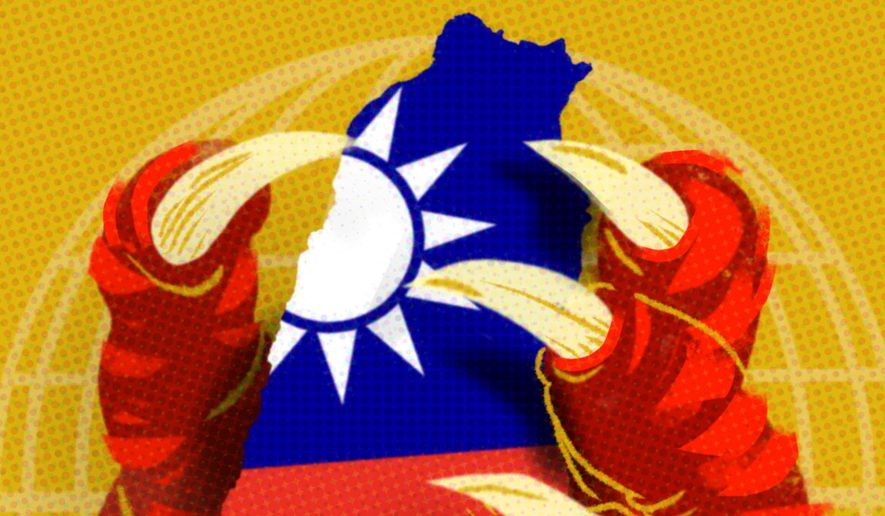
The Chinese Communist Party recently achieved a series of propaganda and narrative victories in its relations with Taiwan, the United States and the rest of the free world.
In April, a Taiwanese opposition leader flew to Beijing and bent the knee to CCP General Secretary Xi Jinping, signaling subservience.
This preceded the passage of an underwhelming defense budget by Taiwan’s Legislative Yuan after months of contention, as well as President Trump’s visit to Beijing last month. During that summit, U.S. leadership appeared to be eager to revive relations with the CCP.
Further emboldening Beijing, Washington appears to have stalled weapons sales to Taiwan.
With Chinese military and psychological pressure at record levels and the Trump-Xi summit now concluded, the questions at the heart of the debate go far beyond budget numbers and the optics of meetings.
How committed is Taiwan to its own defense? How reliable is the U.S. as Taiwan’s key ally? And who is shaping the answers to those questions in the minds of ordinary Taiwanese?
Even though the U.S.-China meeting produced no formal policy shift on Taiwan, Mr. Xi got what he wanted: the chance to shape the conversation about Taiwan’s future.
Beijing has been watching Taiwan’s democratic process closely, using proxies among politicians and media to nudge public opinion toward closer relationships with the mainland.
The opposition blocked the defense budget for months, and Kuomintang (KMT) Chair Cheng Li-wun’s visit to Beijing right before the Trump-Xi summit was framed by both Beijing and the opposition as “fostering peace.”
The message to Washington was clear: Beijing has leverage over the parliament, and Mr. Xi wants the U.S. to believe that Taiwanese public opinion is on his side.
Taiwanese President Lai Ching-te’s administration initially proposed a budget of $39.8 billion to $40 billion, but the opposition KMT and Taiwan People’s Party blocked it, proposing a far-smaller alternative of just $12 billion.
Their stated justifications: They did not want to provoke China or spend more on U.S. equipment, deliveries of which have been delayed in the past.
After months of heated debate — some of which erupted into brawls on the floor of the Legislative Yuan — the passed bill landed at $24.8 billion. It is the largest special defense budget in Taiwan’s history, funding critical air defense upgrades and ammunition stockpiling, but it still falls short of Mr. Lai’s original plan, which included boosting the domestic drone industry and developing full asymmetric capability.
The State Department’s reaction to the passed budget said it all: “Further delays in funding the remaining proposed capabilities are a confession to the Chinese Communist Party.”
The opposition’s claims that the U.S. is not delivering equipment are exaggerated. The delivery backlog is real, but its causes are well documented: COVID-19 supply chain disruptions, the war in Ukraine and surging demand from the Middle East. Not American unreliability or unwillingness to arm Taiwan.
Ms. Cheng’s visit to Beijing was also focused on the 1992 Consensus, the long-standing basis of KMT-CCP relations. Both Mr. Xi and Ms. Cheng attempted to reframe it, shifting its basis from “One China” to “opposing Taiwan’s independence” — a significant concession that was never part of the original framework.
Beijing’s narrative warfare runs on multiple fronts, misrepresenting the Aug. 17, 1982, U.S.-China Communique to portray American arms sales as illegitimate and misusing United Nations Resolution 2758 to deny Taiwan’s international participation.
Inside Taiwan, the battle is being fought through media and online influencers, with pro-China narratives steadily eroding public trust in the U.S.
Yimeilun, or “Ameriskepticism” — the belief that the US is purely self-interested and would abandon Taiwan if China invades — is rising in Taiwan.
The current defense budget will not meet Taiwan’s security needs. Years of narrative warfare have eroded public trust, weakened the public will to invest in defense and allowed Beijing to deepen its foothold inside Taiwan’s democratic process.
The lessons of history are clear: Mixed signals and perceived lack of willpower invite aggression, which could have truly disastrous consequences for Taiwan and the world.
Washington must overhaul its narrative efforts to revitalize Taiwanese morale and make clear to the mandarins in Beijing that Taiwan is absolutely worth defending.
• Stan Kwiatkowski is a political commentator and host of the YouTube channels “Hard News” and “Freedom Is Not Free.” He has lived in Taiwan for more than nine years.

Please read our comment policy before commenting.